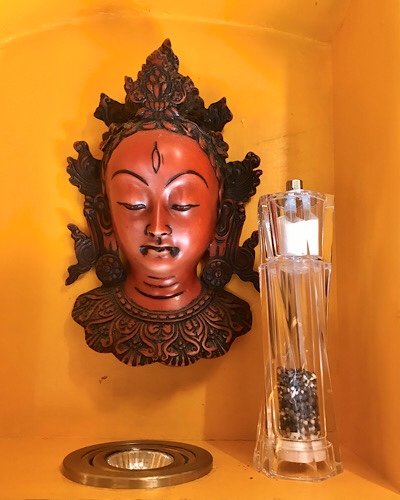
On the Way to William Penn House for Tuesday Night Yoga Practice

Peace and light, E — Posted with WordPress for BlackBerry.
The indoor plants have been multiplying. When the pandemic is no longer keeping me home most of the time, I might find there are more than I can care for well.

During one of our sessions, one of my fellow students asked whether she was really seeking a life of renunciation because she sometimes really craved sitting quietly for meditation. For her, having first experienced meditation as an adult who has a rich and comfortable life, even the shortest time sitting with eyes closed looking only within felt like it might be a denial of the outer world.
The practices Paul Muller-Ortega is teaching, and as he makes absolutely clear, are very much for the householder and are not the rarified path of a renunciate. Sitting in silence is a blissful and steady; it is going towards the inner world and not going away from the outer world.
We do not have to renounce our lives to sit regularly in silence. We can frankly delight in the sweetness of inner light and stillness and honor our desire to do so (a true renunciate would have to renounce even that desire). Meditation as part of the daily life of a householder, is a bedrock of support so that we can be ever more fully engaged in our lives, no matter how noisy they can get sometimes.

Peace and light, E — Posted with WordPress for BlackBerry.
For the past week, I have been contemplating, practicing with, and teaching the axiomatic sequenced alignment principle of Anusara yoga “stabilize the periphery; move from the core.” It means exactly what it says. We stabilize the outer edges of the pose (feet, hands, head) and move from our core to get into the full expression of the pose. For example, have you noticed how often the yoga teacher will have you put your hand on your hip when you are first in a standing pose and working the alignment of the foundation and core body? Only when the central alignment has been reached, do you extend the arm and hand to complete the full form of the pose. The reason Anusara teachers are taught to use this technique is that it stabilizes the periphery, so that the students can concentrate on the major alignment and then move from the core.
Off the mat, this principle means to me that we start with our overall goals and needs and the essential principle of trying to move from and respond in the highest before getting distracted by the details of whatever is going on. As I contemplated and taught the principle this week, I found myself thinking and talking about lots of different examples on and off the mat. The central idea was there, and then as the classes progressed, depending on the level and the students, I wove in illustrative examples that made sense with what was happening in the classes.
I found myself struggling, though, to write about this principle. I had too many different things I wanted to explain about how it helps in yoga asana both as an important therapeutic practice and as a way to expand one’s core abilities. A plethora of examples of how it works off the mat came to mind. To write coherently when one has limited space/attention span of reader/number of words, one has to first stop getting into the details and start with the central theme. Then it is necessary to flesh out the central theme with very select details that enhance the understanding of the central premise. The writer chooses not to scatter the central theme into so many details that the central point is obscured or lost in the details. My struggle to write about this principle served then as a perfect example to myself about the very principle about which I was choosing to write. I needed to “stabilize” the details, so that I could express coherently the core principle.
Do you have good examples of how applying this principle has helped you on or off the mat?