Evacuation Walkout Route

If you are walking from the march to RFK tomorrow afternoon/evening and would like a rest stop nearby, send me an email or message me on Facebook.
If you are walking from the march to RFK tomorrow afternoon/evening and would like a rest stop nearby, send me an email or message me on Facebook.
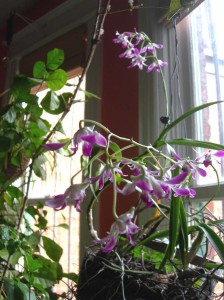 A number of years ago, when he was moving from Capitol Hill to Denver, my friend and former neighbor Robert gave me this dendrobium orchid, which bloomed this year for me for the first time. The dendrobium was just an extra. If you know orchids, you can see that it is planted with a vanda. These orchids came from Robert’s mother’s garden in Florida. When she had to give up her place in Florida, Robert brought home some of the orchids, including the vanda. If I know Robert, he just saw a baby dendrobium in the garden and stuck it in with the vanda when he carried it back north to Capitol Hill. When Robert moved to Colorado, he left the vanda with me because he did not expect it to tolerate the Colorado climate. Even here, the vanda is not likely to bloom. Not enough heat, light, or humidity in DC (really!!!). But after five or six years of steady care, the dendrobium flourished and finally bloomed. Robert inspired my affection for orchids; he had a greenhouse and knew each one of his tropical plants intimately. We would go to an orchid show or nursery, and he would look with love on each and every plant, cherishing their individual traits, no matter how small or large. At the botanical gardens, he had different plants he visited and enjoyed. Now his yard has cactii and peppers. He has a few of his most faithful orchids, which are flourishing and which were delightful to visit, and I have this lovely reminder of a time when Robert was one of my local gardening buddies. This, I think is one of the extra joys of gardening, especially with houseplants that come from cuttings. They have a history with our family and friends that is passed on, cherished, and shared. I also have a night-blooming cereus that was a baby from a plant that started as a baby of one in his mother’s garden. The night mine first bloomed (just a single night in the year), the parent plant with Robert in Denver also bloomed.
Bonus love from this particular dendrobium; it is scented!
A rather conservative co-worker, who was one of the people who would have to go grocery shopping last night lest the family be without perishable food for a few days, was talking to me about the impending snowstorm (including me advising him of the one forecast for next Tuesday/Wednesday). “It shows,” he said, “how easily our infrastructure and food supply can be disrupted.” I gave it a little pause, and then replied, “this is why I talk about gardening in our own yards and switching away from agribusiness to a more sustainable and self-sustaining way of living and seek to shift myself, though it is difficult.” He said, “hmmm,” letting the idea stick in his mind, but not wanting to carry the discussion further. I know him well enough to have dropped it for the time, but also know he will think about it and perhaps over the years, for his beloved daughters or out of perceived necessity, start making small shifts.
In yoga practice, the concept of suddha vidya — illuminative wisdom — is both revealed and practiced. When we start practicing or even before, we may have occasional and early insights into fundamental truths of being, but without steady practice and contemplation they will be fleeting and not shift our way of living. If we practice and study continuously, though, our insight will become steadier, more consistent, and will start to illuminate all states of our being on and off the mat. The more I practice, the more it is illuminated for me the connection of all beings and my need to live in a way that is more open, tolerant, loving, and aligned with the complex web of our interconnection. My co-worker’s insight might not have been “yoga,” but it was indeed a moment of illuminative wisdom in its recognition of a misalignment of society that tears at the fabric of our being.
You may have noticed that I do not say what I will be teaching. In my blogs and classes, when referring to the philosophy that inspires me, I speak of what I will be reading, what I will be contemplating, and what I will be exploring. It is not false humility. It is a recognition that reading and contemplating a work even several times over a few years is not enough to be “teaching” it. My teaching can, however, authentically be inspired by that level of exploration. I make offerings of what sparks me to think, to practice, and to want to continue to delve ever more deeply into the yoga practices.
This session, I will be reading, contemplating, and inspiring my own practices and my class plans from the Pratyabhijnahrdayam.
Pratyabhijnahrdayam: The Secret of Self-Recognition, J. Singh (Motalal Banarsidass Publishers, Reprinted 2008)
The Splendor of Recognition: An Exploration of the Pratyabhijna-hrdayam, Swami Shantananda with Peggy Bendet (SYDA Foundation, 2003)
We may not be able to change much of what we get in life–where and when we were born, certain innate talents and physical attributes, but we have the choice at every moment what we will create with what we have been given.
Will we create beauty and happiness where we can? The point of the yoga practices, I think and have been taught, is to lead us to choose what best serves more and more often.
For example, I cannot create a monumental sculpture if the only art material I have is a point and shoot camera. I could do nothing but lament my lack of resources, or I can still make art.
What do you choose with what you have?

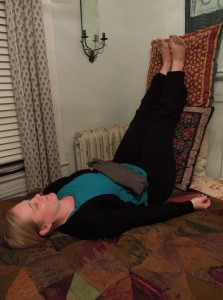
Let’s face it. When we are on travel and staying at someone else’s house or in a hotel and doing all the running around that comes with visiting or working or sightseeing out of town, we can get out of balance. This disruption of routine can upset our sleep and our digestion. You don’t need the exact collection of pillow shown in these photos. The point is that you can use whatever pillows and blankets (or even towels or your own coat or sweater to make the shapes of yoga bolsters and blankets) to do a nourishing and balancing restorative practice. I like to travel with a hot water bottle in the colder months; there is little more comforting than yoga restoratives with a hot water bottle.
1. Legs up the headboard (sometimes there isn’t enough room on the floor to do any yoga even to do vipariti karani (legs up the wall pose)). Here, pillows are stacked against the head of the bed because it otherwise would be uncomfortable (and risky for the art over the bed). I suggest this pose first to surrender to being turned upside down, to undo the effects of gravity and too much walking around and carrying things, to relieve the legs and feet and to allow more energy to recenter itself in the heart. Stay for 10 minutes, or even longer.
2. Supported twist. Start with your left thigh against the pillow stack, so that the energy follows the natural direction of the large colon, thereby helping relieve the impact of travel disruption to the digestion. The gentle twist also wrings the adrenals, allowing them to release the toxicity of travel and disrupted diet. After 7-10 minutes, switch to the other side with the right thigh perfectly parallel to the pillows before bowing forward.


3. Balasana. Place a pillow or two between your heels and your seat. With your toes touching and knees wide apart, bring a couple of pillows, or folded blankets between your knees back to mid-thigh and then bow forward over the support, adjusting your makeshift props as needed to feel at ease in the pose. The pose invites a fullness in the back body, letting the adrenals rejuvenate after the cleansing action of the twists. This is good. Stay for 10-12 minutes or so, remembering to turn your head to the other side half way through.

4. Supported supta badha konasana (bound angle pose). After you’ve relieved the feet and legs, nurtured the digestion and the adrenals, now is the moment to surrender to bliss (ananda) and open the heart to being right where you are–wherever that might be. Key for this pose is to make sure that the support under your back is right up against your sacrum. Shown by the fabulous yogini model are three possible ways to use the hot water bottle. I wouldn’t have thought to put it on my face, but she delighted in that idea, and I can see how it would be good for sinuses stressed by travel.



As with any physical practice, you should approach even gentle poses such as these with appropriate awareness, honoring your own body’s limits. If you want to learn how to practice yoga asana safely and optimally, it is best to take classes to supplement a personal practice.