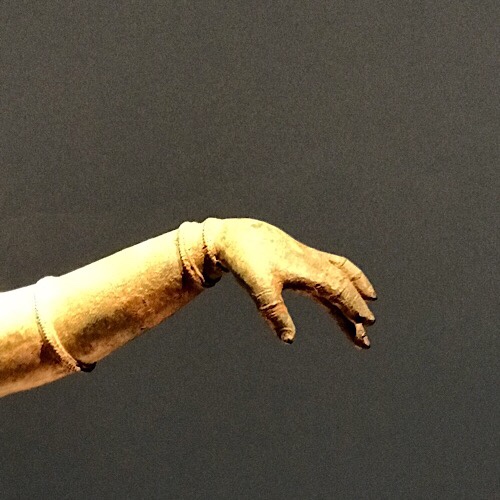
Tandava

Nataraja, Freer-Sackler Galleries

Nataraja, Freer-Sackler Galleries
“For him who is moderate in food and play, moderate in performing actons, moderate in sleep and waking, for him is the yoga which destroys sorrow.” Bhagavad Gita, 6.18 (trans. Gitartha Samgraha, in Abhinavagupta’s Commentary on the Bhagavad Gita).
Food here, of course, is more than what we put into our mouth. It is everything that comes in through the senses. Play, too, is beyond what we do for “fun” in this society. How much these words have kept their truth since written; what different meanings they carry in our time of technological marvels. What does “moderation” mean to us? Does moderation have an implicit relativeness?
Since I first read the Gita in high school, I have been contemplating this sloka and resonating with it. Now, I come back to it over and over again, as my understanding of the rest of the text deepens and my practice grows. It is still giving me food for thought. (Pun intended).
Although, having been raised as a Quaker and continued to practice as such in adulthood, I do not observe most of the Jewish rituals and holidays. This year I was certain that I at least wanted to bake something traditional for Rosh Hashanah, and I felt engaged with wanting some part of ritual observance.
Thus in recognition of RGB leaving this embodiment into that of a tzaddik, I have a honey-glazed, sourdough, apple challah–baked round for the cycle and fullness of the year.

It still does not seem right to have daylight savings time start before the equinox. I remember it used to be the first night I cooked outside. Now it is always too cool and not quite light enough, and my morning meditation goes back to finishing before it is light. Whether it matches with the weather or my mood, though, it is here this weekend. I’ve had a much more intense work week than usual, which is resulting only partly from having been out of town for the previous week. The coming weekend promises to be very full (assuming all goes as anticipated) with teaching my own class and studying with Ross Rayburn up at Willow Street both Saturday and Sunday, trying to go out to see some friends dance Saturday night, going to the contact improv jam on Sunday, and then having dinner with neighbors.
To try and not get too off cycle by getting a socially induced equivalent of jet lag, I am starting to get ready for bed an hour early tonight and planning to get to the office before 8 tomorrow morning. Try doing the same things you would do if changing time zones. Get plenty of rest, drink lots of fluids, keep down the caffeine intake and if you really want to have caffeine, make sure you stop drinking it earlier in the day than usual; have any protein in the morning and then dine lightly on grains and vegetables in the late afternoon or early evening. Don’t eat anything heavy at night. That way you will have energy when you wake up too early and be sleepy when it is time to go to bed way before you think it is.
And most important, use the change in time as an opportunity to celebrate the respective joys of shadow and light by having extra attention brought to them whether you will it or not. It is always exciting the first night, particularly if it is warmish and bright as is in the forecast, that it stays light unnaturally late.
A couple of years ago, I took a brilliant class with Desiree Rumbaugh in which she used the theme of “getting out of our own way” to lead us to a place to better integrate our shoulders. As I was practicing with the Anusara principle of “thigh loop” this week, I was reminded of that class. We’ve all been in the situation where our habitual mindset, physical posture, life style, or emotions get in the way of our finding more freedom and happiness.
When our thigh bones move into the front plane of the body, the forward movement keeps us from opening our hips more fully and from getting into deeper and stronger poses that require our hips to be open (in fact, out of the way). When we take our thigh bones back, we physically have more freedom, more range of motion and are better able to access the deepest places of power and openness that allow us to soar on the mat. I’m working on it on the mat as a great reminder to get out of my own way off the mat.