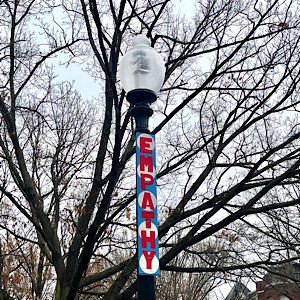
Found Exhortation

An exhortation to a more spacious, loving, conscious being should always begin graciously.
An exhortation to a more spacious, loving, conscious being should always begin graciously.
Dear Friends,
Brrr. It’s cold out there. And if it is seeming colder than usual, you are right. There have only been five winters on record with fewer days above 50F in Washington, DC. Perhaps, like me, you have noticed that you are feeling just a tad sensitive or edgy or maybe a little blue. I recognize the symptoms; in my distant past, a therapist suggested that I might have “seasonal affective disorder.” My prescription for myself when winter has me feeling down? Do more yoga, keeping a focused intention on cultivating the light of inner awareness.
The form of meditation I practice is intended to allow the practitioner to rest in the light of inner awareness. One of the aspects of the Anusara principle of “opening to grace” for me is to open to the light in myself and others. On a more physical level, backbends will open up your heart and make room for the light; core work will warm you up by stoking the agni, the inner fire; forward bends will help you go deep inside to find your own light. There is a light-filled practice for every day of the week, every time of day, and every mood you are in.
Avoid the temptation to huddle inside, eating too many carbs and hiding away. When the sidewalks are passable, bundle up and take a long walk. When you come back inside, do a good therapeutic and restorative practice–it’s as good as hot chocolate (and no one said you couldn’t have the hot chocolate, too). Invite friends over for a potluck. Cook bean soups. Have hot cereal for breakfast and perhaps for dinner. Balance the warm food with the freshest of fresh food by growing sprouts on the kitchen counter.
Want to light up your yoga fire, sun, inner light with company? Join me and your friends and neighbors at William Penn House classes on Tuesdays at 6:30. Need a little R&R or found you have tweaked something shoveling or walking on the ice and snow? Drop ins are always welcome at the gentle and therapeutics class at Willow Street, Takoma Park, Saturdays at noon. Give yourself something to look forward to by signing up in advance for the second “Relaxing Into Optimal Alignment with Anusara Restoratives” workshop at Willow Street on Saturday, February 26th.
And plan for Spring with “Yoga for Gardeners,” the weekend of the Spring Equinox–yes, it is only weeks away. As has been my practice in previous years, my profits will go to support the Youth Garden at the National Arboretum.
Looking forward to sharing, expanding, and delighting in the light with you soon.
Peace and light,
Elizabeth