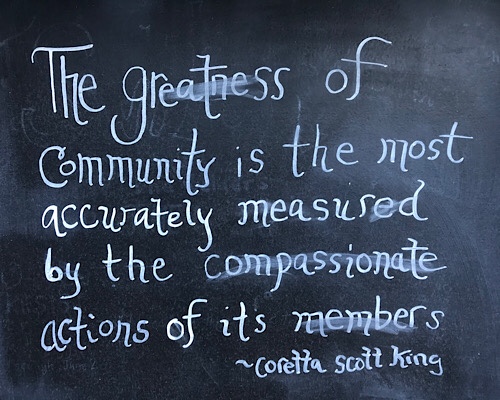
On the Way to William Penn House for Tuesday Night Yoga Practice
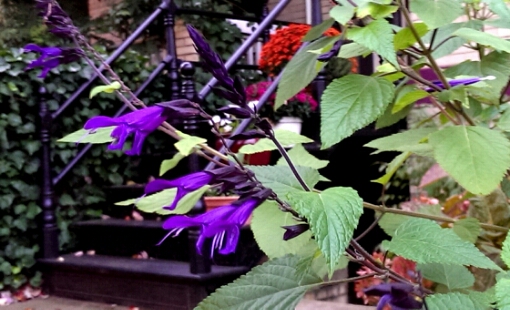
I cut off the gnawed parts, diced the rest, and put it in the freezer. One day in snowy winter, I will thaw it and cook some warm for winter soup or stew with beans and grains and possibly greens.


The dance of yoga is about motion in stillness and stillness in motion, and in not letting oneself be frozen. Stillness is the space between vibrations, instead of the shutting down or closing off vibration. To experience the space between the vibrations (spanda) when changing shapes (poses; going from one thing to the next), one must emerge into the shape and disssolve out of it, with the expanding delight of the coming and going more important than achieving some precise, required shape to demonstrate self-control and mastery (not unlike the teaching in the Siva Sutra that knowledge both binds and liberates).

To third person who said to me that I deserved a nice vacation, I said that I think of myself more as being fortunate than deserving of such luxuries.

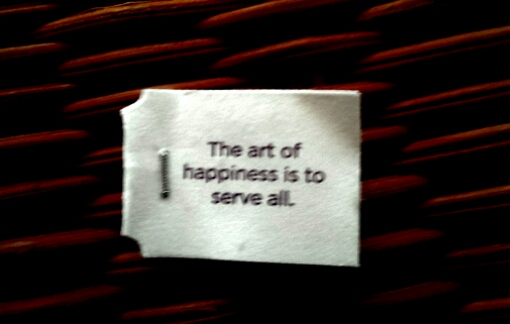
This morning, a friend suggested that if he took into account the needs of others when making plans, all he would be doing is serving others, and he would never get to do what he wants. “Why would I want to do that?” he asked.
I think that’s a common enough question in this society. By uncanny coincidence, the teabag I selected right after the question was posed suggested a possible answer.
As we are taught by the stories of the monkey deity Hanuman, whose main characteristic is a longing for devotion that he demonstrates (while still being utterly himself) through service (seva) cultivating mindful relationship is the highest service to our own self and not just to those with whom we are in relationship.
To take care of our selves can be done with consideration of others without sacrificing our own needs. The answer, I think, is in how we assess and balance our own needs. For me, when I consider the impact of my planning on others with whom I am in relationship as well as my own needs, for example, of freedom, autonomy, and personal delight, I am also considering my needs for companionship, mutuality, connection, and respect. If I completely privilege the former, I may be neglecting the latter and vice versa.