Polar Vortex Dinner
Goat cheese and garlic polenta, with lentil, mushroom, and roasted tomato ragout, and wilted arugula.
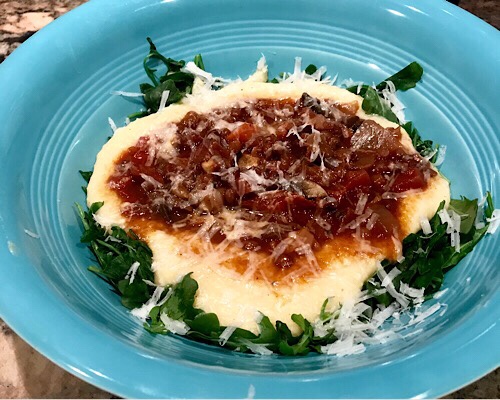
Goat cheese and garlic polenta, with lentil, mushroom, and roasted tomato ragout, and wilted arugula.
It may be true that power that gives power over corrupts, but being empowered is liberating. The yoga, when practiced as part of an ethical life, is empowering. But beware those who claim that “enlightenment” frees one from behaving with integrity.

Peace and light, E — Posted with WordPress for BlackBerry.
In November 2006, the New York Times published a recipe adapted from Jim Lahey’s Sullivan Street Bakery for “no-knead”bread. I immediately adapted it further (as did many of those who commented on-line). Many thought the NYT adaptation benefited from more salt. I also have made it much more energy efficient (the NYT recipe expects the dough to rest in a 70F room and for the oven to be pre-heated for at least a half hour). In the winter, I keep my house at 62F, and pre-heating for only 10 minutes (or baking something else first that doesn’t need pre-heating) is much better for the environment.
As I was baking a loaf (whole wheat, flax seed variation) this week, I thought about how much this recipe teaches about skill and steadiness. The reason the bread doesn’t need to be kneaded, but still yields a crusty peasant-style loaf, is the high liquid content of the dough relative to kneaded breads and the very slow rise time. That one can achieve the results of active labor by mere patience and an understanding of the science of the process recalled for me something I learned at a Rod Stryker workshop a number of years ago about having a steady practice. Rod Stryker was asking students at a week-long intensive whether they had a steady meditation practice. One woman raised her hand and said that she had sat and meditated every day for 30 years. We were all thoroughly impressed. Rod Stryker asked her how long she sat. I think she said three minutes a day, it might have been five. I don’t remember exactly. I was still impressed. Not because she would claim to have a 30 year practice when it was just a few minutes a day, but that she had the self-knowledge to set an amount of time to practice that she could keep. The daily few minute sit was obviously not her only practice or she would not have been at a relatively advanced yoga workshop. It is easy not to develop a home yoga practice, a good home-cooked diet, a garden, or anything else that needs steadiness, if we set the bar too high at the beginning. We don’t want to set it too low either, but finding what we can do with steady commitment and then allowing growth to be spontaneous is the way to keep at it without feeling burdened.
Every once in a while I bake bread that takes attention every day for seven days in a row and then involvement multiple times on the day of baking. It is my having spent the time making more difficult breads that has enabled me to create variations the “no-knead bread” and know it will still come out well. The “no-knead” bread, only modestly varied, I can make whenever I’m out of bread whether I’m busy or not. It just takes throwing a few ingredients in a bowl on a night when I know I’ll be at home the next afternoon or early evening for a three-hour block of time (doing other things almost the entire time).
The basic recipe is as follows:
3 cups of flour. (At least half needs to be bread flour; you should add a tablespoon of wheat gluten for each cup that is not bread flour, e.g., whole wheat or rye.)
1/4 teaspoon instant yeast
2 teaspoons salt (NYT had 1 1/4)
1 and 5/8 cups water
cornmeal or wheat bran for dusting
Day one: mix all the ingredients in a large bowl. If you store your flours in the freezer (which helps keep them fresh and lowers electricity usage because a full freezer is more efficient than an empty one), let them come to room temperature before making the dough. Dough texture is sticky. Cover bowl. Let dough rest for 15-20 hours depending on room temperature.
Day two: dough is ready when the surface is dotted with bubbles. When dough is ready, lightly flour a work surface, place dough on it, sprinkle dough with a little more flour, and fold dough over once or twice. Cover loosely and let rest for 15 minutes. Using just enough flour to keep it from sticking to work surface (I have a cutting board I use only for baking) or hands, shape dough into a ball. Coat work surface and a kitchen towel (not terry) with flour, bran or cornmeal. Place ball of dough, seam-side down on work surface and cover with floured towel. Let rise for about two hours until doubled in size and dough does not readily spring back when poked with your finger. If dough is slow rising because of cool room temperature, put near radiator or put it near stove when cooking something else and when starting to pre-heat oven.
Pre-heat oven to 450F with a 6-8 quart covered pot (cast iron, enamel, pyrex, or ceramic) in oven while pre-heating. When pot and oven are hot and dough is ready, carefully put dough, seam-side down into pot and shake pan to distribute dough more evenly. Don’t worry, it will straighten out as it bakes. Bake covered for 25-30 minutes. Then remove lid and bake for another 15 to 30 minutes until browned. Cook on rack.
Variations: Use just 1/4 cup rye flour along with bread flour. It will taste like a classic french bread. Incorporate a teaspoon or two of olive oil. Semolina flour works well and turns the loaf a beautiful shade of yellow. You can add constituted cracked wheat, but you have to know what dough should look and feel like, because it changes the moisture content. Same for oat bran. I’ve taken to adding flax seed meal into most of my baked goods for the nutritional benefits. Because flax seed meal can be used as an egg replacer, you cannot replace it one for one with flour, but if you replace a quarter cup of flour with a third cup of flax seed meal, and keep the liquid the same, it has worked for me. Try it without a variation first. Practice, enjoy. The more you know about bread-baking, the more options you have. I’ve done it with beer and molasses as part of the liquid and mostly a mix of whole wheat and rye flour to make it taste like pumpernickel. Not my favorite, but it worked.
Play in the same kind of way with your yoga practice at home. Start with a favorite pose you you learned in class. Start small. Start simple, and then let yourself get inspired by the desire to create your own variations.
Having grown up in the New York metropolitan area without much in the way of traditions of any kind, I was not familiar with Hoppin’ John. I am fairly certain that the first time I heard of it was from a college friend whose family has been in South Carolina since before the Revolution. As it is not part of my tradition, I do not feel bound to any particular recipe (I am sure it is sacrilege in some circles to leave out the ham/bacon) or to eating it at any particular time of day (e.g., immediately after the clock strikes 12 midnight). It would not be Hoppin’ John, though, if I did not know its tradition and know where I was deviating from tradition. (Though this would entail a much longer blog than is within my time frame today, this balance of freedom from tradition and needing to know and honor tradition is very much an issue for the Western yoga practitioner.)
1. Soak a cup of dried black-eyed peas for at least several hours or overnight.
2. Dice one small onion or 1/2 large onion (about a cup), a few celery stalks, including the leaves, and mince a couple of cloves of garlic.
3. Heat a few tablespoons of a flavorless oil (peanut, corn, or safflower) in a pressure cooker (my preferred method for saving energy and time) or a stock/stew pot.
4. Saute seasoning vegetables along with a few hot peppers until onion is translucent. I used the last habanero from my harvest and so left it whole. You can use fresh or dried chilis in an amount to your taste/tolerance for spiciness.
5. Stir in a cup of brown rice until rice is coated with oil.
6. Pour in 1/4-1/2 cup of white wine and stir until absorbed (as if making risotto). [You could use stock instead. If you are using white rice, skip this step, which serves to partially cook the brown rice, so that it will take the same amount of time as the black-eyed peas.]
7. Crumble in some dried thyme (preferably from your own garden) and a bay leaf or two.
8. Drain and rinse the soaked black-eyed peas and stir into the cooking pot until all ingredients are combined.
9. Add one 28 ounce can of diced tomatoes and 2 1/2 – 3 cups of vegetable stock or water. How much liquid depends on (a) whether you want a soupy consistency or one more like pilaf or risotto; (b) how liquid are the tomatoes; (c) whether you are using a pressure cooker (less liquid needed) or cooking in a pot.
10. If using a pressure cooker, cover and bring to full pressure, then lower heat and cook at full pressure for 28 minutes. Allow natural pressure release (about 15-20 minutes additional). If cooking in a regular pot, bring to a boil, stir, then lower heat and cook for an hour or more until rice and peas are tender, stirring occasionally.
11. While rice and peas are cooking, mince a few cloves of garlic.
12. Rinse and chop several handfuls of greens (collard or curly kale are best; don’t use spinach or chard, they are too tender). Heat oil and garlic together. When garlic start sizzle, add damp greens and saute until greens are wilted and dry.
13. When rice and peas have finished cooking, stir in sauteed greens and bring back up to full heat. Adjust seasonings, adding more salt and your favorite hot sauce to taste (or allow guests to add their own hot sauce at the table).
I don’t know whether having eaten this will bring me luck and prosperity, but I’ve started the year with lots of vitamins, minerals, fiber, flavor, and cooking, which for me means health, love, technique, tradition, flexibility, and joy! Try this, make your own, read all about Hoppin’ John, or call a friend from the South who must eat Hoppin’ John on the New Year and learn about the tradition and what it means.
Frittata with garden greens and herbs, chèvre, and roasted garlic