| |

Seva

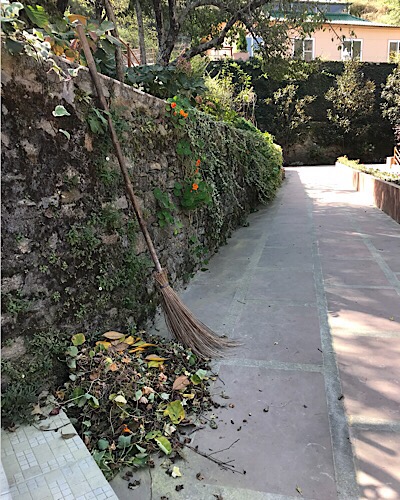
Today, instead of going with the group to visit a Hanuman temple a couple of valleys away (which entailed at least two hours each way of hairpin turns and going through a construction zone so dusty tying a t-shirt or scarf around my head would be necessary and having almost no opportunity to take care of biological needs), I chose to stay back. I honored the spirit of Hanuman with seva in the form of a morning helping tend the grounds.

In the afternoon I will walk into the village with two others who are in residence here. One a Canadian Indian who is a Kabir scholar, the other a Dutch woman who has been spending a month or two every year for the past decade.

There is a Siva festival going on. It is loud even up here on the hill. I will have my earplugs.

I am appreciating getting to connect to the space and the people who live and serve here in a way that I could not when surrounded by the rest of the group. It was very grounding for me, too, to spend a few hours gardening.

Similar Posts

  • | | |

    An Excellent Sufficiency, Homegrown Tomatoes (and the Isha Upanishad)

    The Isha Upanishad starts, “That is fullness (purna).  This is fullness.  Fullness comes from fullness.  Take fullness from fullness, and the remainder is fullness.”

    My maternal grandfather died when I was just a toddler, so I never got to know him.  My mother used to tell us that when he had eaten enough at a bounteous meal, he would say “that was an excellent sufficiency and any more would be a superabundency.”

    On Sunday I went over to Lovejoy Gardens to my little plot (approximately 3′ X 7′ raised bed on concrete, half shaded by a fence) and harvested tomatoes.  There were about 15 ripe tomatoes.  The first thought was that it was too many tomatoes.  Then I thought of all the neighbors I had who didn’t have their own tomato plants.  I knocked on one neighbor’s door.  He gave me tea while I played with the cat.  I gave him tomatoes.  I went for a massage in the afternoon.  I brought tomatoes.  I was sent home with freshly made spanakopita.  I invited another neighbor over for dinner.  We at pesto with basil from the garden and cucumber and tomato salad (cucumber, tomato, and shallots all from the garden drizzled with a little of the best balsamic vinegar and seasoned with just ground sea salt and pepper).  We had a lovely visit, and I sent him home with tomatoes.  In the next day or two, I will make a batch of tomato sauce and put it in the freezer and have someone over for dinner another night.

    There is only “too much of a good thing” or a “superabundency” if we hoard it or try to ingest it all ourselves out of fear, greed, or desire for power or control.  When we have enough ourselves and then share the abundance, we simply create more abundance.  Once again, I am given again from my garden another sweet insight into the yoga teachings.  I am also reminded by this small example that I could share even more broadly from my blessed lot of fullness in global society.

  • | | | | |

    What a Difference an Article Makes

    Leaving aside whether there is such a state as enlightenment and whether nirvana is enlightenment or its equivalent, I believe one should always question one who promises “the” path and doesn’t just offer “a” path that has served the one offering teaching or access.

    Of course, other than potential issues in any community that makes such exclusive promises, one is always free to taste and explore and reinterpret the “the” as “a.”

  • | |

    Some Idiosyncratic, Feminist Musings About Ayyappa

    Ayyappa is the half-brother of Ganesha and Subramanyam. Ganesha and Subramanyam’s mother is Siva’s wife Parvati.  Ayyappa’s mother is Siva’s brother Vishnu while he was the woman Mohini.  Even in the glossed over versions that don’t get into what a modern reader might think of Ayyappa’s mother, he is the extra and unwanted child of the family, although he is needed to save the world from evil.  Ayyappa is the character in the story who represents those who have ever been or felt unwanted or third-wheel or lost or excluded or is somehow missing in society or in relationship, but is still inherently worthy and divine and essential to the functioning of society, even though he is cast out into the wilds of the forest.

    Being the god of such, at the festivals at a major temple in Kerala on the pilgrimage route, all castes are welcomed. No need to be a Brahmin.

    But only prepubescent girls and elderly, post-menopausal women are permitted; women who have the capacity to conceive are forbidden.  Those connecting with the god of the unwanted, the extra, the missing, the cast out, themselves deliberately exclude from access to this god others they make even less privileged.  Even for the men of the lowest caste, the step-brothers, the bastards, and the otherwise unwelcome and unrecognized for their intrinsic worth, by the exclusion of all women of child-bearing age/capacity, Ayyappa’s pilgrims get to experience the sense of inclusion and privilege in society of the more powerful and glorified and popular brothers who have never been themselves cast out.

    Could this by design?  Is it that one cannot really understand what it means to be excluded unless one also experiences the power of being able to exclude in turn? If yes, how easy to pick, in a patriarchal culture, women of child-bearing age as the outcast and denied.  (Do they ask any woman who shows up whether she still bleeds?  If a woman has stopped bleeding, but doesn’t look “elderly,” does the prohibition still apply?).

    I have personally experienced far too many things that have been partly or completely closed off to me, overtly or invidiously, because I am a woman or not of a particular social or religious background, and much where it was worth risking ease to challenge the status quo.

    As for an Ayyappa pilgrimage, I’ve seen photos of half a million escstatic and determined male worshippers surging towards the temple for festival (looks something like returning to the tube station after seeing the Rolling Stones at Wembley Stadium in 1982 or the infield on a muddy day at the Preakness only more testosterone than that), and what first came to mind was not, wow, I really want to join that party.  Rather, I asked myself where do they urinate and defecate.

    I personally cheerfully leave this one to the men (and my more intrepid and determined sisters), even if it makes some of them feel special in part because they have excluded a whole class of people from being able to formally worship.  I’d much rather spend time with Kali. Thank you very much.

    Maybe I’d go stand outside Sabarimala in off season, when the temple is closed.  I’d take a photograph and contemplate what the idea of Ayyappa–god of the unwanted, the unwelcome, the third wheel, the excluded, the extra, the cast out from the benefits but saddled with the hardest task–means to me–both as one who has experienced the pain of exclusion and one who has excluded others (as most all of us do even when we try not to), and how it can inform me to relate to others with more grace and compassion.
Leave a Reply

Your email address will not be published. Required fields are marked *

This site uses Akismet to reduce spam. Learn how your comment data is processed.