Signs Around Town
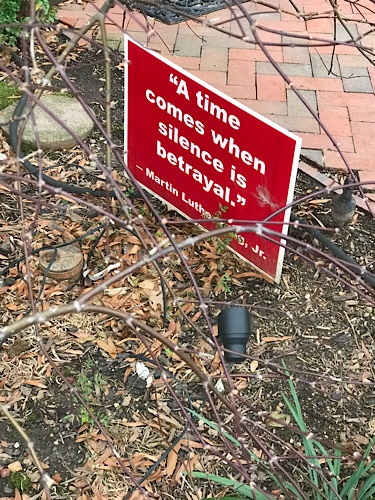
Look around–to your right, to your left, all around you, deeply inside–there is, most likely, more to love.

Peace and light, E — Posted with WordPress for BlackBerry.
Of my friends on facebook, several reveled in staying inside because of the rain yesterday. Others complained about being unable to do things that would have been better on a dry day. Reporters and anchor persons seemed to think it newsworthy whether the rain will impact football or baseball games. How about telling us whether the rain we are getting is optimal for the native flora and fauna and how it is impacting the farmers? We seem as a society to have forgotten the relationship of the weather to food.
Dear Friends,
Best wishes to all whatever your holidays are bringing and however you might be celebrating. I write this in the midst of days full with preparing for my much anticipated travel to India with Professor Douglas Brooks, where I will experience among other amazing things, the temple at Chidambaram, where the idea of Shiva as the Cosmic Dancer first arose, seeing friends and family before I leave, and taking care of all manner of things at work and home so that things will be in as much order as possible both while I am gone and when I return.
I typically make the holidays a quiet time. I enjoy going to a few choice parties and visiting with friends and spending a few days in New York visiting family and exploring museum exhibits and delicious meals, but mostly I use it as time for introspection and refreshment. I process what has happened over the year and get myself and my house and papers ready for a new year of working and teaching and creating. I practice and rest. I take exquisitely long and contemplative walks and write and photograph. When I have spent the holiday season in this way, come the first of January, I feel ready for whatever might come. I know that my general health and emotional well-being are definitely enhanced by consistent daily yoga and meditation practice, regular sleep and wellness activities, such as massage, keeping a beautiful and clean home, and eating healthy meals that come in part from my garden, and the holiday season is enhanced for me by honoring my regular practices and health needs.
By choosing to go on an adventure, with the amount of energy I will need to expend to be open to the outragious influx of sensory input and information and to weather the challenges of travel (including a nine-hour time difference) and to get back to work immediately on my arrival in the middle of of a week in which I already have a known deadline, I can be fairly certain that the comforting, well-rested feeling to which I have become accustomed from the holiday break will not be how I start 2012. In this sense, going on this trip is willfully ignoring and disrupting all that I know keeps me on an even keel. Sometimes, though, we just have to intentionally shake ourselves up to see what ways we can expand and how much. Such shake-ups not only open us up to new possibilities and ways of thinking, but they also help us get ready for the invevitable upheavals in life whose exact timing and nature we cannot control. My holiday blessing is that the shake-up is one I have chosen, that comes when I am healthy and secure, and that will no doubt provide much fuel for growth and creativity. I definitely am looking forward to bringing home new insights and energies to share with you in the new year, perhaps even the seeds for the first art exhibit in many years.
I wish you all peace, health, and joy through the holidays and the new year. To those of you who are currently dealing with extra challenges of embodiment, please know that I am holding you in the light and will be sending beams of healing energy from abroad.
For everyone, here are the yoga offerings for the holidays and the beginning of 2012:
No coincidence, my trip is at exactly the same time as Willow Street is closed for Winter Break, and I won’t be missing any of my Saturday noon gentle/therapeutic classes. The class is continuing in the Winter Session (registration is now open) and I hope to see friends both returning and new signed up for the session. For Willow Street free class week, I will be leading a gentle/therapeutics class on Saturday, January 7th to welcome those new to yoga, the class, or to Willow Street to all the healing potential of Anusara yoga. Free class week is a great way to get to class for the first time that curious friend or family member with whom you have been wanting to share the wonders of yoga.
I know lots of you will be wanting the yoga during the holiday period, so I’ve invited two guest teachers for the Tuesday night William Penn House class. Meridian Ganz-Ratzat will be leading the class on Tuesday, December 20th, and Anna Karkovska McGlew will be leading on Tuesday, January 3rd. They are awesome teachers, so come check out the classes, even if you haven’t been to the William Penn House class before.
There will be no rose garden yoga classes between Christmas and New Year, but check out the great array of holiday offerings that week at Willow Street Yoga to celebrate the transition from 2011 to 2012. I’ll be back to neighborhood classes, starting with the house class on Wednesday, January 4th, and hope to see you at William Penn House in the new year.
Thinking ahead for ways to sweeten your 2012 schedule or looking for a great holiday gift to give that enhances health and a celebration of life, but doesn’t result in more stuff being manufactured? Give the gift of the ultimate nurturing yoga to yourself, friends, and family, with a registration for “Finding the Warmth Inside: Relax Into Optimal Alignment with Anusara Restoratives,” Saturday, February 25, 2012, 2:30 PM – 5:00 PM, Willow Street, Takoma Park studio, $35.00, click to Register Online. Suitable for all levels.
I look forward to seeing many of you at my regular neighborhood and Willow Street classes and at workshops in the new year. Much love and many blessings.
Peace and light,
Elizabeth
A random pick. But the deck has an uncanny way of offering up the appropriate word for the day most of the time.

Peace and light, E — Posted with WordPress for BlackBerry.