A Bit of Beauty from the Garden

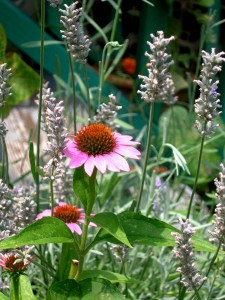
Sage, Chili Peppers, Echinacea
Sage, Chili Peppers, Echinacea
A friend of mine who is an avid and wonderful knitter decided to make a shawl for a friend who is about to have surgery. Instead of whipping out a shawl herself in a few days, she invited other friends to knit squares and bring them to her. She is going to piece together the squares to create, in essence, a physical manifestation of a gentle, loving, communal embrace.
I loved this idea. Though I could not put name to face for the friend who is suffering (I think I would likely recognize her), to support my friend who is setting such a strong intention of sending healing, I am knitting a square or two with some beautiful handspun yarn leftover from a sweater several years ago.
As I knit, I am setting an intention to infuse the cloth with healing energy. In having been invited to participate in this project, I have been given the gift of a potent reminder of how strongly our attitude and intention in whatever we create and offer can shift how it goes forth into the world — whether it be gifts, practice, speech, food, work.
Friday, when I was traveling through New York City on my way home from a business trip, I detoured to the Metropolitan to see the Walker Evans’ postcards and the Bonnard, Late Interiors. The curator chose this quote to inform the viewing of the paintings: “Material concerns and worries about the future are troubling me a lot, and I’m afraid that painting may abandon me because of a lack of mental freedom.” Pierre Bonnard to Henri Matisse, September 1940.
The quote made me think of the yoga principles of ardha, kama, dharma, moksha. In classical yoga, in order to reach liberation (moksha), we need to have our material life — how we eat, consume, dwell, etc. (ardha), our love and relationships (kama), and our work/life path (dharma), in right order. From a tantric perspective, when ardha, kama, and dharma are aligned so that mind, body, and spirit are united in our day to day being, then we are living liberated — jivan mukti (moksha).
In 1940, the Nazis were growing in power and World War II was impending. Bonnard had lost his love, Marthe, was ill and aging, and was in some financial difficulty. He was afraid of losing his vision, his creativity (dare I interpret “painting may abandon me” as “loss of connection to spirit”) because ardha and kama were out of alignment. The late paintings carry a sense of yearning of spirit — perhaps because of the consciousness that struggling physically and emotionally challenges our ability to truly see, to feel connected to spirit. The paintings are lovely with color and light. The subject matter makes them accessible at a surface level. Shadowy figures and ambiguities, though, give a sense of longing and seeking. Although there is a certain basic prettiness because of the color and the subject matter, they are not comfort paintings. They invite one to think about whether color is enough, whether home is enough, what we need to be in a place where we can rest at one with ourselves.

Peace and light, E — Posted with WordPress for BlackBerry.
Unless you have to wear a uniform, there is probably a little flexibility in what you can wear to work (aren’t we lucky to live such a bountiful lifestyle that this is a dilemma). A tie might be required, etc, etc. You can always choose, at a minimum, to have clothes that fit properly and allow some freedom of movement.
My choice to be comfortable rather than “lawyerly” in my office attire except for special occasions possibly has impacted my career, but it is salutory for me on a day-to-day basis to wear clothing that is appropriate for the weather (when we dress inside for the weather outdoors, we need to use less energy for heating and cooling; wouldn’t it be great if we could get everyone to do this) and allows for freedom of movement (this includes shoes).
When I pick out my clothing, I want to be able comfortably take a full breath (think waistline), easily raise my arms overhead or interlace my hands behind my back (how do the shoulders, chest, and back fit), do uttanasana (coverage, waist line, tightness around the legs, back, and shoulders), and run for the bus (tightness of clothes and shape of shoes; forget heels). If you need to wear a jacket, there still is nothing stopping you from wearing a shirt underneath that allows for free movement nor having the jacket properly fit.
There are a lot of ways our choices can enhance freedom rather than constrain it. Choosing to wear comfortable clothing (which usually is better able to be cleaned at home than at the dry cleaners — helps the environment) and comfortable shoes (which helps avoid bone deformation and possible surgery — good for you; good for the environment), is just one of many.
Sometimes when I am blogging about my garden — the joys I experience and its wonderful produce — I feel like I might be presumptuous. I am no Christoper Lloyd or Alice Waters. I just have a tiny space behind my urban, rowhouse that I have turned into a personal celebration.
A visitor from out of town graciously commented that in some ways the limits of my garden make it even more wonderful. In this sense, I know, perhaps best, from my garden the yoga teaching that ultimately to find freedom in this life we need to celebrate all we are within our limitations to find an inner space of unbounded, liberation.
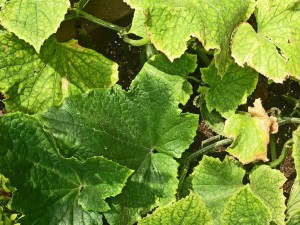
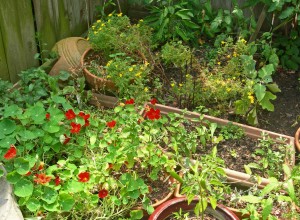
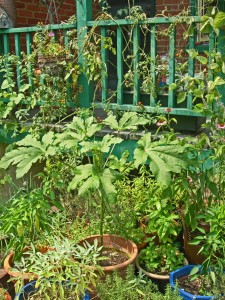
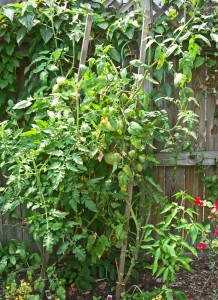
(Shown here, cucumbers, mint, nasturtiums, peppers, greens, sage, savory, basil, okra, onions, more peppers, red and yellow cherry tomatoes (well picked), brandywine and roma tomatoes, eggplant (slow to start this year), echinacea, lavender, orchid.)