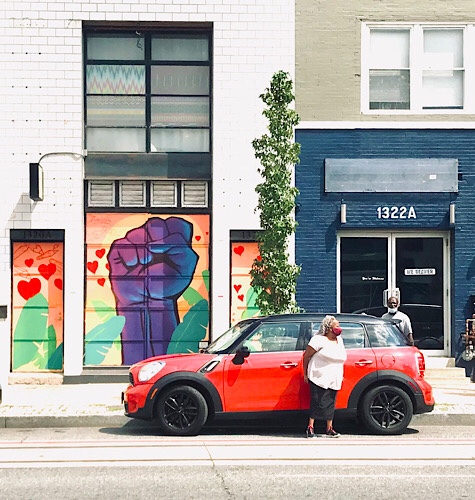
On the Way to William Penn House for Tuesday Night Yoga Practice
A few months ago, I succumbed to the brilliant marketing at one of those yoga studio boutiques filled with enticing outfits that make one feel like part of the in crowd and bought a pair of leggings covered in an allover peacock feather print that made me think of Murugan whose temple we visited on the trip to South India and whose steed is a peacock.
One of the stories about Murugan, who is Ganesha’s brother (Ganesha being the beloved elephant god and remover of obstacles), talks about a competition between Murugan and Ganesha for divine knowledge. (Let’s leave aside for now the question of why a divine being would need to enter a competition to gain divine knowledge as too big a question for a blogger who has no academic or priestly expertise in the Hindu pantheon). In the story, as I have heard it (and as described in the Wiki article that I have shamelessly linked to above, despite all the disdain one might appropriately have for one who cites to a Wiki article), Murugan loses because what he does is try to show off his prosaic prowess by tearing around the world three times. Ganesha wins by quietly circumambulating with quiet worship Shiva and Parvati, the god and goddess, the essence of being, the pulsation of opposites.
When we were out walking in the woods the other day, my friend ER took an incredibly insightful picture of me trying too hard to look like the yoginis who grace the magazine covers and can do the most magnificent asana. The brilliance of the photo is its revelation of the empty ridiculousness of my posing like the beauty I am not, and of pointedly demonstrating how neither wearing wild peacock pants, nor being able to do a tolerably deep backbend reveals anything to the self about spirit. But perhaps it also shows, in its candid and ironic look at an all too human yogini, that like Lord Murugan, who despite of or perhaps because of his absolutely flawed nature is actively and devotedly worshipped, I in my laughable striving may still have in my human being something of the divine. I can only hope.

On Saturday night, two foster cats were delivered to my house. I have been living without any pets for almost a year. I have only spent six years of my life — three of my college years, two of my law school years, and this past year after my cats of 21 and 18 whom I had adopted in 1988 left their bodies — without a cat or dog (or gerbil, hamster, rabbit) in the house. Early in the year I was grieving. As the year progressed, I came up with different reasons why I wasn’t ready to, or shouldn’t get another cat. In the last month or two, I noticed that I had not gotten a cold since Becky passed. I was starting to think that maybe I had a choice between feeling somewhat empty for the absence of pet energy or being sick.
On Wednesday, I responded rather casually to a plea to find foster home for two adult cats who needed a home because their current home-maker was suffering from cancer and would not be able to keep them. If they did not find a foster place here right away, they were going to be shipped to Iowa in the cargo hold. They had already been adopted from a shelter once, and are not a good age for easy adoption at a shelter. So I have taken them in, theoretically on a temporary basis, but they are growing on me fast.


Pete Seeger singing raghupati raghav raja ram before the Beatles went to India. The music and his influence lives on. What a gracious being.
Note: Adding “ji” to a name is both an honorific and an endearment.
Yesterday I wrote to my DC elected officials and to the budget office to let them know how important it is to me that local municipalities fully fund public transportation, as the budget year comes to a close. Metro officials are threatening to close down many bus lines entirely, which will mean that far too many people will be unable to get to work, especially for low-paying jobs. Hundreds of workers are scheduled to be laid off, which means (as an icy cold budgetary matter — the budget after all being a moral document) that they will need services and no longer will be paying taxes. Disrepair, injuries, and accidents will become even more prevalent, and service will be slowed at already overtaxed and overcrowded times. Our air quality will go from yellow/orange to orange/red from the increase in gridlocked traffic. I discussed the issue and the urgency of making our voices heard with several co-workers today.
I left the office at 5:40 pm this evening to go to take Suzie Hurley’s 6:15pm class at Willow Street, Takoma, Park. I was standing on a metro train at 5:46pm. The ride is supposed to take 13 minutes from Judiciary Square metro. We reached Takoma Park at 6:27pm. I went over to the studio when I arrived. If the door was open, I would have looked in and caught Suzie’s eye and quietly seen whether I could slip in. The door was closed, and I could hear that the class had already started doing standing poses. Under circumstances where being late is clearly not my fault (and I try to avoid those by being willing to be early if it turns out the travel has been optimally sequenced), I will join the class just after centering and before the asanas begin. As much as I would have liked to have taken a yoga class after the slow metro ride, I felt that I shouldn’t risk disturbing the other students by coming so late. I instead will be doing a long, deep, slow, inward-moving practice when I am finished writing, corresponding, getting ready for practice and sleep, and doing some preparations for tomorrow’s work day.
In my growing acceptance that I would be arriving too late to Takoma to take class, I thought about the email I had received earlier in the day about the Friends Committee on National Legislation’s “Our Nation’s Checkbook” campaign. The email reminded me that a third of my tax dollars are being spent on war. “What about investing in green jobs, preventing more home foreclosures, and funding diplomacy to prevent wars?” I was asked. “What about public transportation,” I thought, as I sat on the stationary train between stations. “How many trains could be operated efficiently and safely for each fighter aircraft?”
How do I want to live? What are my priorities? When does short-sightedness or immediate personal satisfaction impact my long-term health and happiness and peaceful co-existence on a crowded planet? For what purposes do I practice? How would I like to invite others to live?
The ride home, of course, had nary a problem. A train arrived in under five minutes. The ride back to Union Station was exactly 11 minutes. Everyone had a seat, and the car was nearly full, so it was at perfect capacity. It was still light, and lots of people were out because of the balmy night and the beauteous blossoms, and I felt safe strolling home instead of taking the bus. What a beautiful night!