| |

The Nyaya of Watering the Mango Tree (and tantric yoga multi-tasking)

“Practical Sanskrit” just did a post on its Facebook page that discusses the nyaya (maxim) of watering the mango tree.  When we water a tree with the intention to honor our ancestors and the earth for its gracious offering, we are simultaneously taking care of the tree and honoring our ancestors, the earth, and the tree.  The post continues by inviting us to be more conscious of trees, especially in the city, and to be more engaged in caring for them.

Practical Sanskrit’s post reminded me of a comment on this blog a couple of weeks ago.   A commenter on stated that most of the things that I write about doing to live more lightly on the planet require substantial financial means and education.  That is true in certain cases–obviously, if I wasn’t blogging, I would not have any need to try and go “carbon neutral” with the blog (although it is no more expensive to have a carbon-neutral web host than one that is not).  And as I explained yesterday when chatting with a cabinet-maker who was at the Amicus Green stand at the Green Festival yesterday, with the grant programs, tax credits, and loans available, we can now put solar on our houses with virtually no cash outlay in Maryland and the District (other states may not make it so easy).  In that case, one still needs to be a homeowner, but can still do it without significant money to burn.

But most of the things I do to try and live more lightly, while still being comfortable, I learned in the years when I was truly poor (and I didn’t much like having always to worry about how I was going to pay the bills):  not having a car; not having cable tv; turning off the water while I soap the dishes and brush my teeth; taking short showers and turning the water off while lathering; keeping the thermostat between 59-63 in the winter and dressing warmly; keeping the thermostat between 78-82 in the summer and dressing and eating lightly; shopping for clothes at the consignment shop; furnishing my house from flea markets, auctions, and neighborhood sales; doing my own sprouts on the kitchen counter; having much of my diet be dried grains and pulses bought in bulk; turning off all the lights in the house except for the one I am using at the moment; bringing my own lunch to work as a regular activity and saving eating out for special occasions; avoiding buying and wearing clothes that require regular dry cleaning.

What is nice about being financially comfortable is I now can do all those things with loving intention, rather than feeling constrained by my lack of material well-being.  I am not forced to do them.  Tantric yoga, with its emphasis on being in the world, invites us always to act with intention, to make all of living an offering and a recognition of spirit.  It is easier to do when we are educated, aware, and yearning for spirit, than when we are forced to do something out of material poverty.  It is also easier to do when we do it for love rather than a sense of guilt or obligation.  Being able to live with intention, picking and choosing how we live and what we consume, can truly enhance grace in our lives.  I am sure there are those who grumble about having to go out and water the mango tree to make sure it fruits when they would rather be watching tv.  How much more life-enhancing to water with love for the tree.
Similar Posts

  • | | | |

    Signs Around Town (and More Thoughts on the Dangers of Yoga)

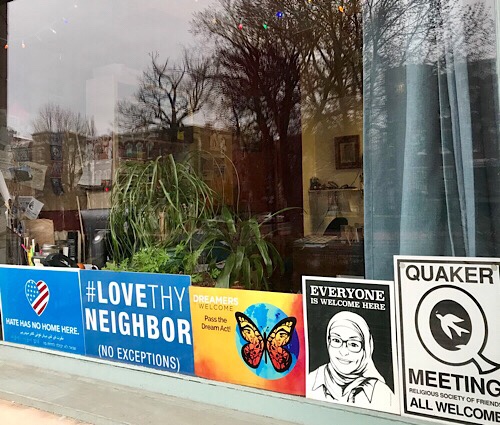
    These stickers have been around town for awhile; I first noticed them during one of the big marches. I assume that it is meant to be ironic. The idea of fighting for non-violence, though, certainly highlights the degeneration of much of our political dialogue into an us versus them fighting stance, even for those seeking peace or social justice.

    The truth of the matter is that just as we cannot realize inner peace by forcing our mind to be quiet, and we put ourselves at risk in our asana practice if we force ourselves into poses to realize external notions of advancement that mirror our conventional cultural values, so too, we will not open the way to peace if we fight for it using the paradigms of the two-party system that now serves the military-industrial complex instead of expanding recognition of the needs of all to be connected and nurtured.

    Peace and light, E — Posted with WordPress for BlackBerry.

  • | | | |

    Cherry Blossoms at the Japanese Memorial (and Abhuta)

    When I was walking home in the gray chilly day, astonished and awed by the beauty and effulgence of the cherry blossoms as if experiencing them for the first time though I have been witnessing them blossom here for over 25 years, I thought about the principle of abhuta.

    Abhuta, which means wonder, is one of my favorite sanskrit words. It is one of the important aspects of the Anusara alignment principle of “opening to grace.” When we approach things freshly and with wonder, then we will not only experience more delight in our daily lives, but we will be more open to learning something new from what we experience over and over again, both on and off of our mat.

    Peace and light, E — Posted with WordPress for BlackBerry.

  • |

    “Dry Clean Only” (Don’t Believe Everything You Read)

    As I was doing my laundry yesterday, most of which I line-dried, I thought about the fact that I have not been to the dry cleaner in nearly a decade. This is one of the small things I have chosen in order to be a little kinder to the environment.

    Some of my clothes, especially things I bought several years ago, say “dry clean only.”  This includes knits made of wool, tencel, modal, or rayon (all of which are natural fibers) and linen and silk unconstructed clothing.  All of these do fine with hand washing (or on the gentle cycle in the washing machine) and being hung up to dry (this also applies to cotton, button-down shirts).   Of course, if it doesn’t say to dry clean then you definitely don’t need to dry clean.

    Always believed the label?  How was clothing made of natural fibers cleaned before there was such a thing as a dry cleaner?  Think they look better or it is easier to get them dry cleaned?  Think about the solvents, the plastic, the energy for the cleaning method, and whether you drive to the dry cleaners.  Then make a decision.

    Most things do not need to be cleaned by use of poisonous solvents (just because a solvent is “organic” or “natural” doesn’t mean it is good for the environment) and then wrapped in non-recyclable plastic to take home (many dry cleaners will take back the hangers, but will say they need to use the plastic wrap because their premises are too dusty for your clothes to stay clean outside the plastic wrapper).

    So look for clothes that say “gentle wash, line dry” instead of “dry clean only.”  If it says “dry clean only” think about whether it really applies.  It will not apply for a wool sweater, most knits, or unlined clothes.  A business suit — yes, it won’t keep its shape unless you dry clean.  Do you really need to wear a business suit?  Will a choice not to wear a suit impact whether some people think you are truly “professional”?  Possibly.  If you decide you need to wear a suit regularly, how many times can you wear it before taking it to the dry cleaners?

    PS.  Don’t experiment with things that are new and expensive.  Try it on older clothes and discover whether you need to believe everything you read.

  • | | |

    Changing the Paradigm to Find a New Way (and “Opening to Grace”)

    A student and friend sent me a link to an article posted by the Center for Consumer Freedom alerting consumers that excessive levels of heavy metals have been found in the reusable bags being sold by some of the big box retailers and supermarket chains.  The analyst reached the conclusion that consumers should be allowed to use disposable plastic or paper bags [environmental consequences ignored] so that they are not forced into the untenable position of having to use bags that are manufactured with unacceptable levels of toxic ingredients.

    It is fantastic that the folks at CCF advised people of the potential hazards associated with the manufacture and use of certain types of reusable bags.  What I do not follow is the absolutism of the “either or” choice presented:   poisonous bags (forced on you by environmentalists) or disposable plastic or paper bags (with all the attendant hazards to the environment).  Why does the bag you use have to come from the grocery store?  The types of retailers identified might have seized another retail and advertising opportunity to make cheap, hazardous reusable bags in nations with cheap (i.e. inadequately paid and treated) workers in countries with lax environmental and consumer safety standards.  But this is just another example of how corporations prosper at the expense of the health of the planet, as if the worth of the stock of corporations — the part that is separate from the world in which the corporation operates — in itself is the highest good (that’s a discussion for another day).

    I write about this article because it seems to me to be a perfect example of how staying within paradigms, choices, and societal constructs presented can keep us in the kind of ignorance (avidya) that prevents us from being in alignment, from seeing the good, and from responding in the highest.  I am sure you, as can I, can think of far too many other examples of how if we stay with the question as it is framed, can prevent us from finding a peaceful, loving, healthful solution.  The choice here is not bad for the environment and your kids (or pets) reusable bags or bad for the environment disposable bags.  The choice is between bad for the environment bags and reusable bags that made by you or someone you trust not to use poisonous materials.

    I have been carrying my own bags on a progressively more consistent basis since I was inspired to invite people to participate in Earth Day when I was in junior high and high school in the 1970s.  The photo shows some of my favorite carry bags.  From left to right:  (1) the day pack I bought in 1984 to carry my law school books, which were very heavy; it cost maybe $20 and it is still going strong; (2) cute organic cotton bag with “make love, not war, haight-ashbury 1968” silkscreened on it; I get complimented on it whenever I use it, especially when I turn down super cool disposable bags at fashionable stores in NYC (“no thank you; I have my own bag”); freebie canvas bag from Barney’s Coop; cannot be sure that it was made with union labor, but am pretty sure it isn’t one of those toxic bags described in the article.

    Next time you are struggling with what seems like an choice between Scylla and Charybdis, invite yourself to soften, to open to the bigger picture, to open your heart and mind as wide as the widest space of meditation, and ask whether you are asking the right question.

  • |

    Letter from Friends Committee on National Legislation on Budget Priorities

    Wanted to share with all of you the text (plus link) of an email I received today from FCNL:

    Here in Washington, everyone agrees that the current level of federal budget deficits is unsustainable. Our FCNL policy is that – with a few exceptions – government should take in sufficient revenue to cover the nation’s needs.  But as our lawmakers debate how to cut the deficit, we need to insist on truth telling; a serious consideration of all federal spending, including the Pentagon’s budget; and open discussion about priorities. Contact your representative today.

    take actionThe plan that the House leadership offers for a vote on Friday fails that test. The plan proposed by Rep. Paul Ryan (WI) reduces the $15 trillion federal budget debt by about $155 billion over 10 years – that’s a drop in the ocean. This plan “saves money” by transferring resources from programs that assist people with low and moderate incomes to wealthy individuals and corporations.

    Rep. Ryan’s plan, according to an analysis by the Center on Budget and Policy Priorities, would cut $4.3 billion in federal spending – two-thirds of that directed at programs for people of low and moderate incomes. The plan would then give $4.2 billion of that sum away in tax cuts that benefit primarily wealthy individuals and corporations.

    We at FCNL want Congress to be serious about federal government spending, which means looking at ALL expenditures and balancing priorities. Cutting waste, fraud and abuse makes good sense. The place to start  is with Pentagon spending. Fair and adequate taxes and other government programs should also be examined.


    Take Action

    Urge your representative to reject the Ryan budget and to support efforts to make at least $100 billion a year in cuts to the Pentagon budget, as recommended by the Sustainable Defense Task Force.

    Ask 5 friends to contact their representative too.


    Find Out More

    Who says we can and should cut Pentagon spending? The answer may surprise you.

    The Sustainable Defense Task Force outlined how nearly $1 trillion could be cut from the Pentagon budget over the next 10 years. Read the summary and share it with others in your community.

    Read the analysis of Rep. Ryan’s budget that was done by the Center on Budget and Policy Priorities.

    Find out more about the Our Nation’s Checkbook campaign to shift money from the military budget to advance other priorities.

One Comment

Leave a Reply

Your email address will not be published. Required fields are marked *

This site uses Akismet to reduce spam. Learn how your comment data is processed.