Similar Posts
A Secret Garden
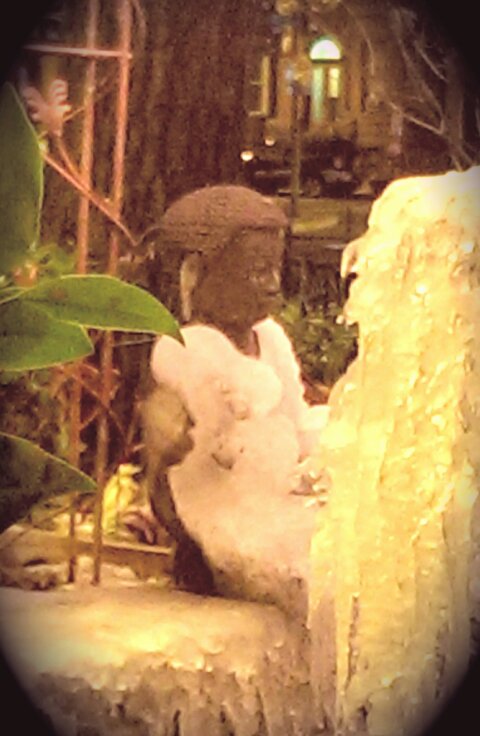
I was at a meeting at another agency that was built in the years when civil service was a respected nd honored activity. The garden is clearly maintained, but I have never seen anyone in it, and wonder whether entrance by anyone other than maintenance is permitted. Does the solitary air of the garden make it feel more personal and sweet? Or does it seem isolated and less intriguing because of the absence of people?
I wonder whether people who are naturally drawn to meditate would be the ones who would answer yes to the first question and no to the second.
- Art and Culture | Asana, Pranayama, and Yoga Practice | Food for the Mind (Yoga Philosophy, etc) | Meditation
“It’s All Good” (and Voltaire’s Candide at the Shakespeare Theater)
Last night I went to see the revival of the Bernstein musical version of Voltaire’s Candide, now playing at the Shakespeare Theater’s Harmon Hall (discount tickets available), which was absolutely a delight — fantastic staging and direction, luxurious costuming, enthusiastic performances. Throughout his journey, which is beset with cruelty, hardship, natural disaster, and other mishaps wherever he goes, Candide sings of his tutor’s optimistic advice that “all’s for the best in this best of all possible worlds.” The application of this philosophy leads to some silly results, including the Monty Python-worthy lyric “it’s a great day for an auto da fe.”
I have a friend who, after telling me of various life challenges and griefs, inevitably signs off with the phrase “it’s all good,” though I am not sure she believes it. I thought of her repetition of the phrase “it’s all good,” while I was watching the musical. Later in Candide’s travels, he encounters a second philosopher scholar who (I’m paraphrasing loosely) contradicts the “it’s all for the best” philosophy of Candide’s tutor by telling Candide to just look around and he will know that things are not in fact always for the best. A fluffier version of the debate in the novel, as to whether things are all for the best when there is so much cruelty and devastation, is interwoven into the rest of the play.
I’ve never had a desire to wear the t-shirt proclaiming that “it’s all good.” I look around me, and I simply do not believe it. I do believe wholeheartedly, though, Voltaire’s premise that we have the responsibility to “cultivate our garden.” As my teachers John Friend and Paul Muller-Ortega espouse, we should “respond from the highest,” regardless of what we experience and encounter. By having our response make the best of all possible worlds from things that are not evidently for the best, we bring more light into the world, whatever is our world view. I can only hope that with steady practice of yoga and meditation, I can keep ever truer to these teachings when I am seriously challenged.
- Art and Culture | Asana, Pranayama, and Yoga Practice | Community and Family | Food for the Mind (Yoga Philosophy, etc)
The Svadharma of the Pinky Toe (and Radical Affirmation)
Svadharma, from sva (self) and dharma (duty) means our personal path, duty, calling, or place. The principle of svadharma is a significant teaching in various yoga texts, such as the Bhagavad Gita, especially emphasizing the importance in acting in accordance with one’s caste (for example, Arjuna needing to act in accordance with his dharma as a warrior) or one’s sex (consider Sita’s role in the Ramayana).
Extrapolating this teaching and taking it onto the mat, during one of the practice sessions the previous week at the Certified Teachers’ Gathering, John Friend said that “every part of the the body has its own svadharma to increase the pranic flow.” He then said that if you just took a photo of the feet of an Anusara yoga practitioner in any pose, you should be able to see that the whole body was fully engaged and active. John Friend’s teaching here was not just using the yoga philosophy as a catalyst to better understand the body. By using the principle to illuminate the practice, the practice reflectively illuminated the principle itself, without denying or denigrating its original context or getting bogged down in its historical baggage of perpetuating the caste system and demarcated, subservient roles for women.
Thinking about the svadharma of the pinky toe has no such baggage. The pinky toes are homely looking things, they do not fit well into most women’s shoes, they rather painfully bump into things, and they are hard to move independently. They are not essential for living and do not have the emotional charge of the heart and brain, the exquisite connection to the world of the sense organs, or the connection to life itself of the lungs. Despite this, the call to lift and spread the toes, to draw the pinky toe toward the heel, or the hip happens just about every time I go to the mat in my practice or teach a class. Activating the pinky toe by opening it and spreading it apart from the other toes is a conscious act of opening that helps hug the shins to the midline. In hugging the shins in by means of activating the pinky toe, the yogi on the mat can then safely move the thighs back and apart, creating an expansion of the pelvic floor that provides room for more strongly tucking under the tailbone to access core power. The pinky toe thus is an important part of our practice, even if we could manage to get by without it.
But the svadharma of the pinky toe on the mat is not just to be able to help us access the movement of “shins in” so that we can better do “thighs out,” although that is an important physical part of its essence. The toe does not move on its own. We have to start by bringing our awareness and consciousness to the toe. Part of the pinky toe’s svadharma, then, is to invite the infusion of consciousness to show how full participation of even an apparently insignificant part of the body can lead us to a better understanding and personal experience of the pulsation between reaching out and hugging in and affirming ourselves. By intentionally bringing our awareness to the power we can unleash in the pose by the movement of the pinky toe, we bring the opportunity for greater strength, expansion, and flow of energies. This is why, I think, John Friend suggested that by just seeing the toes we should be able to know the engagement of the whole body and mind in a particular pose.
As a practical and therapeutic matter, recognizing and bringing into play the svadharma of each and every part of the body serves to help us increase the flow of energy and expand our range of movement. In addition, activating the parts of the body that are inclined to slack (for example, the pinky toe or the adductor and abdominal muscles) will bring ease to the muscles that tend to overwork to compensate, such as the neck and low back muscles. We are not just stronger and more flexible when every part of the body does fulfills its svadharma, but we eliminate much pain and suffering. (More to come on this particular concept in other posts.)
Off the mat, when all parts of the whole are fully conscious of and know their svadharma, the whole will itself have more consciousness, more light, and better experience the bliss of being. It is easy to see, without judgment or question, that the pinky toe cannot do the work of the heart, although when the pinky toe is working it can help contribute to an integration of mind and body that will further the opening of the heart and thus the whole person. Finding our svadharma as a whole person within society does not have to be about conforming to preconceived social norms that no longer serve. The better we are able to understand where we are in time, space, and the interconnected web of being, though, the more fully we can participate in leading society itself to a more conscious and light-filled place, just as bringing our conscious awareness to the actions of the pinky toe can do the same for us as individual yogis on the mat. When we recognize and live out our true svadharma as such, we radically affirm ourselves, the community, and the very essence of all being.