Similar Posts

  • | | |

    A Flood of Memories (and Luminous Spaciouness)

    I returned home yesterday from teaching my Willow Street classes and having a late lunch with a friend to a message on my answering machine from my mother advising me that a cousin had died. Although I was not close to my cousin, her parents, my great Aunt and Uncle, were a significant part of my formative years.

    As I made telephone calls and sent emails to get coverage for work meetings on Monday and care for the cats so that I could leave for New York, I found myself flooded with long-ago memories of my cousin, my family, and myself. I could also hear and feel old patterns surfacing, as they tend to do in such situations.

    In counterpoise to the tumble of memory, I felt a strong pull to go into the space of meditation.

    In the spaciousness, I no longer feel trapped by the inevitable consequences from the events giving rise to all those memories that have partly shaped my path. The light of consciousness itself, as the ground of the play and the illumination of inner space, begins to reveal the links and sequnces of the memories, the cause and effect, thus allowing me to see other ways to react. Instead of remaining entangled by trying to dismiss or reject or cling to any part of my history, I could see shapes, sequences, and opportunities.

    At lunch, one of the things my friend and I had been discussing was the idea of bringing into “luminous spaciousness” our relationships. John Friend had invited us to think about that concept at the Teachers’ Gathering last month, and I have been contemplating the practice in a variety of contexts and discussing with fellow Anusara yogis what it would mean to them to bring luminous wisdom to relationship by seeking to create the true spaciousness we can find in our practice of yoga and meditation. I had talked about it previously with the friend with whom I lunched yesterday. She asked, “where was your blog entry on luminous spaciousness; I’d been looking forward to it.” “I haven’t found the right context for describing it that would convey what I think it means for my practice,” I’d replied. When I came home to my mother’s message, because I had been continuing both the contemplation and the dialogue, I was focused on the practice when I found myself in a situation where I really needed it. (Great reminder of the need for a steady practice).

    I am now on the Long Island Railroad, heading to my parents’ house. Tomorrow we will go back into the City for the memorial service.

    As I allow my thoughts to be stirred up–giving myself space, as it were to have natural mind processes–I seek space and light for myself in my relationship with my family to try and foster more love and clarity.

  • |

    “Hugging to the Midline” (and discipline/discipleship)

    Last night in group practice a student asked what she could do to keep her standing leg upper thigh/outer groin from cramping in ardha chandra chapasana (sugar cane pose).  I responded that she probably was not using her inner thighs enough; she need to hug more to the midline.  Another student pointed out that it is very challenging to hug to the midline in an asymmetrical pose.

    Anyone who studies Anusara yoga has heard the teacher say “hug to the midline.”   The physical instructions most often given to help the student do so, are “shins in” (coupled with “thighs back and apart”) or “isometrically draw your heels/feet together” (or hands in an arm balance or elbows/forearms in pincha mayurasana or sirsasana).  “Hugging to the midline” is one of the three aspects of “muscular energy,” the second of the five “Universal Principles of Alignment” in Anusara yoga.

    To help find the midline in an asymmetrical  pose, I invited the students to do a partner exercise in ardha chandrasana (balancing half moon pose).  One student went into the pose.  The other student stood behind the one in the pose and place a hand or forearm underneath the lifted ankle of the student in the pose.  The student in the pose then pressed down energetically into her friend’s support.  The student was then able to find how to do “shins in” with the lifted leg.  What all the students discovered was that by working with far more enthusiasm and power to the midline, it was much easier to open the heart into a deep back bend in the pose.  As it was a backbending practice, we also explored the principle in various one-legged backbends, including eka pada ustrasana (one-legged camel pose) and eka pada urdva danurasana (one -legged wheel pose).  The students who might not otherwise have been able to find these poses, discovered that if they hugged with heartfelt enthusiasm to the midline, they found an ability to do a pose that they might otherwise have thought beyond their reach.

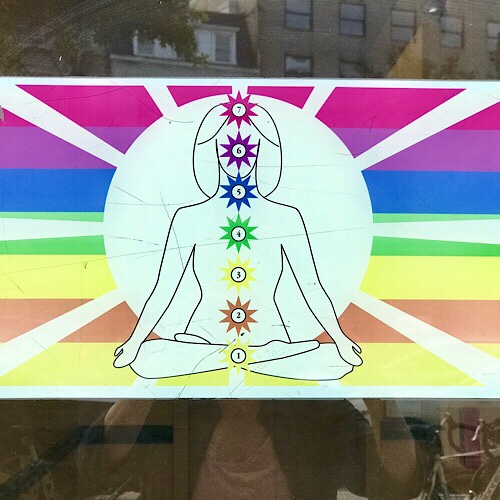
    This alignment principle was a perfect way to illustrate the theme of the practice, which was discipline as discipleship to the light (see yesterday’s blog post).  All of the alignment principles in Anusara yoga are designed to get us deeper into our hearts; it is an added benefit that they make us stronger, more flexible, more secure in our bodies, healthier, and more energetic.  Hugging to the midline will definitely help us engage our core muscles, thus giving us more strength and tone.  As an energetic matter, hugging to the midline draws us into the central channel, the sushumna nadi — the place of grace where the kundalini energy rises.

    When we are practicing sincerely, we are not just seeking to achieve a pose or get stronger or even to have kundalini experiences.  We do not discipline ourselves for some external goal.  Rather, out of the deepest longing to connect, we engage the principles to align our energetic and physical bodies so that we can be more in the flow and find more capacity to soften and expand our hearts and carry that into our lives, lifestyles, and relationships.  The physical practice can show us how this works, and then, when we are aware, pulses us back to our true desire.  More than the physical act of hugging to the midline makes it easier to do a heart-opener (backbend) and the energetic act of drawing to the midline may stimulate the flow of the kundalini energy, the discipline of drawing in to find the light will help us soften and expand the heart center so that we can reside more deeply there, and thus experience and share more joy, love, and compassion.

  • |

    Not Wanting to Know

    I don’t want to see the pictures.  I don’t want to read the news, but putting my head in the sand will not eliminate the existence of the tragedy.  Those of you who have read this blog regularly, know that in my own comfortable middle class way, I am seeking to reduce my energy consumption.  As I write, a contractor is replacing my old rubber roof with TPO roofing (“cool roofing”).  My old black rubber roof has been needing repairs for the past few years.  I am working with another group to get solar panels installed, and I needed to replace the roof first.  I hope this will make things more comfortable and reduce my footprint.  (Yes, I know the only way truly to do it, is to live in a whole different way).

  • | | |

    What If? (an Invitation)

    What if for a whole day you did every single thing with the intention of becoming blissful? If you have them, taking care of pets or kids or elders? Every thing that you did at work? How you went from one place to another? Every morsel of food and drink you selected, prepared, and ate? All your errands? Your getting dressed and undressed? Your correspondence?

    Would you even need to “practice yoga” by doing postures or meditating if you were living yoga–fully unifying the day to day with the conscious intention of experiencing the full bliss of consciousness at every moment?

    Why not try it for a day and see what happens? And then let us know.

Leave a Reply

Your email address will not be published. Required fields are marked *

This site uses Akismet to reduce spam. Learn how your comment data is processed.