Similar Posts

  • | | |

    What’s For Breakfast?

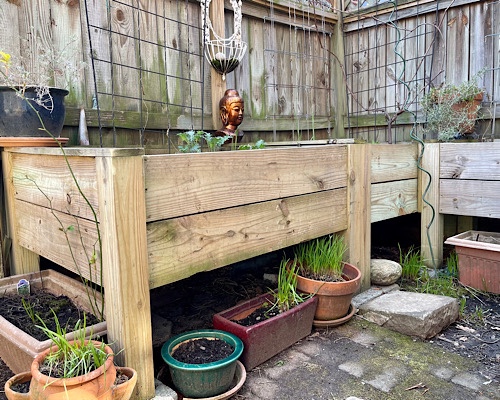
    Snowpeas, tri-color beans. Peppers. Cherry tomatoes, basil (blueberries and strawberries did not make it out of the garden).

    A student asked me the other day why I garden–was it to save money, he asked, was it for better tasting food?

    It does save money to grow food and food eaten straight out of the garden is a foodie’s exquisite pleasure, but those are not my primary motivations.

    I garden for the delight it brings through all of my senses and for the joy of knowing that the garden never questions nurturing. The more I give the garden, the more it gives back, without question or judgment.

    I garden for the sense of relationship with the deeper seasonal patterns. To experience at an intimate level the impact on health and thriving of variations in seasons, light, heat, and rain.

    With the drought and extreme heat in our area, the garden is struggling. Peppers are fruiting before having gotten tall and full. Cucumbers are yellowing and drying, though a couple have grown large enough to eat. There is a surfeit of kale, but the snow peas, which prefer cool weather, barely had time enough to grow enough to flower before it was too hot to thrive.

    Part of the reasons some recipes have many ingredients is because they are premised on there not being enough of any one thing to make a meal. I am getting a few servings of vegetables every day, but the blasting heat is preventing the kind of abundance for some things I might have in another year. The grapes, though, may be outrageous; they like this crazy heat.

    I want to be conscious of these challenges and serendipities. I want to know how I might need to change and adjust to thrive in a world that is ever more out of balance. I garden because it helps me be aware of crisis and challenge, but always and first providing extraordinary pleasure and beauty.

    Peace and light, E — Posted with WordPress for BlackBerry.

  • | | | |

    They’re Almost Here (Way Too Soon)

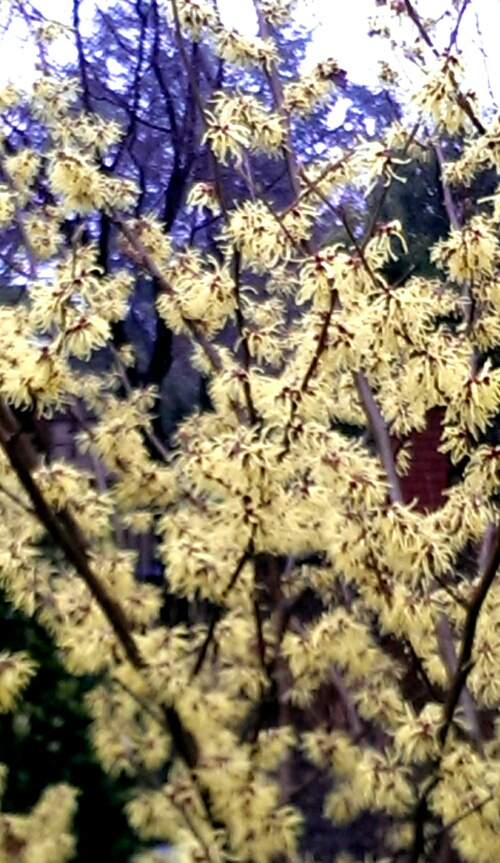
    The cherry trees are starting to flower–two weeks earlier than an average spring and likely to set a record.

    In my own yard, the greens that over-wintered and are newly coming up are suffering from lack of rain and May/June temperatures. Though it is still technically winter, the lowest lows are in the high 40s F in the 15-day forecast. It is still risky to take out the tropicals, though if the 15-day forecast looks the same in mid-April, I will go for it, even though historical last frost is in May.

    What cannot wait is planting cool weather vegetables such as snow peas. They still might not thrive if the unseasonable warmth and lack of rain do not level off. But Spring is so early that now is the chance to catch the growing season.

    As I can go to the grocery store and the farmers’ market, I could just let the season pass me by, ignoring the realities of the season we are getting.

    Much of the reason I garden is to heighten consciousness and connection to nature. If I do not make sudden adjustments the way a farmer would to, then I am missing out on a great opportunity. That meeting the unexpected time constraints imposed by abnormal weather patterns is not in sync with my schedule just highlights the importance of us needing to shift ourselves to be aligned with the great flows of energy.

    Enjoy your gardens (strawberries will be early too–i already have some plants starting to form fruit).

    Peace and light, E — Posted with WordPress for BlackBerry.

  • |

    “First principle” (and akrama and krama)

    When I think about the Anusara alignment principles in the context of the tattvas (see earlier posts), I think about “opening to grace” appearing in two places on the tier.  As “first principle” it is the first among a larger sequence about how we come to the mat, rather than just the first of the physical principles.  “First principle” not only starts the practice and the dialogue, but is already there. It is, in this sense, so fundamental that it is not part of the sequence, but is sequenceless (akrama).  If you are fully conscious of “grace” and can embody it in all aspects of your physical, energetic, and mental day to day existence without further instruction, study, or practice, then there is no need for other practice or instruction (this I think is a very rare being, and certainly I’m not such a being).

    The next set of tattvassuddha vidya, ishvara, saddha shiva, and shiva-shakti (see link above), correspond to the Anusara alignment principles of “attitude, alignment, and action,” which although they are themselves described in sequence, are fundamentally sequenceless as they happen all at the same time and are more elemental than the practice of the physical/energetic alignment principles in sequenced practice.

    In this way of understanding the play between the sequenceless and sequenced, we have a universal “first principle” that embodies the purpose of all we do on and off the mat.  It is followed by how we want to practice, described in a way that becomes less of just a concept (which as a universal concept is akrama) and more of a practical understanding (which applies when we are in space and time and therefore in the krama of embodied existence).  As we dance in this play between the sequenceless and the sequenced, we come to practice (or to do any activity) with the “attitude” of wanting to live the “first principle,” to know and experience what is fully present and not bound by time and space.  We then (because we must) study and practice specific “alignment” to try and express this attitude with our “actions.”

    The physical/energetic alignment principles then come in as a the way of better refining, studying, and practicing the desire to recognize with mind and body the “first principle.”  The sequence of “open to grace, muscular energy, inner spiral, outer spiral, organic energy” comes then at the level of physical and mental practice to return us back to “first principle.”  “Open to grace” is first in this sequence, too, but as “first principle,” for me, it is something more than the first of the alignment principles.  “First principle” is not just the start of how we practice when we practice Anusara yoga, but the whole reason for practice.  It is the universal, overarching, blissful element of being that draws us to the practice because of our yearning to know it.

Leave a Reply

Your email address will not be published. Required fields are marked *

This site uses Akismet to reduce spam. Learn how your comment data is processed.