Untitled
I have spent most of the last three days working from home so that I could be on site while repairs ensuing from the earthquake and hurricane were done. I’ve been luckier than most in the path. The damages I sustained from these extreme forces of nature can all can be repaired with relative ease. The leak in the living room was from gaps between the house and the windowsill and the porch roof and the house. The leaks in the upstairs bathroom were from screws attaching the skylight to the roof having been shaken loose. The 100-year old gutter pulled away from the house and sprang some leaks, but can get wait another year or so with just being patched instead of replaced. The cracks in the brick and the mortar dislodged and completely washed away call for repointing before winter, but that was going to have to be done in the next five or six years anyway. Several more things got loosened or lifted up or away from where they were supposed to be, but that is why god made caulk guns and foam sealant in spray cans.
What I find interesting about looking at the damage is that the worst of it was at places that previously required repairs during my 21+ years in the house; some of these, based on the way the ceilings had already bulged or cracked when I moved in were evidently chronic trouble spots perhaps since the house was built. Why those places? It could be the soil on which the house sits, the direction it faces, the activities of neighbors, the presence and absence of trees around the house, the minor, but daily tremor caused by the D6 bus. If something was going to come apart at the seams in the house, it is not surprising it came apart where it is inclined to come apart and even less surprising that Hurricane Irene created more damage because the house was already fraying at the seams because of the earthquake (and the continuing aftershocks). The places that came apart under stress were the places where the old repairs did not reintegrate fully into the integrity of the design and function of the house. Those are still are the vulnerable spots, the places most likely to come apart in a blizzard or a hurricane or an earthquake. The better and more thoughtfully integrated into the rest of the structure of the house a repair, though, the more likely it is to cease to be a spot for future repairs. Some old repairs that were done mindfully have ceased even to be remembered as places where a repair was required.
The same sort of pulling apart at the edges, at the weak spots, at the less than optimal repairs of old injuries, as happened with the house in the past few weeks, happens to me when challenges and opportunities for personal growth pile on, as they have been doing for me for the past several weeks, starting with things wholly unrelated to the weather. Although I am taking things in stride and with ever more flexibility and openness the more I practice, I can feel my familiar default setting–anxiety and sadness–emerging at the stress points. None of the personal things that had come up before the earthquake and hurricane, nor the impact of both and the preparation for the latter, alone would have been enough to shake me up much. As they become a basketful, though, I can feel my old tendencies closer to the surface with each thing that gets added into the experience.
Just like the places where the house tends to come apart, my tendency to get anxious and the triggers for the anxiety are familiar spots. They have been there for decades. Perhaps they came from another life. For the house, the original spots may have started with the materials–the character of the trees and stones and mud and ore out of which the house was built. Some of my stress points I recognize in my parents and my grandparents whether or not they come from previous lives of my own, some are related to my physical make-up, some from the exact place and time of my birth.
These tendencies of ours are samskaras — the ingrained patterns that are the results from our actions, impressions — some deeper than others — in the very fabric of our being that shape how we behave and respond to what comes, thus creating more samskaras. The more we respond in our habitual way, the more imbedded become the samskaras and the more they keep us from being conscious of and aligned with the fullness of being. One of the key benefits of practicing (meditation and other practices) is to lessen how impressionable we are, that is, to make it so that new stresses do not deepen old patterns or create additional patterns that take us out of alignment with the flow of being.
As I feel old stuff getting churned up, I seek to dissolve and benignly release it through my practices, while steadily, and as mindfully as I can, doing what needs to be done to get on with this fully-engaged householder life at this wild time. It is one of my intentions to practice sufficiently so that I will be able to be in the flow and respond in the highest no matter what comes. There will likely be more and greater challenges than what I have already in this lifetime experienced.
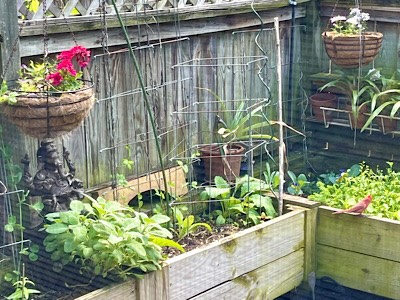
Cardinal eying the baby chard. I really ought to start greens inside. Ganesha looks on. The still exuberant saga in front of him was three times the size. It was not hard to find people who wanted some. I also have been offering lots of mint and yarrow. Locals, let me know any time you want to know what’s available for sharing.
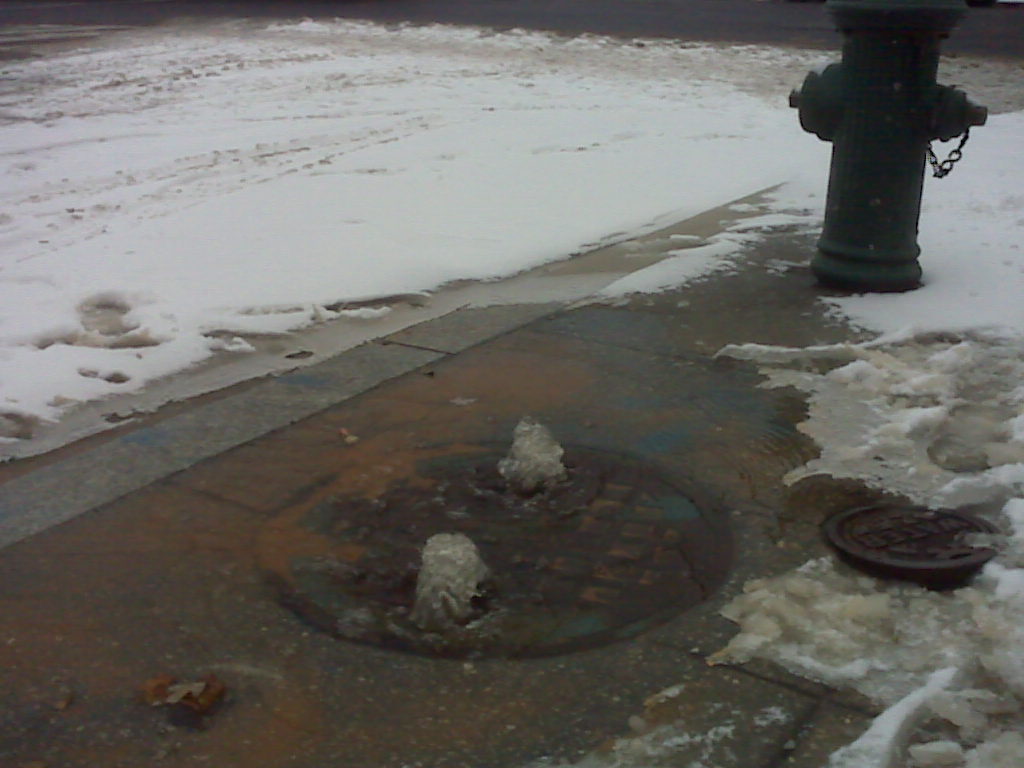
I saw this water main break while I was walking to work this morning. Several people walked past it without a glance–could they really not have noticed? It looked relatively recent because the puddle was still modest and had not started freezing. I paused, took out my mobile device and telephoned the mayor’s city-wide call center (in DC “311”–whoever answers will transfer you to the right place; in this instance, “water emergencies”). A couple of people who saw me calling looked at me as if it must have been my fault or else why would I be calling,
I thought about what it was that moved me to call. I saw harm to the environment (colossal waste of water while we are in a drought if the leak was allowed to continue without the earliest possible intervention) and potential danger to people from spreading icy water that will turn into ice late this afternoon. What is it, though, that leads one to take action to change or fix something that is technically not one’s business. What makes it part of one’s duty or responsibility when it is not directly related to one’s individual property or person? At some levels, it is just social contract. By choosing to live together in closely proximate society, it is in all of our self-interest to take care of shared areas, though the ubiquitously unshoveled sidewalks leads me to believe that most people haven’t been taught or grasped the principle that if we all contribute “our share” the whole place and our own lives would be far more enjoyable.
These thoughts led me to think of the application of the yamas and niyams in Patajali’s Yoga Sutras and in particular, the principle of brahmacharya, which is one of the five yamas on the first level of the eight-fold path of yoga in Patanjali’s Yoga Sutras.
Brahmacharya literally means being like Brahma, but it is often translated as celibacy. Brahmacharya, from a less socio-morally result-driven interpretation, could also be thought of as aligning with the divine. Before we are enlightened, though, how do we know what will help us align with the divine? I once heard Professor Douglas Brooks say, in a lecture I attended a number of years ago, that the yamas and niyamas, the ethical precepts that lay a foundation for the practice of yoga are for the goal of the individual reaching enlightenment. I was a bit taken aback by the statement at the time. It sounded as though the yoga precept was that the purpose of ethical behavior was self-interest, and was not because ethics was summum bonum. I am less troubled by the idea after much contemplation. What is the harm of the goal enlightenment serving to motivate and shape our behavior? The methodology that includes the yamas and niyamas would have us engage in certain ways of living and practices in order that we can change our karma by shifting the patterns (samskaras) that take us away from spirit rather than lead us toward spirit.
To me, this means acting in away that not only does not harm (ahimsa–the first of the yamas), but seeks to expand the possibility of fostering the collective good, including the good of the earth. In this sense, to the extent that brahmacharya is a precursor to enlightenment–the merging of the individual self with the greater “Self” or spirit, acting from a placed of enlightened self-interest can be seen as helping us to find the true Self (as long as we are not attached to a particular good or outcome, but that is a whole other topic).
This is an especially fine year for them. I was thinking about what it means to trust that winter will end and the trees will mostly bud , leaf, and fruit again starting in the Spring.