| | | |

Outrageous Light (and Sadhana)

I just spent a week looking at the celestial realms — inner and outer.  Fifty of us spent a week meditating and studying with Paul Muller-Ortega at a retreat center in Sedona.  It might seem from these pictures that there was not a moment when we weren’t exclaiming in awe over magnificent visions.  The truth is that many times of the day, the sky was not spectacular, but I was always looking and always had my camera in my pocket, whether the sky was dull or flat when I left my room or whether it was engaged in some outrageous display of light.  The photographs below are in chronological order to show the pulsation of night and day, the progression of the moon from almost full to full, the shift in mood from day to day.  But, the images show a completely edited view.  There were the views for which I did not take out my camera at all.  Those were the majority, but I was still looking.  There were the views I photographed, but deleted from the camera memory, choosing not even to save them.  There are the photographs that I downloaded onto my computer, but did not even enlarge to get a better view.  There are photographs I enlarged, but decided not to edit.  Then there were the photographs I chose to edit by making decisions about cropping, brightness, contrast, hue, and saturation.  The photos below are a subset of the last group.

If I were doing a show where I printed and framed the work, I would have worked from at least ten times as many images and would have done multiple prints of each image before choosing what to display.  In this persistency and discrimination, photography teaches much about meditation practice.  To show what is seen in a way that shifts the soul of the viewer, the photographer has to look over and over again.  For example, Robert Frank took over 20,000 images for “The Americans.”

Anyone (especially these days with the technology available) can take an extraordinary picture or two if in the right place at the right time with the camera.  But to have a body of work takes consistent devotion, work, and presence.  So too, with our meditation practice.  Some days exquisite visions arise.  Sometimes we are pulsing with extraordinary energy that fills us with a sense of the very fullness of being.  Other times, old issues or the to do list or even feeling trapped by sitting still is what comes.  If we sit consistently over a long period of time, though, we will witness — just as the camera did — the extraordinary.  We will know from being consistent that it is our very consistency that reveals bliss.

Similar Posts

  • | | |

    State of the Garden

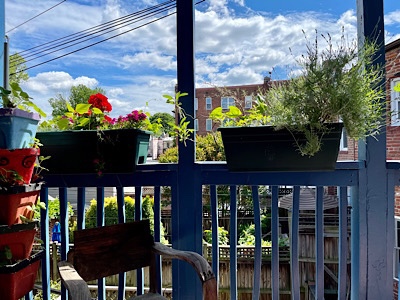
    After having at long last (years), had the back sleeping porch and deck repaired and improved, the garden has expanded to the sleeping porch. I’m trying beans, cherry tomatoes, and hops as trailing vines. It will be interesting to participate. Everything except the geranium and the strawberries were volunteers or plants outgrowing their space below.

    I’ve given away lots of starts and divides and have plenty more, as well as cuttings. Locals—let me know if you want some. Soon I will be fully vaccinated. If you will be also, we could even do some yoga.

  • | |

    Prana+Yama or Prana+Ayama (and Global Climate Change)

    The other day a friend commented that it seemed that a major contributor to global climate change is how we have set out to control our environment instead of aligning with it (my paraphrase).  So much, he said, of what contributes to global climate change is how we heat and cool and light our homes and work places.  For example, instead of honoring the change of seasons, we overcool in summer and overheat in winter, so that we can wear the same clothes and eat the same foods year round in apparent comfort.

    This comment resonated with me deeply.  It brought to mind what I have been taught about possible approaches to pranayama — the yoga practice of conscious breathing.  Pranayama usually as translated as breath control or restraint.  This assumes that the conjunction in sanskrit is of the two words “prana” and “yama.”  Prana here refers to the subtle energy of the life force in general, which we can understand best through the breath.  Yama means restraint.  If, however, we think of pranayama as the conjunction of “prana” and “ayama,” which is a reasonable way of looking at the way the word is formed, we can understood pranayama to be the practice of expansion or alignment with prana.

    When we seek with our yoga breathing practices on the mat or with our technology and lifestyles off the mat to restrain and control nature at the expense of listening and understanding, we will be at war with ourselves and the earth.  If, however, we seek to align better with nature on and off the mat, to expand and enhance our relationship with the life force, rather than to restrain and control nature, we will expand our awareness of the subtle forces of the earth and live in a more life-affirming way.

  • | | | |

    Thoughts on Sadhana

    In this realm we can be hit by a car. That’s why, though I see benefits to having some experience with a wide range of practice, I prefer to concentrate my regular practices to those that are designed to maintain compassionate and serene engagement with embodiment to those designed to renounce, escape, exempt or rise above the messiness, complexity, and, sometimes, trauma of embodiment.

    What about you? Perhaps you do not feel any need to examine this question.

  • | | |

    An Example of How One Door Closing Opened Another (and Article in Yoga Journal)

    I think snow can be beautiful and enjoy the hush when it first falls, but it’s not my favorite thing, which was one of the reasons I settled this far south (yes, DC is pretty far south for a native New Yorker).  Last winter with its record snow falls felt at times as a seemingly endless exercise in looking for the good and trying to respond in the highest.  Among other fallout of the snow, the February blizzard grounded my flight to San Francisco where I was supposed to go to celebrate the start of John Friend’s 2010 workshop schedule and to visit friends.  Instead, I was home shoveling.  With the arthritis in my spine and some other old injuries to groin and shoulder, I had to be extra careful with my alignment so that shoveling could be an enjoyable work out instead of a dreary and potentially debilitating task that I was doing instead of playing with friends and yogis in San Francisco.  Being grounded at home and needing to be in alignment with the shoveling, led me to blog about Anusara alignment for snow shoveling.  Putting this advice out there led to an editor at Yoga Journal discovering my blog and interviewing me for a short article that (I haven’t seen it yet–waiting for my copy to arrive in the mail, but a friend who was reading the most recent edition at Willow Street’s Silver Spring studio gave me the heads up last night) is in December’s magazine (page 22).

    While missing out on a vacation due to weather is not exactly a momentous disappointment or life challenge, this story is an example of how we never know what life is going to bring our way.  We cannot choose what life gives us, but we can choose how we respond, and how we respond will change how the path unfolds.  I persist in the yoga and meditation and share my teachings and experiences because it has been so helpful in opening my perspective and finding more delight and opportunity in life.  In that regard, one of the reasons I challenge myself on the mat, inviting myself into places of discomfort and effort and staying with them until I find ease and even delight, is to help me be able to see the good and to respond in the healthiest and most optimal way on and off the mat.  While I love sometimes just to do the easeful poses, what has brought more strength and joy to all of my life is going deep into the hard places and staying with them.

One Comment

Leave a Reply

Your email address will not be published. Required fields are marked *

This site uses Akismet to reduce spam. Learn how your comment data is processed.