Sightings Around Town

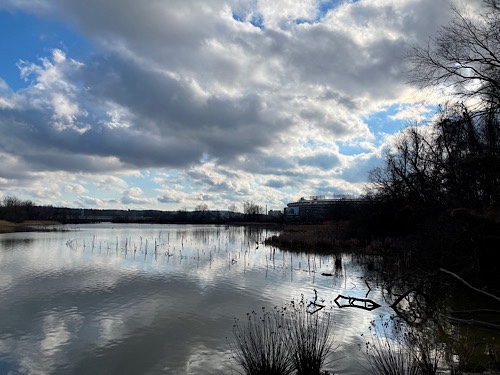
The river has been calling me.
Yesterday’s inaugural concert spurred all sorts of memories from me. When I was a child, we went a number of times to the Clearwater Revival Festival and other folk festivals where Pete Seeger was a headline. He is just ten years older than my Dad, and though my parents were not among those who became famous, they were hanging around the Village and my Dad was doing activist things at the same time. James Taylor’s “Shower the People” was a favorite when I was in junior high school. There was a boy from camp who played the guitar who I remember saying that “a little James Taylor goes a long way [towards getting a girl’s attention].” Bruce Springsteen, John Cougar Mellenkamp, U2, Bob Marley, Aaron Copeland, and the great oldies (played at the concert and listed as Obama’s top ten ipod songs), are part of the music of my high school, college, and law school years.
Not needing music or advertising to help me decide to vote, I didn’t pay much attention to how music was being used in the campaign. But here was the music, and it was mostly my music, too. The concert was very clever, designed to appeal to black and white, young and old, and populist — they were careful to have the performers whose oevre might not appeal to an older or younger crowd stick to songs with mass appeal.
Interestingly, it gave me an insight to those conservative guys from the middle of the country who said they liked W because he was the kind of guy they could hang with and have a beer. The concert was a concert I might have attended when I was in high school or college or law school. I had an insight about what it feels like to feel comfortable with the education and background of the President, but only up to a point. I enjoyed this trip down memory lane, but it did not impact my politics or how I would view the Presidency. There is a fine line between relating and agreeing, appreciating and accepting without question.
This ad, which I saw while I was riding the train to NYC last week, reminded me of a primary reason I practice yoga. The sincere yogin doesn’t negate the spaces between opportunities to vacation, but seeks to live fully each day.
It might be more enjoyable to play or adventure than to have a stressful day at the office on any given day, but I’d hate to think I am a better person only when I have vacated work and home.

As I get deeper into studying tantric philosophy I have taken the time to pause and reflect on how that philosophy originated and grew and who were the people offering and practicing the teachings. The tantric teachings I have received and offer are completely chaste. Put “tantra” into your favorite search engine, though, and you will see that people tend to think it is about intimate physical connection (my first euphemism). What is tantra? Is it one or the other? Is it something one can have without the other?
To help me think through and contemplate the issue, I read David Gordon White’s The Alchemical Body. I followed this with Lilian Silburn’s Kundalinia–Energy of the Depths.” What seems fairly evident–if you want the details, I invite you to read the books yourself (and also on sri vidya, Douglas Renfrew Brooks’ The Secret of the Three Cities)–is that despite the inclusion of those not twice born and women in the rituals, the community of tantrikas was no less sexist than more traditional society. The role of women in the secret rituals, as I have read it described, is one that would be wholly unacceptable to me in terms of equality, gender neutrality, and respect for women as human beings and not as archtypes and means to an end for male practitioners.
I did not get into the depths of knowing the historical details before I had been strongly drawn to the metaphysics of Kashmir Shaivism, which has been an integral part of my yoga studies. As I think about how a feminist, pacifist can find the universal teachings while still acknowledging the historical and social context in other texts such as the Bhagavad Gita and the Bible, it seemed given tantra’s rap in today’s society, I should see what my answer is for the tantric teachings as well. In thinking about the issue, I contemplated how I see the teachings in and out of the historical context (as you can see from the link to Swami Lakshmanjoo, the philosophical teachings are presented today without a hint the secret rituals).
I also asked the following, among other questions: How important is it for the student to take the teacher for the whole of the teachings and his or her human strengths and weaknesses? Is it ok to just really believe in one aspect of the teachings? Can we pick and choose what to learn and still be faithful to the lineage? Can we love and respect someone fully even if we disagree with his or her way or life and/or way of participating in society? Is extraordinary grace and genius enough to make what might otherwise trouble or even appall us seem irrelevant? Is it easier to come to terms with this issue for those teachers from different time periods or cultures and thus for whom our own choices or “modern thinking” might not have been available?
I think that the Wikipedia entry for Abhinavagupta, which mentions that the community would have engaged in secret (my spam-avoidance euphemism) ritual, but avers that “[w]e can only speculate about whether he was physically chaste, and either answer to this question is not very meaningful in the context of his life and teachings” gets it half right. It seems to me that it would be meaningful when looking at his life, but not of import in the modern receipt of the teachings. I think, for me, the very resonance of the philosophy and the practices with which I am familiar are not less meaningful for the historical concomitance of the hidden practices.