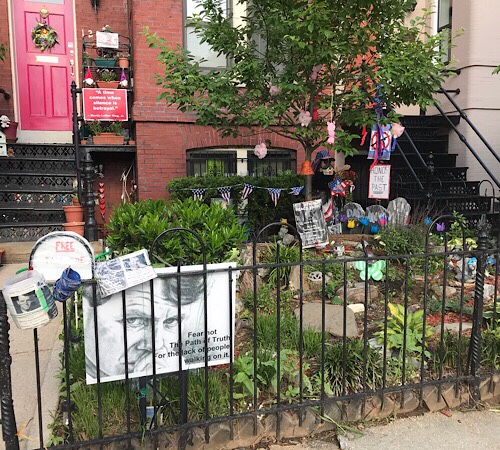
Found Objects Around Town

Sometimes, the best thing to do is nothing.
The past few days have been very full. Last week was an intense week at work. I am enjoying having a house guest and deepening a new friendship. The workshop sessions on Friday night and this morning with Amy Ippoliti at Willow Street were wild and rich with information and play. I always enjoy teaching my two Saturday classes. Among all this activity, I hosted a little dinner party last night, which was quiet, but bubbling over with conversation.
After the workshop this morning, instead of going right home, I rode to Dupont Circle and had brunch with a fellow yogini, after which we walked up to Columbia Heights through Meridian Hill Park. We had a fantastic time talking and catching up, and I loved doing a little exploring in a part of the city that is outside my usual haunts.
All of these activities were healthy and life enhancing, but still, it was a lot. Just as including savasana is critical to assimilating the benefits of a good yoga practice into the fabric of being, taking a nap this afternoon before having one more evening of visiting with my friend Elisa and my getting ready for a couple of jam-packed, demanding work days, the sweet rest of a Sunday afternoon nap was critical for me to allow all the delights of the weekend to settle and integrate, to feel rested and enriched, instead of feeling like I need another weekend to rest from the weekend.
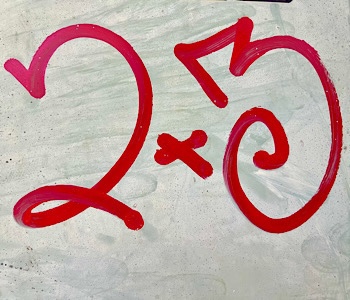
Invoking the pairs of opposites, the duos, and all the triads—how important they are in the stories we tell of spirit and creation and existence.
Having grown up in the New York metropolitan area without much in the way of traditions of any kind, I was not familiar with Hoppin’ John. I am fairly certain that the first time I heard of it was from a college friend whose family has been in South Carolina since before the Revolution. As it is not part of my tradition, I do not feel bound to any particular recipe (I am sure it is sacrilege in some circles to leave out the ham/bacon) or to eating it at any particular time of day (e.g., immediately after the clock strikes 12 midnight). It would not be Hoppin’ John, though, if I did not know its tradition and know where I was deviating from tradition. (Though this would entail a much longer blog than is within my time frame today, this balance of freedom from tradition and needing to know and honor tradition is very much an issue for the Western yoga practitioner.)
1. Soak a cup of dried black-eyed peas for at least several hours or overnight.
2. Dice one small onion or 1/2 large onion (about a cup), a few celery stalks, including the leaves, and mince a couple of cloves of garlic.
3. Heat a few tablespoons of a flavorless oil (peanut, corn, or safflower) in a pressure cooker (my preferred method for saving energy and time) or a stock/stew pot.
4. Saute seasoning vegetables along with a few hot peppers until onion is translucent. I used the last habanero from my harvest and so left it whole. You can use fresh or dried chilis in an amount to your taste/tolerance for spiciness.
5. Stir in a cup of brown rice until rice is coated with oil.
6. Pour in 1/4-1/2 cup of white wine and stir until absorbed (as if making risotto). [You could use stock instead. If you are using white rice, skip this step, which serves to partially cook the brown rice, so that it will take the same amount of time as the black-eyed peas.]
7. Crumble in some dried thyme (preferably from your own garden) and a bay leaf or two.
8. Drain and rinse the soaked black-eyed peas and stir into the cooking pot until all ingredients are combined.
9. Add one 28 ounce can of diced tomatoes and 2 1/2 – 3 cups of vegetable stock or water. How much liquid depends on (a) whether you want a soupy consistency or one more like pilaf or risotto; (b) how liquid are the tomatoes; (c) whether you are using a pressure cooker (less liquid needed) or cooking in a pot.
10. If using a pressure cooker, cover and bring to full pressure, then lower heat and cook at full pressure for 28 minutes. Allow natural pressure release (about 15-20 minutes additional). If cooking in a regular pot, bring to a boil, stir, then lower heat and cook for an hour or more until rice and peas are tender, stirring occasionally.
11. While rice and peas are cooking, mince a few cloves of garlic.
12. Rinse and chop several handfuls of greens (collard or curly kale are best; don’t use spinach or chard, they are too tender). Heat oil and garlic together. When garlic start sizzle, add damp greens and saute until greens are wilted and dry.
13. When rice and peas have finished cooking, stir in sauteed greens and bring back up to full heat. Adjust seasonings, adding more salt and your favorite hot sauce to taste (or allow guests to add their own hot sauce at the table).
I don’t know whether having eaten this will bring me luck and prosperity, but I’ve started the year with lots of vitamins, minerals, fiber, flavor, and cooking, which for me means health, love, technique, tradition, flexibility, and joy! Try this, make your own, read all about Hoppin’ John, or call a friend from the South who must eat Hoppin’ John on the New Year and learn about the tradition and what it means.
When I was walking to work this morning, I saw this man stretched out on the grass in Stanton Park. It was drizzling, but pleasant. I did not feel any need for an umbrella. The man was definitely breathing, and he had put some cardboard on the ground before lying down. Had it been sunny and had he been lying on a bench or a spread out blanket instead of on wet grass, I would not have wondered at all whether he might need help.
Would he want “help” that would include waking him up? Would it serve to call emergency services when his lying out in the rain did not seem like an immediate matter of life or death, though did raise questions about whether the man was ok? If all calling did was trigger police waking him and telling him to move actually have made things better for him? Because I could not answer these questions and because he had made himself the pallet of cardboard–leading me to think he had chosen the spot rather than fell, I decided to leave him be. I cannot know whether that was the right thing to have done.
This debate in my head did raise questions about the conundrums of offering charity and service and whether and when we can ever serve selflessly, unclouded by our own preconceived notions of what is right and good.

Peace and light, E — Posted with WordPress for BlackBerry.
Crescent moon at dawn
Like the one caught gleaming in
Siva’s matted locks.