Signs Around Town

Peace and light, E — Posted with WordPress for BlackBerry.
Peace and light, E — Posted with WordPress for BlackBerry.
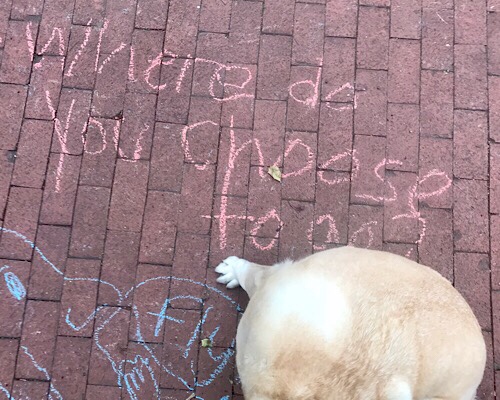
I stopped to take a photo of the question. This delightful dog would not move and insisted on attention. He finally moved far enough off of it to have it legible after he insisted I rub his belly. I guess I could have gone without a photo, but it was nice getting the canine love. His human was patiently bemused.
When I decided to make strawberry towers part of the new sleeping porch garden extension, Niraj Ray of Cultivate the City told me to remove all of the flowers until mid-May to allow the plants to develop leaves large enough to support sizable and sweet berries. He also suggested feeding them every time I water.
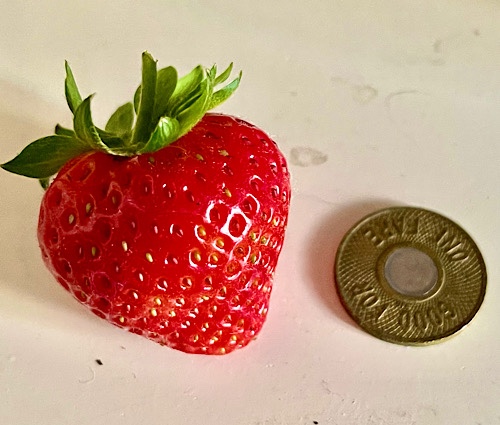
It has been a pleasure nurturing the plants and finally watching plump, juicy berries redden in the sun outside my study window.
Might this delicious lesson in the benefits of being patient be a lesson applicable to how and when and why to re-emerge post vaccination, but before the end of the pandemic?
We’ve had many inches of rain today, strong winds, and tornado warnings. This morning I got a call from my handy man that the drain under my back porch was stopped up and the basement was about to flood. He should not have been at the house. The work was supposed to have been done a couple of weeks ago, but a host of different occurrences got in the way. He only checked the back patio (he was working on something in the upstairs bathroom) because he had installed my rain barrel and wanted to make sure it was working properly (a story goes with that too). I left the office so I could go home and bail and monitor. The handy man wasn’t able to clear the drain with a snake, but bailing it out and then using the handle end of a rake cleared it out.
It is almost midnight and another band of heavy rain has been moving slowly through the area. I’ve gone outside a few times, but it all now seems fine. I’m hoping it will stay ok so that I can go to bed without worry.
I said to the hany man that his having been here today was part of the mysterious workings of the goddess of sequencing; it saved me from a flood in the tenant’s apartment. He said, that’s great, but it does not justify my procrastination. My point to him is that we never know when something that seems like a problem may turn into a blessing. His point to me is that just because things turned out for the best does not mean we can abdicate our personal responsibility for our own actions.
As I listen to a month’s worth of rain coming down in a few hours, I am reminded how lucky I am to have such things be my challenges, when so many are suffering.
Last night, at his workshop at Willow Street Yoga, Todd Norian discussed the niyama samtosha — contentment. “Perfect,” I thought, because I had been contemplating the practice of samtosha all day. When I had sat to meditate in the morning yesterday, it was hard for me to stay with my mantra or any sense of peacefulness, light, or delight. Thoughts of the horrendous repercussions of the Supreme Court’s decision on campaign finance kept arising. Time to get back to the foundations of practicing! As I began walking to work (past the Capitol), I brought myself back to the practice of samtosha, which I find one of the most useful practices for me.
Samtosha is the second of the niyamas set forth in Patanjali’s Yoga Sutras. The yamas and niyamas are ethical precepts for living and for practicing. In Patanjali’s eight-limbed, dualistic path of raja yoga, they precede the practices of asana (the physical postures), pranayama (breathing), and the various stages of meditation, which culminate in samadhi (equinimity or bliss). When I am struggling with what I witness in the outside world, I always come back to the practice of samtosha. Some people may be naturally lighter-hearted than others, but contentment is indeed a practice, and it is a foundational practice.
When I practice contentment, I remember to be grateful for all that I have. When I fully practice contentment, instead of becoming bleak and cynical (it is easy enough for me), I not only feel more naturally cheerful, but find I have have more strength to continue acting in accordance with my beliefs, even when I am confused, alarmed, outraged, and disgusted by what is going on outside. When practicing contentment, I try to find my own light, I seek the love and company of friends, I join with like-minded persons to be moved to work for change, even if I do not trust it will make any visible change to anyone other than me.
FYI, Todd Norian will be at Willow Street Yoga Center all weekend. If you are local and reading this in time, try to come for some of the weekend. He is wonderful.