Effulgence

Peace and light, E — Posted with WordPress for BlackBerry.
Peace and light, E — Posted with WordPress for BlackBerry.
Is it for the light shows,
Wild visions, strange and
Mysterious powers?
Or is it for the sweet spot
Within and beyond
And containing the very
Outrageousness of
Being still?

Peace and light, E — Posted with WordPress for BlackBerry.
Dear Friends,
It is Saturday morning of Independence Day weekend. I have sat for my morning meditation, watered the garden, pet the cats, and done a few errands around the house. In an hour or so, I will be heading up to Willow Street to teach my noon class. As I take the time to care for garden, cats, house, and prepare to teach, I have been contemplating the concept of freedom.
In the tantric shaivite tradition, we are taught that one of the key aspects of spirit is svatantriya — ultimate freedom. We are also taught that we are ourselves inseparable from spirit, just as a drop of ocean water is no less part of the ocean for being a drop. Spirit chooses, out of its freedom and play (lila) to embody itself in forms that are limited in space and time. One of our greatest sources of suffering is feeling bound, thinking that we are stuck with who and what we are in the constraints of this mortal body, with all its quirks, forgetting our own auspiciousness.
I could get grumpy about the need to do errands and to teach on a holiday weekend. I could feel constrained from my usual activities around town by the combination of single-tracking on the Metro and the influx of tourists for the activities on the Mall, the combination of which will likely add an hour’s communiting time to teach today and to do volunteer work in Georgetown tomorrow at the Lantern Bookshop. I could choose instead to be grateful that I have a house that needs caring, a garden to water, a class that gives me great joy and abiding satisfaction to share the incredible yoga principles that have so enhanced my own life, and volunteer work that I have enjoyed for over 15 years.
I am not going to be telling anyone that we are without limitation, being as we are in time and space. We are always and perfectly free, however, to choose to turn towards the auspicious, the light, the good, the uplifting, the highest or we can turn away. We can act in ways that bring us ever more in alignment with spirit , or we can act in ways that take ourselves and that in our orbit farther from the good. The more we exercise our freedom to turn towards the auspicious, the happier and healthier we will be, regardless of the fact of life in a mortal body. That choice is our true freedom and the way to our hearts.
To help you experience svatantriya, to choose freedom of heart, there’s nothing better than some free yoga. The weekend of July 15-17, Willow Street Yoga will be offering it’s summer free class weekend. I’ll be offering gentle/therapeutics at noon on July 16th in Takoma Park. Preference is giving to new students and to returning students who have brought new students with them.
For July at William Penn House, I’m offering a two-part freebie: (1) brand new students get first class free; please invite your friends and neighbors; (2) if you are an existing student who brings a new student with you, you get a free class when the new student comes back for a second class.
Have a wonderful Independence Day, however you choose to celebrate and see you soon.
Peace and light,
Elizabeth
Another opportunity. Another opportunity to soften, another opportunity to open to what is possible within limits as I attempt to work with yet another interface for the same blog. If the machines did not tell you, would you be able to tell the difference between an entry done on the laptop, the Blackberry, or the IPad? I have the most functionality on the laptop. The Blackberry and IPad apps are both missing key functions. As I start learning the IPad, I try to stay with a sense of openness and wonder at what technology offers instead of getting frustrated by learning curves and limitations. It’s yet another opportunity to practice yoga off the mat!
The latest batch of chilled infusion made with herbs just picked from the garden:
Peppermint, spearmint, lemon balm, licorice mint, fresh stevia.
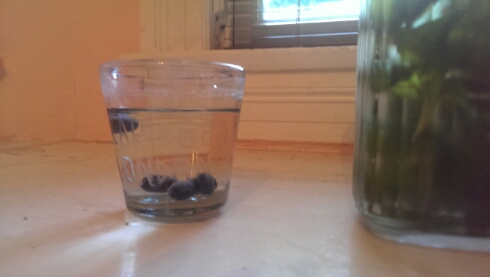
Served with a few blueberries just for fun.