The Primary Reason I Wish I Could Whistle
Sometimes there is little more cheering than singing (and, if I only could, whistling) along with Eric Idle.
Sometimes there is little more cheering than singing (and, if I only could, whistling) along with Eric Idle.
Yesterday’s inaugural concert spurred all sorts of memories from me. When I was a child, we went a number of times to the Clearwater Revival Festival and other folk festivals where Pete Seeger was a headline. He is just ten years older than my Dad, and though my parents were not among those who became famous, they were hanging around the Village and my Dad was doing activist things at the same time. James Taylor’s “Shower the People” was a favorite when I was in junior high school. There was a boy from camp who played the guitar who I remember saying that “a little James Taylor goes a long way [towards getting a girl’s attention].” Bruce Springsteen, John Cougar Mellenkamp, U2, Bob Marley, Aaron Copeland, and the great oldies (played at the concert and listed as Obama’s top ten ipod songs), are part of the music of my high school, college, and law school years.
Not needing music or advertising to help me decide to vote, I didn’t pay much attention to how music was being used in the campaign. But here was the music, and it was mostly my music, too. The concert was very clever, designed to appeal to black and white, young and old, and populist — they were careful to have the performers whose oevre might not appeal to an older or younger crowd stick to songs with mass appeal.
Interestingly, it gave me an insight to those conservative guys from the middle of the country who said they liked W because he was the kind of guy they could hang with and have a beer. The concert was a concert I might have attended when I was in high school or college or law school. I had an insight about what it feels like to feel comfortable with the education and background of the President, but only up to a point. I enjoyed this trip down memory lane, but it did not impact my politics or how I would view the Presidency. There is a fine line between relating and agreeing, appreciating and accepting without question.
Last week I went across town by bus to renew my expired drivers license and replace it with the real ID version. On the way home I visited a friend from work whom I haven’t seen in person since before the initial stay at home order. Then I left work early on Friday and went to see the Sonya Clark exhibit at the National Museum of Women in the Arts. The art was worth seeing, but it was overly crowded.
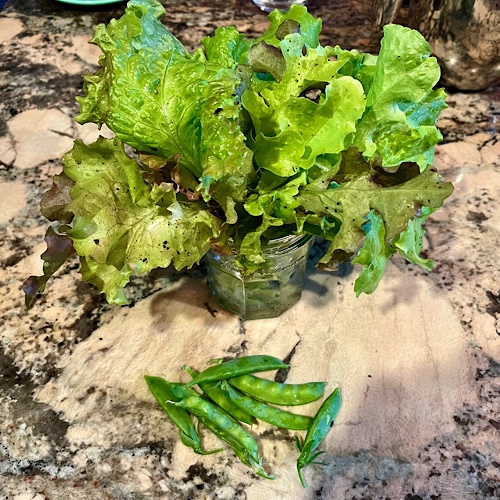
I spent the weekend with the garden and house and practices. Readying for what comes, but am sure I don’t want the old “normal.”

Looking up at the skylight, glad that I am only listening to and not out in the wind.
Later, I will bundle up, as if getting ready to go trekking in the Arctic, to open the space for contact improv jam and dance.

Peace and light, E — Posted with WordPress for BlackBerry.
A fundamental precept of classical yoga is that of vairagya or renunciation. The yogin is meant to gradually renounce all of the life of mind and body until he or she transcends them and sees only spirit. I have been thinking about how renunciation fits in with the holidays and how we, as a society, have come to celebrate them. As some indulge to excess and all sorts of tinsel trappings, others denounce the excess as taking away from spirit and renounce the whole thing. A reactive renunciation of the holidays wholesale because they are so commercialized can feel just as harsh as full consumption of the holidays, as marketed on TV, can feel bloated and unhealthy.
When we approach yoga from a tantric perspective, the practice is not geared towards vairagya. We seek instead to be fully engaged in life, trying to live each moment, taste each bite, breathe each breath, take each step as a way of connecting more deeply to the spirit. This does not mean reckless indulgence. It does not mean heedlessly consuming and taking into ourselves that which does not nourish ourselves or which harms other beings or the earth. Through practice and study, we develop viveka or discrimination, which informs us of what will enhance our lives and lead us towards a place of light and health.
In the context of the holidays, to make them truly holy days, the tantric observer will not reject holiday celebrations out of hand simply because they have generally become commercialized and often unhealthy. Rather, he or she will discern ways to celebrate and honor earth, family, friends, and self that are in alignment with nature and optimize the connections among them. This may mean picking and choosing how and with whom to celebrate, but always with honor and respect. This is an art that I am working on personally; sometimes it is hard to know where to draw the line, especially if co-workers or family are living in ways that do not feel nourishing for us. Then the game is to not seem Scrooge-like to those who think that the holidays are about lots of heavy food and shopping, while we are choosing to honor the season in another way.
Is this to protect the line or the person who might step on or over the line? When do boundaries and rules protect and enhance life and when do they arbitrarily, inequitably, or rigidly curtail it?

Peace and light, E — Posted with WordPress for BlackBerry.
This site uses Akismet to reduce spam. Learn how your comment data is processed.
Indeed.
I can whistle, usually.