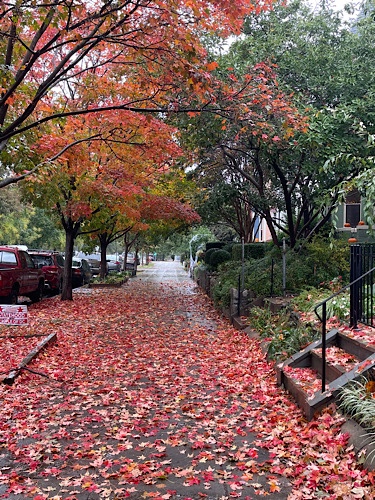
Happy Valentine’s Day
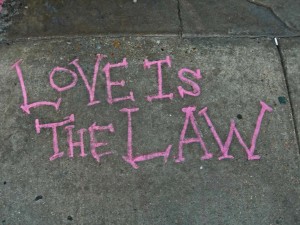
I have been cleaning out old files. Mostly I keep my drawers and closets relatively free of clutter and the unnecessary, but there are occasional pockets that have lived on because they were not a priority and neat enough. Found among postcards and letters from friends was one I received from a friend of a friend in October 2001. I never got to know her well. My friend has since moved out of the neighborhood and his friend moved back to Germany several years ago to start a family. Here is what she sent:
a picture from India [not shown] and a saying for you —
Live with intention
Walk to the edge
Listen hard
Practice wellness
Play with abandon
Laugh.
Choose with no regret
Continue to learn
Appreciate your friends
Do what you love
Live as if this is all there is.
A super sweet message. Now that I have shared it, I will recycle the original piece of paper. Thank you Uta. I hope all is well.
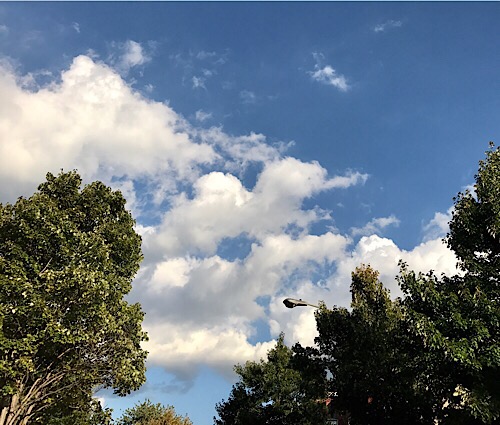
It’s unseasonably hot, we desperately need rain in my location, the air quality is poor, the air conditioning broke yesterday, the madness is on so many fronts it is easy to feel overwhelmed, but still, I pause to notice a heart-shaped cloud. And then write another email. And make another donation. And do a few calming poses.
Perhaps I would find more credibility in the map if the well-meaning creators of the “U.S. Peace Index” recognized that real human beings who wish to live in peace and who are U.S. citizens reside in the District of Columbia (though perhaps they are not included because local governance of the citizens of the District are subject to the whims and opinions of elected officials from both the most and least peaceful of states and thus are governed by the whole map). It is of interest nonetheless.
I returned home yesterday from teaching my Willow Street classes and having a late lunch with a friend to a message on my answering machine from my mother advising me that a cousin had died. Although I was not close to my cousin, her parents, my great Aunt and Uncle, were a significant part of my formative years.
As I made telephone calls and sent emails to get coverage for work meetings on Monday and care for the cats so that I could leave for New York, I found myself flooded with long-ago memories of my cousin, my family, and myself. I could also hear and feel old patterns surfacing, as they tend to do in such situations.
In counterpoise to the tumble of memory, I felt a strong pull to go into the space of meditation.
In the spaciousness, I no longer feel trapped by the inevitable consequences from the events giving rise to all those memories that have partly shaped my path. The light of consciousness itself, as the ground of the play and the illumination of inner space, begins to reveal the links and sequnces of the memories, the cause and effect, thus allowing me to see other ways to react. Instead of remaining entangled by trying to dismiss or reject or cling to any part of my history, I could see shapes, sequences, and opportunities.
At lunch, one of the things my friend and I had been discussing was the idea of bringing into “luminous spaciousness” our relationships. John Friend had invited us to think about that concept at the Teachers’ Gathering last month, and I have been contemplating the practice in a variety of contexts and discussing with fellow Anusara yogis what it would mean to them to bring luminous wisdom to relationship by seeking to create the true spaciousness we can find in our practice of yoga and meditation. I had talked about it previously with the friend with whom I lunched yesterday. She asked, “where was your blog entry on luminous spaciousness; I’d been looking forward to it.” “I haven’t found the right context for describing it that would convey what I think it means for my practice,” I’d replied. When I came home to my mother’s message, because I had been continuing both the contemplation and the dialogue, I was focused on the practice when I found myself in a situation where I really needed it. (Great reminder of the need for a steady practice).
I am now on the Long Island Railroad, heading to my parents’ house. Tomorrow we will go back into the City for the memorial service.
As I allow my thoughts to be stirred up–giving myself space, as it were to have natural mind processes–I seek space and light for myself in my relationship with my family to try and foster more love and clarity.
Last month, Sianna Sherman taught a weekend workshop at Willow Street Yoga. At the beginning of one of the segments of the workshop, she talked about the story of the monkey god Hanuman and his leap to Lanka (he did this to rescue Sita, who had been abducted by her own demons. Sita sent Hanuman back to India without her, asking Hanuman where was Ram, but that’s a whole different thread in the Ramayana.)
The first demon Hanuman encountered was Mainaka, a golden mountain who rose up out of the sea. She gave Hanuman a place to rest. She was helper. But she was also demon in that she wanted Hanuman to stay and rest with her and to give up his journey. Some of the stories characterize Mainaka only as a helper, and not as a demon. If Hanuman had become stuck in the comfort Mainaka offered, though, and failed in his journey, she would have been for him the demon of complacency. The question Sianna left with us to consider about Mainaka was where have we been too comfortable? Where do we need to express gratitude and appreciation, but move on?
The second demon, Surasa, was a fierce water serpent who emerged from the water to swallow Hanuman up as he was flying over the ocean. To escape, he first tried making himself so big that she Surasa could not swallow him, but she just opened her mouth wider and wider, gnashing at him with her razor-sharp teeth. Hanuman escaped by then shrinking himself to the size of a dust mote and flying out from between Surasa’s teeth. Being able to make himself immense was one of the powers he needed to be able to fight the various demons, but he needed also to be willing and able to make himself small to complete the journey. He would have been stuck if he had not been capable of taking on different shapes and approaching things from different perspectives. Surasa may have tried to swallow him up, but she also taught him perspective. “Are there places where you could use more perspective?” asked Sianna.
The third demon , Sinhaka, at least according to some versions, tried to eat Hanuman’s shadow. Inseparable from his shadow, the only way to escape was to turn back to face and claim his shadow as his own to battle Sinhaka. Running away would have just kept Sinhaka champing at his tail and dragging him back from success. We have to recognize and face our shadows in order to be complete and to understand the full spectrum of being. We were invited to ask whether there were particular fears from which we were running.
What stayed with me, and has me still thinking about the workshop, was that the emphasis was on treating ourselves and the obstacles we face on and off the mat with compassion. We often give lip service in Western tantra to seeing the good or the necessary in our demons. For example, whereas classical yoga thinks desire needs to be eradicated, tantra recognizes both that we would not get out of bed in the morning without it and that desire is what can lead us to practice and seek spiritual connection. When we can truly look at our demons (both our own personal ones and those we see in both wider and more intimate relationships), our demons are not evidently nor necessarily to be slain or eschewed or to be seen as only malignant or pestilent. When we approach our own demons and those of others with true compassion, we open the possibility of change through deeper awareness, connection, and recognition of humanity.