Similar Posts
Slow Cooker Granola (and Intentions)
It is my intention to write a newsletter talking about the shift in my life that is leading me, effective this week, to take a partial sabbatical from teaching yoga. I will still have my Tuesday night class at William Penn House and hope to see many on at least an occasional basis. I will also be available for single and group privates and expect to teach a workshop or two in the Fall. But after eight years, I will no longer be traveling up to Takoma Park every weekend, currently on Friday nights and before that Saturdays, to teach. In this shifting, I have much to say about Kali–goddess of sequencing–and moving within the limits of time and space and some other things beside.
In the meantime, while I am wrestling with how to say what I believe are among the things I want to express and as I deal with a bout of being very busy at work and spending far too much time at the computer to want to spend more time writing in the evening, I just want to mention that it is indeed possible to make decent granola in the slow cooker. I experimented with that today, in between conference calls and emails and document reviews (slow cooking, after all, takes very little consistent attention). The cooking reached its conclusion while students and I gathered for Wednesday night practice. More important than requiring little attention after the initial preparation stage, the slow cooker doesn’t heat up the kitchen, and I refuse to turn on the oven if it is going to be 80F or above. Slow cooker granola is an excellent compromise between no homemade granola in the hot months and turning on the oven.
When I’ve experimented some more, perhaps I’ll create a recipe, adding to the many dozens on the internet. My first attempt was relatively low fat and no refined sugar. Yum. And if you’re a local, do come join me this Friday for a sweetly nostalgic and celebratory evening of restoratives. 5:45pm-7:15pm, Willow Street Takoma Park. Drop-ins and make-ups welcome.
Friendly Thanksgiving Day Yoga Practice Returns
I’m delighted to advise that there will be Thanksgiving morning yoga practice. All donations will support those in need of sanctuary (sanctuarydmv.org).
Send a private message for more directions or questions about the practice.

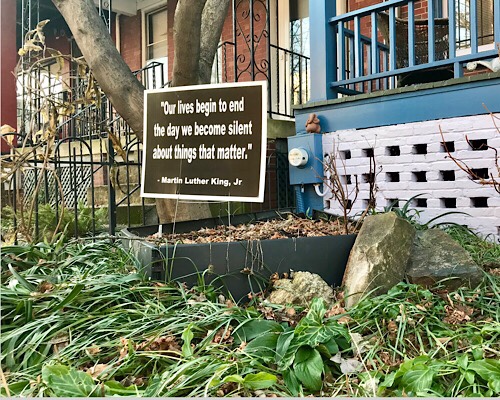
Signs and Symbols Around Town

US Capitol, August 3, 2021–Action in support of the Voting Rights Act Thought-Provoking Blog Post on Debate
Thanks to Professor Douglas Brooks for this thought-provoking piece on debate and yoga.
The Danger in Taking Instructions Out of Context (and Satcitananda)
Those of you who are regular readers may sometimes wonder why this blog, which purports to be about yoga, only on the rarest of occasions goes into any detail about the physical alignment principles for asana. I just received a comment on a post that I wrote several months ago that reminded me of my conviction that the optimal place to discuss and practice physical alignment principles is in class. This conviction is not because there isn’t value in reading about the alignment principles–I look at the Anusara Teacher Training Manual on a regular basis–but because it is critical to understand the bigger picture, to have a loving eye on the alignment, and the opportunity to ask questions right away, which we can only get when we practice with a teacher. In this instance, the commenter said in response to a post in which I had indicated that “thighs out” was shorthand for part of inner spiral that she had heard that “thighs out” in the common Anusara alignment instruction “shins in, thighs out” was just hitting the thighs apart and was something separate from inner spiral. Would I mind clarifying.
I found the comment timely as I was recently at a workshop where the teacher had noted the injuries that can flow from overdoing an isolated action that is intended to describe one part of an element of the basic principles of alignment (in that case “taking the armpit back.”) I agreed with the teacher that just jamming the armpits back can stress the shoulder and limit freedom if it is done in isolation and as the first action in a movement involving the shoulder girdle. It can be an incredibly helpful alignment instruction, though, if the students recognize (as reminded by the teacher) that we don’t take the armbone back without first opening to grace, including softening and expanding and making the “inner body bright” and also practicing the movement in a way that recognizes the point of the instruction is to encourage students to integrate the head of the armbone into the shoulder socket by means of muscular energy.
Like taking the armbone or armpit back, I do not believe that taking the thighs apart should ever be treated as an isolated point of alignment. It should only be done in proper sequence and in proportionate action to the amount the yogi is able to work the other principles. “Shins in” should not be done without first opening to grace, including softening, expanding, listening to the body, and establishing a good foundation. It is also only one of the three aspects of muscular energy. “Shins in” is just one way a teacher might tell students to apply the principle of hugging to the midline, but the student should not neglect hugging the muscles to the bone or drawing energy from the periphery to the focal point of the pose just because the teacher only cued “shins in, thighs out.” After all, there are only so many words that can be said in a single class and only so much on which we can focus at a time, but that does not mean we should be neglecting the basics as we seek to become more refined in our practice. Just as “shins in” is only part of muscular energy, the companion shorthand instruction “thighs out,” emphasizes just one aspect of inner spiral — that which serves to broaden the broaden the pelvic floor by means of the movement of the thigh bones. That does not mean that it is independent of the other aspects of inner spiral–spiraling inward and expansively from the feet upwards and taking the thighs back, both of which sequentially come before the “apart.”
Wow. For those of you who read this for the gardening or cooking or to enjoy the photographs, this level of detail might seem mind-numbing. Part of the danger of getting into the weeds in writing about alignment is just that. Not only is it distancing, but it gets educated readers into a space of debating the finer points and wondering whether things have been said just right. It becomes far to easy to lose sight of the point of yoga in the first place, which is to bring us joy on and off the mat. Remembering the intention to cultivate joy (ananda) when we are practicing actually physically protects us from getting in trouble by over-efforting with regard to one small aspect of alignment. When we are (sat) consciously (cit) in the moment with an intention to cultivate bliss, then we are much less likely to do any physical action so hard or so precisely that we forget the big picture and how the principle or the pose fits in with the overall flow and alignment principles and do more harm than good.