|

Take a Moment (and be in it)

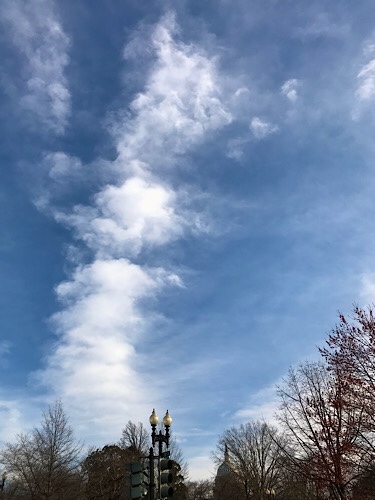
On unexpectedly beautiful days like yesterday, I make sure that I get out during the workday.  I’ll ask a co-worker, “did you go out?”  Often the response is, “I couldn’t go out; if I went out, I wouldn’t have wanted to come back in.”  This is not an uncommon response.  I so treasure the spaces of delight in the midst of any day, that it is hard for me to appreciate that response on an emotional or visceral level.

But what my co-worker is saying is that she will get so caught up in longing (pain) that pleasure for a short time is not worth the pain.  Thinking about it in that way, I understand.  Patanjali cautions us not to get caught up in the “pairs of opposites,” pleasure and pain.  Both the longing for pleasure and the avoidance of pain take us out of the moment and make it hard for us to connect to the essence of being.  If we are always yearning and avoiding, we cannot rest in the bliss of being.

When we take a walk outside, or stop to eat a nourishing lunch, or pause for five minutes to meditate during the work day, it will only have fleeting benefits if we do it just for the pleasure.  If we can consciously bring ourselves into the moment and simply rest in our own being, then it will help us just be (in the state which is free from pleasure and pain/longing and avoidance) while we are in the whirlwind of activity and challenges of our day.
Similar Posts

  • | | |

    It Takes a Snowflake

    It is almost inconceivable to my limited mind how many snowflakes it took to whiten our world yesterday morning.  This weekend, there will be far more snow (alas, it will be too cold to stick to the trees and create such a beautiful canopy; instead we will have howling winds and heavy going).  I might catch the first of the snowflakes tomorrow morning on my walk to work before the storm really comes in with all its wild fury.  When there are only a few, it is easy to see the individual flakes.  Once there is a storm, though, we tend only to see the storm.

    Just as it is hard to remember that the snow is about both each individual flake and the whole snow fall together, we forget about the simultaneous place of ourselves as individuals as part of the whole, or we get caught up witnessing ourselves as individuals and forget that we are all a part of a much vaster energy.  The reality is that we are all both all of the time — we are completely individual and part of a vast, interconnected web.  When we can remember and witness both aspects of ourselves, then we can most deeply witness, participate in, and appreciate the extraordinariness of being.

  • | | | |

    Balance of Stability and Freedom

    Last night, we were talking about the parameters of cultivating a steady and fruitful meditation practice, and Paul Muller-Ortega suggested that it was about the balance of stability and flexibility. He had learned the principle from a different source, but I have contemplated and explored the principle in depth from teachings I have received from John Friend.

    A critical aspect of the Anusara alignment principles is to find the perfect balance of stability and freedom. We need stability to stay fully and safely in each pose. We need freedom to achieve the fullest and most delightful expression of the pose.

    We find the stability both by making certain that we have established our foundation (which is an aspect of the first principle of opening to grace). By then using the three aspects of muscular energy–hugging the muscles to the bone, drawing into the midline, and drawing energy from the periphery to the focal point, we make possible an expansion of our edge, whatever that might be. Having a solid, aligned foundation and affirming our very core with these actions, gives us security and balance. We also want to reach out, to be playful, to expand to our fullest, which we do using the expansive, outreaching organic energy — from focal point to the periphery, from the midline to our outer edges, from the very marrow of our bones through bone, muscle, skin, and beyond.

    If we over-emphasize (including natural inclination) stability, then we can get stuck. If we just let ourselves be free, then we end up all over the place. When these elements are perfectly balanced, we can safely find our deepest freedom of expression.

    When I teach this principle as the focus of a class, I always invite my students to think of how important the balance of stability and freedom is for every aspect of our lives.

    The discussion last night put this principle in the context of the regularity and steadiness of our practice, with the recognition that to stick with our practice, we will sometimes need to vary the time or amount of our practice, or what elements are included in the practice.

    To get the fullest benefits of a practice (this applies to any practice and not just to meditation), we need to show up consistently and to practice in accordance with how we have been taught. To stay steady, though, we need to give ourselves the permission or freedom not to show up, or within appropriate parameters, to modify the practice when life gets in the way of what we think would be the ideal practice. If we think we have to do things at the exact time and place every day in a perfectly precise way, we become rigid. On the other hand, if we are loosey-goosey about it, then we do not have much of a practice and will not realize the benefits that we could get.

    Where in your practice or life would more stability and steadiness give a field for greater freedom and happiness? Where could you give yourself a little more flexibility so that you feel that steadiness brings the possibility of joy, rather than tying you down?

    Peace and light, E — Posted with WordPress for BlackBerry.

  • | | | | |

    View from the Window (Rainy Day)

    Afghanistan Lebanon Dreamers Haiti

    Wildfires Hurricanes Earthquakes

    Ebola Plague Delta-Variant

    Vaccine Refusers

    Etc

    As long as I am well fed in my comfortable home, far better, when I am not actively working/serving, to garden and meditate and study and try to create some joy than to wallow in hopelessness. And make a little art to remind myself of beauty.

Leave a Reply

Your email address will not be published. Required fields are marked *

This site uses Akismet to reduce spam. Learn how your comment data is processed.