On the Way to William Penn House for Tuesday Night Yoga Practice

My boss with whom I’ve worked for over 20 years and who has an unfortunate tendency to get agitated (gentle understatement here) at the workplace has just discovered Thich Nhat Hanh. My boss was intrigued by Thich Nhat Hanh’s suggestion that when you find yourself getting angry, “don’t.” Knowing that he is still going to have to take action in response to the things that tick him off (and, as I would add, that not getting angry is distinct from disengaging, failing to act, or being apathetic), my boss still invited us to say to him when we see him getting worked up, “remember Thich Nhat Hanh.” I liked that. I like that he recognizes a need to change and grow and is starting to take steps after years of appearing not to be aware of the impact of his tendencies on himself and his co-workers.
One of the best ways I know to shift our reactiveness is to develop a steady meditation practice. If you don’t already have one, I invite you to begin to develop a daily meditation practice, which could include conscious breathing or visualizations. If your practice is only sporadic, notice how much better it is when your meditation is part of your daily routine.
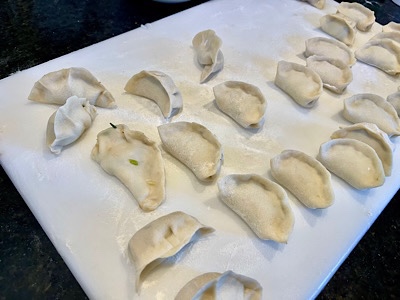
Last Monday I had the honor and delight to be invited to a multigenerational dinner of homemade dumplings at a neighbor’s house.
I was told it was customary for guests to shape a share of the dumplings; the hosts do everything else. As I have not grown up making dumplings as part of group family activity, that meant I needed first to be shown what to do with the already made dough and filling.
Skills used to make homemade noodles, tortillas, and pizza helped make dumpling shaping an accessible activity. It was tricky at first. Two people were showing me two different ways, which was somewhat confusing in an enjoyable way, and helped emphasize that for friendly dumpling making, ultimately, everyone needs to find their own method that works for them. Also, as with many hand skills, because it was the first first time I was being shown, I was simultaneously transposing it from right to left-handed.
It only took two tries to get a dumpling that wouldn’t explode in the pot and lose its filling. It took several more to make one that had nice pleats and blended in with the rest.
We had an interesting discussion about the difference between learning by eating several variations and then reading several recipes and then trying to replicate a version that resembled what I had eaten prepared by someone who learned from childhood as part of a multigenerational group process.
I have long contemplated, and continue to do so, how my comfort in learning anything from a book and then seeing if I can do it or something like it, has shaped my meditation and movement practices.
It’s pretty easy to see which dumplings I made. No difference in taste. I was also happy to contribute garlic chives from the garden.