Similar Posts

  • | |

    Negation, Affirmation (and a new yard sign)

    I went to a delightful brunch yesterday hosted by friend and neighbor K, who lives on the other side of the Hill.  A number of the guests turned out to live within a couple of blocks of me on the Northeast side.  In describing my house to those who lived farther from the Capitol than I (knowing my block was part of their usual walking path), I said, “mine is the one with the ‘War is not the answer‘” yard sign.  “Oh yes, I know which one it is,” was the uniform response.

    K said she did not have the yard sign because she did not want a negative message in her front yard.  It served its purpose for a time, she claimed, but she wanted a more positive message.  I replied that if the sign said “peace is the answer” it would not have the same p0litical meaning.  People would just think, “yes, peace is nice, but whatever,” and keep walking.  We all agreed that was likely, but I left still thinking about the conversation.

    One of the reasons K gave for wishing to turn the sign on its head, was she did not want something renunciatory, and she referenced the principle of “negation” in Buddhism.  I knew what she meant.  Advaita vedanta has a phrase, “neti, neti” or “not this, not this” which means extinguishment of the individual self and a life of the senses and mind to unite with the ultimate Spirit.  The Buddhist “nirvana”  literally means “void.”  I did not engage the conversation in such a way as to bring it to tantra lest I go too far in the direction of yoga geekiness, but the conversation certainly led me to think in that direction.  Tantra seeks to do exactly what K was seeking:  to turn the phrase, “not this, not this” into an embrace that will reveal truth and light by means of affirmation rather than negation.

    Interestingly, though, I think a possible inspiration for K’s yard sign dilemma could come from from Buddhism:  metta meditation (note:  I have been offered this meditation in various settings and have practiced it many times, but it is not my regular meditation practice, so I hope I am not misinterpreting or mischaracterizing it here).  The theory behind metta meditation is to distance one from anger to cultivate calm.  In this creation of calm comes a general demeanor of loving kindness and compassion.  I personally become calmer by embracing and aligning with all my emotions, including grief and anger, but still find the languaging of the metta practice beautifully inspiring.

    In that spirit, I suggest as a possible rewording of the yard sign that still serves the political message, the call to serve:   “may all beings be free from war.”

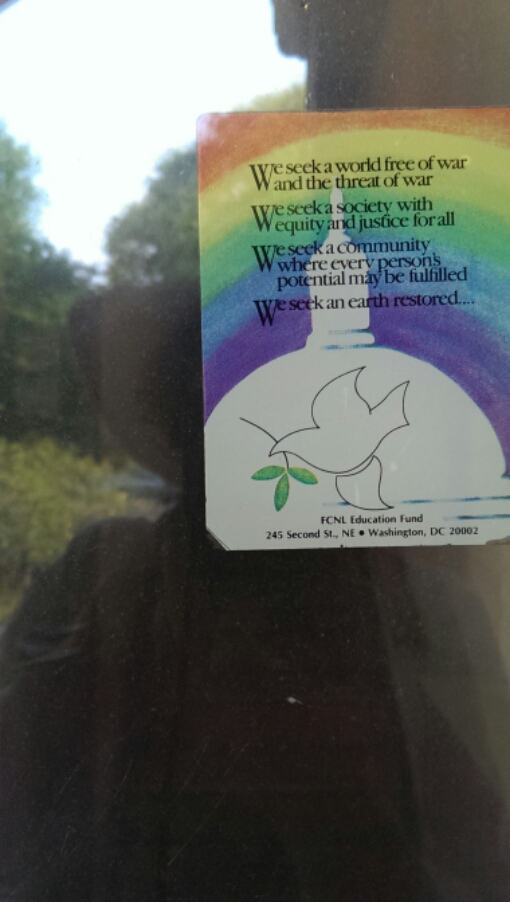
    Or maybe FCNL should make a sign with the query:  “what do I do in my life to remove the causes of war?” Is that still a negative, if we are calling for positive actions to remove causes?

  • | | |

    Learning From Our Demons (Hanuman Leaps to Lanka)

    Last month, Sianna Sherman taught a weekend workshop at Willow Street Yoga.  At the beginning of one of the segments of the workshop, she talked about the story of the monkey god Hanuman and his leap to Lanka (he did this to rescue Sita, who had been abducted by her own demons.  Sita sent Hanuman back to India without her, asking Hanuman where was Ram, but that’s a whole different thread in the Ramayana.)

    The first demon Hanuman encountered was Mainaka, a golden mountain who rose up out of the sea.  She gave Hanuman a place to rest.  She was helper.  But she was also demon in that she wanted Hanuman to stay and rest with her and to give up his journey.  Some of the stories characterize Mainaka only as a helper, and not as a demon.  If Hanuman had become stuck in the comfort Mainaka offered, though, and failed in his journey, she would have been for him the demon of complacency.  The question Sianna left with us to consider about Mainaka was where have we been too comfortable?  Where do we need to express gratitude and appreciation, but move on?

    The second demon, Surasa, was a fierce water serpent who emerged from the water to swallow Hanuman up as he was flying over the ocean.  To escape, he first tried making himself so big that she Surasa could not swallow him, but she just opened her mouth wider and wider, gnashing at him with her razor-sharp teeth.   Hanuman escaped by then shrinking himself to the size of a dust mote and flying out from between Surasa’s teeth.  Being able to make himself immense was one of the powers he needed to be able to fight the various demons, but he needed also to be willing and able to make himself small to complete the journey.  He would have been stuck if he had not been capable of taking on different shapes and approaching things from different perspectives.  Surasa may have tried to swallow him up, but she also taught him perspective.  “Are there places where you could use more perspective?” asked Sianna.

    The third demon , Sinhaka, at least according to some versions, tried to eat Hanuman’s shadow.  Inseparable from his shadow, the only way to escape was to turn back to face and claim his shadow as his own to battle Sinhaka.  Running away would have just kept Sinhaka champing at his tail and dragging him back from success.  We have to recognize and face our shadows in order to be complete and to understand the full spectrum of being.  We were invited to ask whether there were particular fears from which we were running.

    What stayed with me, and has me still thinking about the workshop, was that the emphasis was on treating ourselves and the obstacles we face on and off the mat with compassion.  We often give lip service in Western tantra to seeing the good or the necessary in our demons.  For example, whereas classical yoga thinks desire needs to be eradicated, tantra recognizes both that we would not get out of bed in the morning without it and that desire is what can lead us to practice and seek spiritual connection.  When we can truly look at our demons (both our own personal ones and those we see in both wider and more intimate relationships), our demons are not evidently nor necessarily to be slain or eschewed or to be seen as only malignant or pestilent.   When we approach our own demons and those of others with true compassion, we open the possibility of change through deeper awareness, connection, and recognition of humanity.

  • |

    The Earthquake v. Hiroshima

    We hear the stories of a the tragedy unfolding in Japan, and our hearts cannot help but cry out.  This is a wonderful aspect of humanity.  A friend sent me an insightful article from Caroline Myss in which she very articulately lets all her readers know why we need to work to ensure that we do not have nuclear weapons (and, I would add, new nuclear power) with which I wholeheartedly agree.

    The unfolding tragedy also drives home for me how important it is that we speak out against the wars in Iraq, and Afghanistan, and on the verge in Libya and for sustainable environmental policies.  On the 11th of March, I wrote this in my journal:  “Mother Nature is wild and fierce no matter how much control we try to exert.  I pray that a nuclear disaster does not follow.  U.S. military is working with [later note:  I think that was just an offer] the Japanese to share experience and skill to get in back up power to bring water in to cool the reactors.  Peaceful military work, I am behind.  Some fearful reflection of Hiroshima.”

    My question is this:  why are we sending money to those living in the third largest economy in the world (Japan’s own citizens are reportedly wondering why their government is not doing more to help–sort of how people like us wondered and may still be wondering about the lack of assistance from the government of our wealthy country after Katrina)?  We are denying money on a societal level to help those in the poorest countries or perhaps are not making offerings on an individual level (or not speaking to our elected officials about such topsy-turvy, anti-compassion policies?)  Why do we send our hearts and prayers to those suffering from a sudden natural disaster, but forget to do so for the tens of thousands and their families our own country has killed or wounded?  Why do we spend or allow to be spent in our name billions on killing, but let it be determined that we do not have millions on aid for the suffering or for enhancing life through the arts, education, taking care of our cities, our parks, the natural beauty around us?

    I, like all of you, am filled with a sense of horror and loss and love and compassion and an impulse to help.  How I am choosing to use the energy of my upsurge in awareness of suffering from the unfolding disaster is to give more than I usually give to organizations that work to heal the environment and to prevent new damage by virtue of the current political policies, to seek the end of war, and to give humanitarian aid to the poorest of the poor who are dying and suffering every day at home and around the world in numbers far exceeding the sudden loss in Japan, and to support the increase in light through the arts and education and parks.

    What do you think is the best way you can transmute the natural compassion you have been feeling from reading the news of Japan into making the world a better place?

  • | |

    Asta Vakrasana Variation

    I was working with photos today and came across this shot a friend took a little over a year ago.  Long gone is the memory of exactly why I did not stay fully in the pose.  Perhaps this was the beginning, and I was planning to plant my hand, lift my shoulder and hug my shoulder blades onto my back, and then do enough inner spiral and kidney loop to float off the ground.  Possible, as I have been known to get into asta vakrasana going from the ground up.  More likely, my exit strategy of the moment was releasing all the way to the floor.  What I like about this picture is that it shows me having a really good time, not me being a failure for not being perfectly in the pose.  Though it is always worth striving for the best we can do, for most things in life, the best we can do is try for the full pose and then find the joy and the beauty when we don’t end up embodying our notion of what should have been.

Leave a Reply

Your email address will not be published. Required fields are marked *

This site uses Akismet to reduce spam. Learn how your comment data is processed.