Art and Culture

  • | | | |

    Web Version of Hot Summer E-Newsletter

    Dear Friends,

    Recent newsletters I have received from well-known yoga teachers, in addition to sharing their wonderful offerings and teachings about yoga, have included references to the Gulf Oil Spill, the on-going economic crisis, and the humanitarian tragedies in Chili and Haiti and elsewhere.  The information is presented as showing what yoga can do to help us better serve those in need, seek change in ourselves and the world around us, and find our own light in the face of things we cannot change, but these teachers are no longer keeping quiet about the presence of serious turmoil and tragedy.

    As one who has been outspoken (perhaps too much so) about such issues in the context of yoga, as those of you who follow my blog know, it seems that it is no longer possible to be silent.  We are all familiar with adages, “silence is golden” and “silence speaks louder than words.”  We are also invited, as yogis, to observe the four gates of speech to the best of our ability, on and off the mat:  (1) is it truthful?  (2) is it necessary? (3) is it the right time? and (4) is it said in a kind manner?  These gates are important for evaluating individual utterances.

    For the past couple of weeks, I have been thinking about turning the “four gates” on their head, turning them upside-down in the tantric tradition, and asking how they apply to silence.  When we are silent on an issue, on something that moves us, on something in a relationship that is important to us, are we being true to ourselves to be silent?  Are we being honest by saying nothing (for saying nothing is, indeed, saying something)? Is staying silent timely or is it truly timely to speak up (using the four gates as guidance on how to speak up?); is being silent kind–we’ve all done it ourselves or experienced cold or hostile silences?

    For me, more than ever, it is no longer the time to be silent.  We must speak for the light, for action, for aligning better with nature, for deepening community, for enhancing the subtle energies that will help us heal and grow and shift society.  As long as we are not practicing true “renunciate” yoga–giving up family, friends, shelter, and creature comforts, but instead are practicing the yoga of those still engaged in “regular” life, then we need to become more and more sensitive to how we can joyously affirm life, but passionately engage in seeking change that makes the light more available to all, while still going about our daily business.  This is a razor’s edge balance.  It can be so difficult to live consistently with our ideals, to speak and act in truth and kindness for ourselves and others the ideal all of the time.  Our yoga invites us to cultivate and celebrate our strengths, to affirm ourselves and then to expand.  Expansion can be intensely challenging and sometimes as much painful as exhilerating, but I think it is worth it.

    This summer, in classes, I will be inviting all to join me in the questions I am exploring for myself:  what is my intention?  How can manifesting my intention make life sweeter for myself and those around me?

    Join me for both class offerings and a special workshop up at Willow Street.  William Penn House classes continue with special pricing for public interest workers, students, seniors, and those with other challenges.  A portion of the proceeds from every student goes to support William Penn House’s work.

    At Willow Street, the Saturday morning class has changed:  it is now a “Fusion Flow” from 8:45-10.  What’s the difference between the flow class and Level 2?  We’ve already been doing a slow flow, but there will be fewer breaks, and more time for silence (a timely, nurturing silence), for students to get into their own groove to work towards manifesting their intention.  We will have music most times to bring in a stronger sense of the dance, but I will continue, as always, to emphasize healthy alignment for the class as a whole and be responsive to questions.  Gentle/Therapeutics is at noon as usual.  There’s a free class weekend up at Willow Street where I will be teaching both types of classes on July 17th in the Takoma Park studio and Gentle/Therapeutics in the Silver Spring Studio on Sunday July 18th.  The summer session starts on July 24th.  Those who sign up for a class and a workshop simultaneously, get a $20 discount.  For more information or to register on-line, please visit www.willowstreetyoga.com.

    Want a siesta-like retreat from the heat?  Ready for some relaxation and self-nurture?  Treat yourself to two blissful hours of restorative yoga poses for a sweet afternoon retreat without all the travel!  All levels welcome at the:  Summertime Restorative Extravaganza, Saturday, July 31, 2010, 2:30pm-4:30pm, Willow Street Yoga Center, Takoma Park.  $35.

    As always, feel free to email me with questions or comments or join me on the blog:  www.rosegardenyoga.com.  Just FYI, we’ve fixed the issues with subscribing to the blog.  If you haven’t already, just hit subscribe on the home page, follow the instructions, and then get an email in your inbox the day after I’ve posted a new blog entry.

    Hope you are all having a great start to your summer and look forward to seeing you soon.
    Peace and light,

    Elizabeth

  • |

    Amy Ippoliti’s 30-Day Yoga Challenge

    Anusara yogini and teacher extraordinaire, Amy Ippoliti, started a “30-Day Yoga Challenge,” which she updates monthly, for students and friends who are her Facebook friends.  For the past several months, the challenge has been to work towards some very challenging poses (how appropriate for a challenge).  This month Amy invited students to practice without air conditioning, or for hot yoga practitioners, without extra heat.  Granted, she is based in Boulder, Colorado, where it is not 101F today, but she speaks my mind.  Whenever people have asked me what I think about hot yoga, I have answered that it serves some people very well, but I always find myself asking the question, whence is the heat coming and will it enhance my yoga to change the room temperature if I need to burn fossil fuels to practice?

    Why is practicing without a technologically altered environment a yoga challenge?  Have you ever found that if conditions aren’t right, you think you cannot do your practice?  If we are truly practicing with commitment, then what we want to do is to find the practice that will fit the environment (including not just the outer environment, but the state of our mind and physical well-being) on any given day, even if it means that the practice will not meet our expectation of what our practice should be.

    When we practice steadily and listen to the teachings, one of the things yoga teaches us is how to be more sensitive to our environment and to what we put into our minds and bodies.  A friend complained of being terribly sleepy the other day.  I said it was the heat; look at your pets; don’t you notice that they are sleeping more in the heat?  What practicing in accordance with the ambient temperature means (or eating or sleeping or dressing or engaging in leisure activity) learning better how to align with the energies around us, including being sensitive to how we would optimally practice in the heat.  As yogis, I believe that what we want, ever more deeply and more profoundly, is to live aligned with nature and our own being in it so that we can find better recognize the fullness and the light of being whatever challenges arise.

    I’m doing a modified version of Amy’s challenge here in DC this week:  at the William Penn House, I’ll take whatever air conditioning is on (which, for those of you who are wondering, can be pretty nice and cool since it is the ground floor).  At the house practice, I’ll keep the house at the same 80-82F I typically keep the house when it is over 90F outside; I won’t lower it because I am practicing, but we won’t be having it over 90F.  At Willow Street, I’ll go with the flow.

  • | |

    Happy “Independence” Day

    I received a half dozen emails over the past week from various sources inviting me to think about what Independence Day, and correlatively, the Bill of Rights and the Constitution, mean to me? What does the Bill of Rights mean to a progressive, feminist, environmentalist (contrasted, for example, with someone whose life passion is to prove that true freedom is the right to carry a gun)?

    When was the last time you thought about the Bill of Rights?  What does it mean to you?  Does it have a different meaning for you as an individual and you than as part of a collective?

  • | | |

    Darshan or Puja?

    The other day I was telling one of my regulars that I’d described the group house practice as starting with receiving darshan — receiving sacred knowledge, sitting in the presence of the divine embodied in a great being — from Uma and Sully, who wait downstairs for the students to arrive and expect a petting before everyone goes upstairs to practice.

    ” Is it darshan or puja [performance of ritual worship]?” my student asked.  The two are intertwined.  We naturally offer our gratitude and worship for those in whom we recognize the divine and from whom we learn to know the sacred.

    What would our lives be like if we treated all our encounters and relationships as both darshan and puja, if we came to each person and being open to receiving a glimpse of the divine and the knowledge the divine imparts and approached each encounter as an opportunity to make puja, to formally act with reverence?  The cats certainly expect it.

  • | |

    IRS (and Opening to Grace)

    It is a gloriously cool and breezy morning of the type that is common for New England and very rare for DC, especially heading into Independence Day weekend. I had a longer and earlier walk than I usually do. I have an early morning meeting at the Internal Revenue Service.

    As I walked down Constitution Avenue past the museums and federal buildings, I wondered how many of the hundreds of millions of people whose lives are impacted by the IRS ever think of it as a building with real, live human beings working inside of it.

    It can be tremendously difficult to see a broader perspective when faced with things that cause us burden, obligation, or challenge. One of the key reasons to practice yoga, and in Anusara yoga to practice (it is indeed a practice we have to work on) opening to grace, is to recognize our humanity and the light in all things so that life feels more beautiful even when we are struggling.

  • | |

    Shiva Lingam?

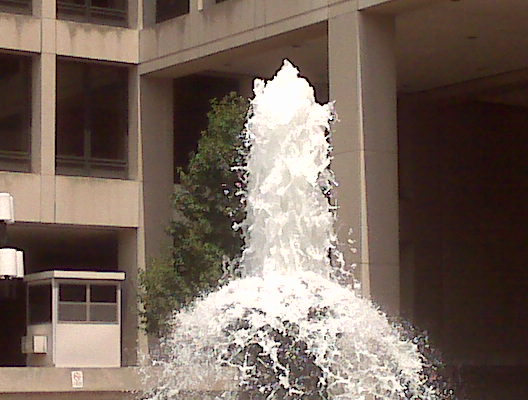
    This fountain is at the main entrance (not on the Mall, but around the corner) to the Department of Labor. It is only on every once and a while, and I do not usually use this entrance, so the fountain is not a main part of my relationship to the building.

    One day, a couple of years ago, when I was sitting quietly near the fountain to get some soothing energy from the sound of the water and being outside, I thought about how much it resembled a shiva lingam. Was I seeing symbols that were not intended? Was the artist pulling one over on the government by submitting a design that carried symbolism that, in 1974, would not have been acceptable to many in charge? Was the symbolism there and understood when the design was permitted to be implemented? Do the answers to any of those questions matter with the fountain and all its imagery present in all its effusion?

  • | | |

    Ecstatic Serenity

    When I was eight or nine, a teacher asked everyone in my class to say what they wanted to be when they grew up.  The other children named the various jobs or professions that appealed to them at the time.  I responded that I wanted to be independently wealthy.  At that age, I was expressing something I already knew from family issues.  Though I did not have the words for it or a clear understanding, what I was saying was not just false precocity.  I knew at a basic level what is taught in yoga:  I would need enough material support (ardha) to follow my heart in love (kama) and work (dharma); then my life could be free (moksha).

    When I was 22 and visiting my friend Dan, he asked me what I really wanted to do with my life.  We had just graduated from college.  Dan was working for a sculptor who was a professor in the art department; I had just moved back to New York, had just gotten over a failed attempt to serve as an office manager for an off-off Broadway theater, was in a place of deep emotional and financial struggle, and was trying to determine what work and corresponding further education I wanted.  “I want to be content,” I said.  “That’s too passive,” he replied.  “No, that’s not what I mean,” I tried to explain.  “For me being content being satisfied and engaged with my work and life, but still working hard and having goals.  It’s not just hanging out.”  I had all sorts of things that I found interesting and possibilities for a life path, but I didn’t have one specific career or life plan that I was certain would be more fulfilling than any of the others.  They just would have satisfied me in different ways.  Because of the dilemma of too many choices, I wanted to be able happy with whatever choice I made, even if it seemed like a compromise.  I was conscious that once I picked, because of the inherent limitations of time and space, that I would either have to be content with my choice or be unhappy.  I have since learned to think of contentment (samtosha), which is one of the niyamas of the path of yoga expounded by Patanjali, as a practice rather than a goal (and it is a very important and continuing practice for me).  Contentment is not an end, as I had thought when I was 22; it is just one part of the path to a goal of living liberated (jivanmukti), experiencing self as spirit in all that one does.

    On a recent telephone seminar, Paul Muller-Ortega, my meditation and philosophy teacher, in the midst of a broad dialogue regarding various studies and practices, spoke a little of ecstatic serenity.  Memories of the discussions I had had long ago about what I wanted welled up in the forefront of my thoughts.  In thinking about what is my intention now, especially with regard to my practice (sadhana), I witnessed my previously stated intentions as just stages on the path to this discovery.  As soon as I heard Paul say the phrase, I thought, “that’s what I want; I want to be ecstatically serene.”   I seek to be always in some part of my conscious being still and peaceful, while simultaneously being passionately engaged in what life brings to me and I bring to life.

  • |

    What’s Up with the Heavens?

    I am no astrologer, but I tend to be sensitive to the subtle energies. After having a week of wild shifts, things not functioning, and sequences not behaving in their usual manner, I resorted to asking a question of my friends on Facebook. Is Mercury in retrograde again, I asked, knowing from the general word I hear that it was not. But it felt like that only more so. This generated a whole dialogue.  My friends commiserated and a couple educated me and gave me some reading material.  I read it, and thought, “yes, that’s what seems to be happening.”

    Have you been noticing any especially wild energetic occurrences for you?