Asana, Pranayama, and Yoga Practice

Discussion of physical aspects of yoga (on and off the mat)

  • How I Injured My Wrist (a Reminder)

    About a month ago, I strained the top of my hand near my wrist as I was moving from uttanasana–standing forward fold to adho mukha svanasana–downward facing dog. I was certain that I had placed my hand properly. I always place fingerpads down first and then ground my metacarpals, with the emphasis on the index finger metacarpal. My fingers were evenly spaced. It felt like perhaps I had jammed the bones or slightly dislocated them–the wrist/hand version of a sacrum “going out.”

    My initial reaction was to work harder, but it was not feeling any better. I resorted to resting for a few days and then concentrating on forearm balance instead of handstand.

    When I was at the weekend workshop in New Jersey last month, one of my friends suggested that I was working too hard. That was definitely on the right track. Once my hand was in place, though, what felt best was to work very strongly. During the first intermediate/advanced workshop, I was fortunate enough to be able to spend a few minutes with John Friend, who gave me an adjustment that rearranged the bones. This cleared most of the pain, but my hand was still extra sensitive.

    I found myself placing leaving my hands soft and placing them with great delicacy. Before going into weight-bearing I added the actions of clawing the fingerpads and drawing the thumb and index finger together, while making sure my metacarpals were firmly rooted. No pain.

    I went through this sequence of events with my Wednesday night group practice students yesterday. I showed them the difference between engaging strongly as the starting point of the hand alignment and sweetly touching, immediately followed by full engagement.

    “What principle of alignment had I been leaving out?” I asked. Without hesitation, they chorused in unison, “opening to grace.” Exactly right. Sometimes practicing the Anusara principle of “opening to grace” is subtle, but it always comes first and, in my experience over the past decade of study and practice, is always essential to have the most life-expanding and holistic of practices.

    Peace and light, E — Posted with WordPress for BlackBerry.

  • | | | | | |

    Web Version of Fall Newsletter (Free Yoga, Annual Thanksgiving Fundraiser for Oxfam, New Props at Wm Penn House)

    Dear Friends,

    Happy Samhain, All Hallow’s Eve, Halloween.  We are slipping into the time of year that is good for dreaming and introspection, while things get wild and windy outside.  I can always tell when it is drawing to the midpoint between the Winter Solstice and the Autumn Equinox because the Christmas cactuses (which always bloom at Thanksgiving) start to bud.  When I went to bring in the tropical plants because of the pre-Samhain winter storm, I saw that a few of the orchids were spiking.  It is almost as much fun to watch the buds emerging and growing and taking on color as it is to see the flowers, which only last so long before the flowers must die so that energy can go back into making the whole plant healthy and ready to flower again.  Inside and out, my garden invites me to a deeper appreciation of the dance of dissolution, creation, and maintenance.

    It takes only modest intention, commitment, and nurture to have plants blooming through winter.  Just as we can cultivate gardens indoors in winter, yoga and meditation help us cultivate inner beauty so that we are at ease with our being regardless of what storms rage and how we are impacted in space and time and material body by the storms.  My solution:  practice of all kinds, and this November is going to be a wonderful month for yoga..

    Just as maintaining a garden in winter calls for props–containers, heat, indoor water source, etc., cultivating the fullness in our bodies, particularly if we are working with a challenge of embodiement, can benefit from the assistance of various props.  I am pleased to announce that we now have lots of blocks and straps for everyone (and some tennis balls, though we could use a few more for when the class is big) at the Tuesday night all levels yoga class at William Penn House, making it an even more supportive environment for those new to yoga or with challenges of embodiment.  As always, a portion of the fee from every student supports the work of William Penn House.

    I will be leading the Friday night free community yoga class at Willow Street Yoga’s Silver Spring studio, which I will be teaching this coming Friday, November 4th.  It is an all levels class that will include discussion of therapeutic applications of yoga alignment, and it’s a great way to bring a friend along with you to get introduced to yoga or to Willow Street.

    If you are in town for Thanksgiving, please join me to support a great cause.  From 10:00am-11:30am, Thanksgiving morning, I will be leading my ninth annual fundraising class to benefit Oxfam at Willow Street Yoga’s Takoma Park studio. 100% of the profits go to Oxfam.  I look forward to seeing many of you, both those coming back and those joining us for the first time.  Friends and family welcome, including children 12 and over.

    Veteran’s Day weekend brings Todd Norian to Willow Street Yoga.  On Sunday, November 13th, the focus of the workshop will be therapeutics.  Todd is an incredibly loving and knowledgeable teacher, and I am planning to be there to assist.  You can sign up on-line or in person at Willow Street.

    I am looking forward to the weekend workshops with John Friend in College Park, MD on November 19 & 20.  Both Mixed Level and Intermediate/Advanced workshops are offered.  This is the first time John Friend has taught in the DC area since 2007. Apply today to join your fellow yogis.  There are several of us going from the Capitol Hill neighborhood.  Feel free to contact me if you are looking to carpool, and if you can either offer driving or are looking for a ride.

    I always enjoy hearing from you by email or comments on the blog.  If you haven’t already, click here to be taken to the subscription page.  For short thoughts about yoga and meditation in your Facebook news, please “like” my public page for Rose Garden Yoga.

    Looking forward to sharing more of the yoga with you.

    Peace and light,

    Elizabeth

  • | | |

    An Opportunity

    Watching traffic blocked, standing hands over ears having to wait to cross the street as an ambulance races in an emergency gives us the opportunity to b grateful that this time it is not for us and also that the emergency workers are there if we need them (so long as we can remember them in our societal budget priorities). It is also an opportunity to respond from the highest, to be reminded to offer love and healing instead of responding with annoyance at the minor disruption in our path.

    Peace and light, E — Posted with WordPress for BlackBerry.
  • | |

    The Danger in Taking Instructions Out of Context (and Satcitananda)

    Those of you who are regular readers may sometimes wonder why this blog, which purports to be about yoga, only on the rarest of occasions goes into any detail about the physical alignment principles for asana.  I just received a comment on a post that I wrote several months ago that reminded me of my conviction that the optimal place to discuss and practice physical alignment principles is in class.  This conviction is not because there isn’t value in reading about the alignment principles–I look at the Anusara Teacher Training Manual on a regular basis–but because it is critical to understand the bigger picture, to have a loving eye on the alignment, and the opportunity to ask questions right away, which we can only get when we practice with a teacher.   In this instance, the commenter said in response to a post in which I had indicated that “thighs out” was shorthand for part of inner spiral that she had heard that “thighs out” in the common Anusara alignment instruction “shins in, thighs out” was just hitting the thighs apart and was something separate from inner spiral.  Would I mind clarifying.

    I found the comment timely as I was recently at a workshop where the teacher had noted the injuries that can flow from overdoing an isolated action that is intended to describe one part of an element of the basic principles of alignment (in that case “taking the armpit back.”)  I agreed with the teacher that just jamming the armpits back can stress the shoulder and limit freedom if it is done in isolation and as the first action in a movement involving the shoulder girdle.  It can be an incredibly helpful alignment instruction, though, if the students recognize (as reminded by the teacher) that we don’t take the armbone back without first opening to grace, including softening and expanding and making the “inner body bright” and also practicing the movement in a way that recognizes the point of the instruction is to encourage students to integrate the head of the armbone into the shoulder socket by means of muscular energy.

    Like taking the armbone or armpit back, I do not believe that taking the thighs apart should ever be treated as an isolated point of alignment.  It should only be done in proper sequence and in proportionate action to the amount the yogi is able to work the other principles.  “Shins in” should not be done without first opening to grace, including softening, expanding, listening to the body, and establishing a good foundation.  It is also only one of the three aspects of muscular energy.  “Shins in” is just one way a teacher might tell students to apply the principle of hugging to the midline, but the student should not neglect hugging the muscles to the bone or drawing energy from the periphery to the focal point of the pose just because the teacher only cued “shins in, thighs out.”  After all, there are only so many words that can be said in a single class and only so much on which we can focus at a time, but that does not mean we should be neglecting the basics as we seek to become more refined in our practice.  Just as “shins in” is only part of muscular energy, the companion shorthand instruction “thighs out,” emphasizes just one aspect of inner spiral — that which serves to broaden the broaden the pelvic floor by means of the movement of the thigh bones.  That does not mean that it is independent of the other aspects of inner spiral–spiraling inward and expansively from the feet upwards and taking the thighs back, both of which sequentially come before the “apart.”

    Wow.  For those of you who read this for the gardening or cooking or to enjoy the photographs, this level of detail might seem mind-numbing.   Part of the danger of getting into the weeds in writing about alignment is just that.  Not only is it distancing, but it gets educated readers into a space of debating the finer points and wondering whether things have been said just right.  It becomes far to easy to lose sight of the point of yoga in the first place, which is to bring us joy on and off the mat.  Remembering the intention to cultivate joy (ananda) when we are practicing actually physically protects us from getting in trouble by over-efforting with regard to one small aspect of alignment.  When we are (sat)  consciously (cit) in the moment with an intention to cultivate bliss, then we are much less likely to do any physical action so hard or so precisely that we forget the big picture and how the principle or the pose fits in with the overall flow and alignment principles and do more harm than good.


  • | |

    Receiving v. Taking Revisited

    Last Tuesday night class, I noticed that one of my students who had started out with very tight hamstrings fairly easily touched his toes at the beginning of class. He is an athletic guy who started yoga in his late 60’s. He first came only with his wife, who has been a regular student for a number of years. After a few months, he started coming even when she was out of town. He said that although it was hard and he does not always feel like coming, he always feels better afterwards, which inspires him to keep showing up.

    When I saw his easeful uttanasana–standing forward fold–I asked whether six months ago he would have thought this possible. He replied that he knew it would just take time. If he had pushed it, he would have just busted a hamstring.

    This was a great illustration of the class theme of receiving v. taking. If he had pushed or grasped at the poses that require hamstring flexibility, he would have just injured himself. By coming to class consistently and practicing with right effort, though, the openness came to him when it was time.

    Peace and light, E — Posted with WordPress for BlackBerry.
  • | | | | | |

    Prasad (and Opening to Grace)

    During one of the sessions at the workshop last weekend in New Jersey, John Friend made a passing reference to the difference between receiving and taking.  He did not go into any detail because it was not central to the theme of the class, but it led me to contemplate on my own about the difference between taking and giving in the context of yoga practice.  In so doing, I thought about the concept of prasad — which is food that has been blessed and is offered to those who have participated in worship (puja).

    When offered prasad, one does not take it.  Instead, the cupped palm is turned up to receive the prasad.  The recipient does not get to pick through the basket and choose which sweet looks the biggest or the tastiest, but simply receives with gratitude the sweet or fruit that is infused with the intention of spirit.  The active part is the showing up with openness and receptivity to the offering, the blessing, the nourishment being offered.

    Coming to yoga class or doing our own practice (asana or meditation) should be, I think, like preparing to receive prasad.  What is primary in the practice of Anusara yoga is being open to grace, but we can no more force openings or enlightenment (grace and insight always elude grasping),  than forcing any particular physical posture or goal really yoga practice.  The point of effort in yoga to improve and expand alignment and knowledge is to enable the practitioner to receive more fully all the potential gifts and grace of practice, and then in turn make fuller and more complete offerings to others.

    Below:  offerings at the Chelsea Farmers’ Market

  • | | | | |

    About Money and Leisure and the Spiritual Quest (and the 99 percent)

    Spiritual pursuit is, in a great sense, a luxury. Without enough time and money for leisure, when and how would we explore spirit? But where else would we find solace if not in spirit when we are suffering from deprivation?

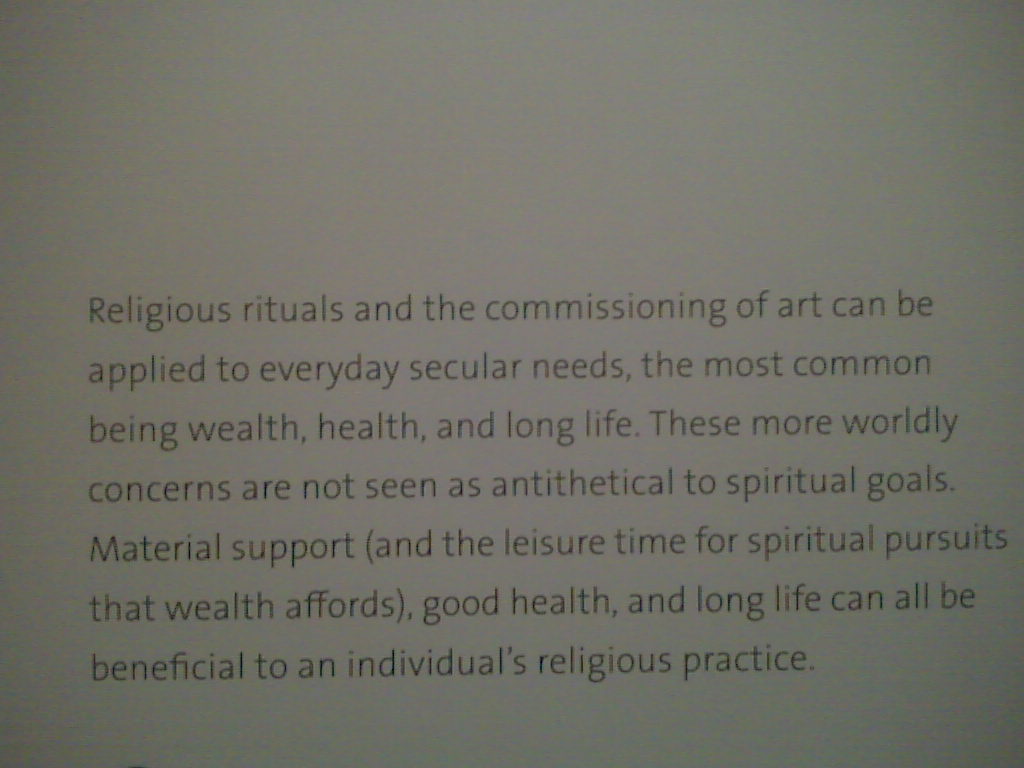
    This question becomes even more pointed when we consider it in terms of the curatorial note (Rubin Museum) below. Those who can afford to commission art to further their own spiritual ideals (including prayers for wealth and family) may not be the one percent, but most surely are the ten percent, or any money would all be for food and shelter at the survival level. I would certainly rather see money spent on making art than war, but what about food, education, and shelter for more in society in a way that nourishes the environment? Such a complicated web of questions about individual and collective desire and responsibility in our relationship to each other and the earth past and present when we think of having wealth sufficiently focused to allow individuals to use it to seek religious boons for themselves in the material world.

    I say this as one who loves and makes art and engages in spiritual exploration with vacation time and budget, who regularly wonders if that is really for the good of others and not just another way of enjoying what life has to offer the fortunate.

    What do you think?

    Photo is of exhibit notes at the Rubin Museum in NYC.

    Peace and light, E — Posted with WordPress for BlackBerry.
  • | | | |

    On My Way to New Jersey

    I was not able to attend the mid-week intensive in New Jersey with John Friend. It was hard enough to make room in my schedule for the weekend workshop.

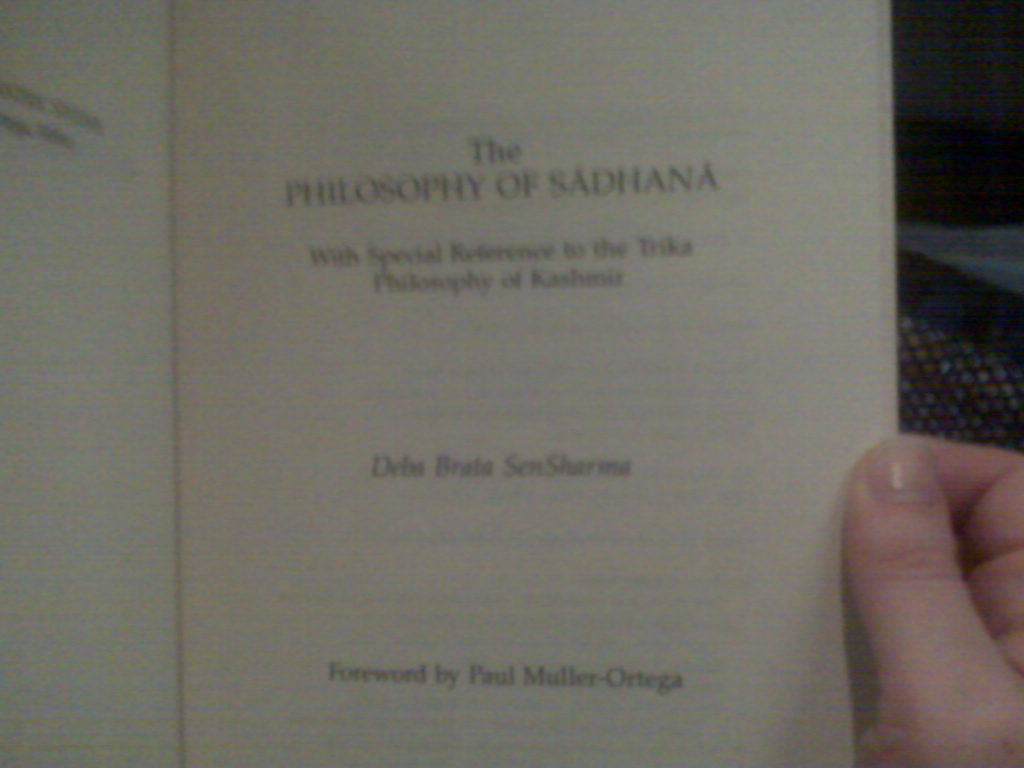
    I can, though, be with my teacher and friends not just in spirit, but in intention. Knowing that the focus of the intensive was sadhana (practice), I selected The Philosophy of Sadhana to read on my way to the weekend, so that when I arrive I can be more in alignment mentally with those who already have been immersed this week in deep study of what sadhana means for ourselves and in community. Choosing to study in a way that connects us with our friends on the path, even when we cannot physically be present with them is, of course, one of the ways we support relationship in sadhana.

    Peace and light, E — Posted with WordPress for BlackBerry.

  • | |

    Lessons in Non-Attachment (Compliments of RIM)

    After 27 hours, plus or minus a few minutes–but who is counting–service was restored to my Blackberry this morning. The reason I had a Blackberry instead of an IPhone in the first instance was because I preferred CREDO (which donates a percentage of profits to causes I support) instead of giving money to political candidates I oppose as do Verizon and AT&T. CREDO now has Android-based phones, which offer all sorts of exciting features that are really quite mind-boggling, if I stop to think about it. I have never been one, though, to give up something that still works fine, just because I could get something newer and more exciting.

    It is interesting to see the articles and comments on the internet about the worldwide Blackberry outage. Much is being said about how this outage will tip users over the edge and send them out to buy another phone because of outrage because of the loss of service. Others note their attachment to the Blackberry and say they will get over the outage because of their attachment. Still others note that doing without email on one’s phone for a day or two is just not a big deal, and they, on their high horses, post mocking comments at the crackberry addicts.

    I most certainly noticed how accustomed I am to sending and receiving communications with my handheld when I didn’t have it for a day not by my choice. My other computers (plural is not a typo) were readily available, so it was no big deal. If I were to lose service when on the road and expecting to meet other people with whom I had not made prior specific arrangement, as is the case for tomorrow and the coming weekend, I would have had to make some shifts. It would have been annoying, though, and would not have felt like the end of the world or a cause for outrage (there are just too many other things more worthy of outrage).

    The episode did leave me thinking about our dependence on technology and how that dependence has shifted both for the good and bad how we relate to our family and friends and the tens of millions with whom we are connected in the ether; how we are attached to our habits and our expected ways things should work, and whether we get stirred up when things don’t go according to plan, desire, or expectations; and how a steady practice of non-attachment can help us open to make the best of things.

    Yes, I looked at the latest phones offer out of curiosity, but no, I won’t be getting one just yet. My three-year old BB is working just fine for now.

    Peace and light, E — Posted with WordPress for BlackBerry.