Memorial Day Walk to Congressional Cemetery

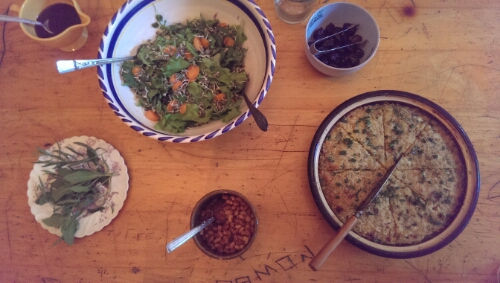
Garden greens with baby carrots and sprouted beluga lentils, with Dijon mustard vinaigrette; spring onion and quinoa torte with eggs from my friend’s hens. Black olives, roasted soy nuts for salad as diners choose, tarragon and mint to refresh palate. Cool herbal infusion (peppermint, spearmint, anise hyssop, and lemon balm). Wine and dessert not shown.

How is it possible to feel lonely when the morning sun shines bright on lush gardens? What do we do, if we know we’re one of the lucky ones compared to most, and yet still feel some absence?
I find doing something for someone else (where both needed and welcomed or else it is not seva) helps remind me of my own presence.
This past Sunday I went to an afternoon workshop with Leslie Kaminoff. Though I was familiar with his book and I follow what he has to say about yoga anatomy on Facebook, I had not ever studied directly with him. Much was familiar, but–and this is why it is important for teachers to study– I did take home some thought-provoking nuances that will invite my own explorations in practice.
A sound bite that very much resonated, especially from the perspective of therapeutic practice and mindful embodiment is the notion that making small changes to things we do very frequently can have a big impact. For example, if all we do to optimize our practice is a minor alignment adjustment to how we stand in tadasana (standing “mountain” pose) or fold forward into and rise up from uttanasana (forward bend), we will make a huge difference in how our physical practice influences and helps day to day movement in our body because they are the most ubiquitous of poses in our modern asana classes.
Next time you’re looking for a bigger change in your health and embodied well-being, instead of looking at big changes and hard effort and feeling overwhelmed, see if there is a little alignment enhancement in a common posture (right now I’m thinking of how I sit in my desk chair) that might shift your everything.
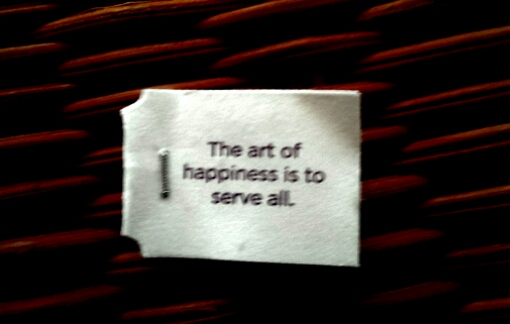
This morning, a friend suggested that if he took into account the needs of others when making plans, all he would be doing is serving others, and he would never get to do what he wants. “Why would I want to do that?” he asked.
I think that’s a common enough question in this society. By uncanny coincidence, the teabag I selected right after the question was posed suggested a possible answer.
As we are taught by the stories of the monkey deity Hanuman, whose main characteristic is a longing for devotion that he demonstrates (while still being utterly himself) through service (seva) cultivating mindful relationship is the highest service to our own self and not just to those with whom we are in relationship.
To take care of our selves can be done with consideration of others without sacrificing our own needs. The answer, I think, is in how we assess and balance our own needs. For me, when I consider the impact of my planning on others with whom I am in relationship as well as my own needs, for example, of freedom, autonomy, and personal delight, I am also considering my needs for companionship, mutuality, connection, and respect. If I completely privilege the former, I may be neglecting the latter and vice versa.

I do sometimes think that the universe is trying to tell me something.