| |

State of the Garden (and a Dinner for Friends)

image

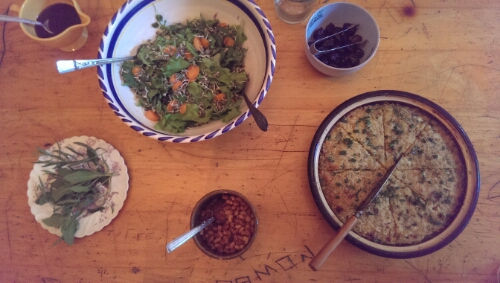
Garden greens with baby carrots and sprouted beluga lentils, with Dijon mustard vinaigrette; spring onion and quinoa torte with eggs from my friend’s hens. Black olives, roasted soy nuts for salad as diners choose, tarragon and mint to refresh palate.  Cool herbal infusion (peppermint, spearmint, anise hyssop, and lemon balm). Wine and dessert not shown.

Similar Posts

  • | |

    An Armload of Radishes

    This morning I went to my community garden plot around the corner before I got ready to head into Georgetown to volunteer at The Lantern Bookshop.

    I ws delghted to find enough snowpeas for a good-sized stir-fry and several zucchini almost ready to be picked (I only get zucchini at the very beginning of the season before the squash borers invade, but if I start early enough, I can get a few pounts of squash and a couple of meals worth of blossoms before I surrender and plant something else).

    The tomatoes were flourishing (no sign of blight. If you have your own plants, keep an eye close for blight; it’s aleady been seen in Maryland. Cherry tomatoes are more resistant, so I’ve concentrated on those).

    I should have the first cucumbers big enough to pick next week, and I have plenty of lettuce.

    The radishes, though, had exploded. “Should I have a radish-themed dinner party?” I thought. “What am I going to do with all of them?” I am not especially fond of radishes. I plant them because they mature very early, they thrive on benign neglect, I have friends who like them, and they give the same crunch I’d prefer from a cucumber weeks earlier.

    I’ve also discovered I like them cooked. Just as you can prepare turnips and their greens together, it also works well with radishes.

    As I was walking home with a bunch of radishes that I could hardly get my hands around, I bumped into a neighbor. I don’t know her well, just recognize her face. “Do you want some radishes?” I asked, hoping I did not sound like I was begging. She hesitated, but then seemed to realize that she would be doing me a great service by accepting them. “You can cook the greens,” I said as I handed her a nice-sized bunch, “and also the radishes themselves if they are too strong.”
    “I’ve never done that,” she said.

    Here’s the recipe I gave her on the street (with a little more detail here):

    Wash radishes and their greens well. Cut radishes into thick coins (this works best with oblong radishes sich as French Breakfast). Cut off the white part of stem nearest radish. Then cut the bunch horizontally so that you have half inch wide shreds. Mince some garlic, onion, and ginger. Stir-fry aromatics in peanut, safflower, or canola oil until translucent. Add the radish coins and stir until well-coated with oil. Add greens, stirring continuously until all the greens are wilted. Add some rice wine vinegegar and cook until absorbed and the grrens are just tender. Take off heat and sprinkle with soy sauce or Bragg’s Amino Liquid and toasted sesame oil to taste.

    “What a nice morning,” my neighbor said, “fresh radishes from the garden and a recipe.

  • | |

    Early Morning Rain

    This morning I stayed in bed after the alarm sounded and listened to the rain.  It was peaceful and pleasant, but it was not meditation.

    Listening to the rain made me extra glad to have spent so much of the weekend in the garden.  The new plants are drinking up the fresh water and will almost soar when the warm sun returns at the end of the week.

    Thinking about how the garden will flourish because I laid the ground to enable it to get the best of the rain and the sun inspired me to get up and take my meditation seat, even though I was late.  It is practicing consistently that lays the ground for us to be ready to have the fullest, most joyous, and most optimal experience of ourselves, the world, and our spirit whatever comes and whenever it comes.

  • | | | |

    Haiku About An Assignment

    I’m attending via the Internet a year-long series of lectures through the Upaya Zen Center about Socially Engaged Buddhism. On the honor system (the program consists only of watching zoom or YouTube lectures and a Facebook forum with no interaction with any leading the program other than group emails), as part of the year, we are supposed to have a “social engagement” project informed by Buddhist principles of right living.

    Social engagement as an intrinsic element of spiritual practice/observation seems completely consistent with the principle of Quaker practice I was raised with —that of putting one’s faith and recognition that there is good in every being—into how one lives and works. It also resonates with my understanding of the yoga practice of seva (“selfless” service), which I have tried to make a consistent part of my personal yoga sadhana.

    After much intentional and spaciously open contemplation of this exhortation to have a project, and in response to my listening to the lectures and the questions and observations of others listening to the the program, I came to the conclusion that, actually, I could not take on another thing without it being toxic to myself.

    In fact, after 30 committed years, I’ve given notice of my intent to retire from the Federal civil service at the end of the year. I am also doing less volunteer work than I had been prior to the pandemic. For the rest of the year, I am continuing my concerted efforts to share my experience and knowledge to make sure my co-workers are prepared to take on the responsibilities for the complex project that has been largely my responsibility to lead and coordinate for over a decade. That, along with what it is taking for a mindful emergence from pre-vaccine pandemic living, is taking all the energy I can give and still be healthy.

    I continue to budget to make reparations, to speak out, and make other consistent offerings, but am at last releasing the need for measurable accomplishments, rather than feeling compelled to find or produce more.

    As saying that I am doing what I have already been doing has not seemed sufficiently responsive, and after these months of trying to articulate what I mean in a way that would not sound dismissive of the task, I wrote this haiku:

    This is my project:

    Be kinder to myself and

    Also to others.

    PS It is, I am sure, just a coincidence that it is Bastille Day.

    PPS Get out the vote!

  • | |

    Yoga for Householders

    Paul Muller-Ortega, who teaches philosophy and meditation from similar roots to those that inform Anusara yoga, spoke yesterday of the differences between the path of the renunciate and the path of the householder.  He strongly stated that neither path was better.  What he suggested, though, was that a householder will better flourish practicing yoga designed for the householder rather than attempting to practice renunciate techniques, while still staying in the householder path.

    What does this mean?  I think it means that we become unhappy and conflicted if we try attempt the practices of the path of complete non-attachment and transcendence of body and mind while we are still very much staying in society and responsible for family, work, and citizenship.  The tantric, householder path, including that of the Shaivite tradition of Kashmir and Abhinavagupta, offers practices that enable one to live liberated in society, instead of suggesting that the only way to true liberation is to reject and transcend work, family, and community.  In yoga terms, the householder path is one that realizes moksha (liberation), through ardha (physical and material well-being), kama (love/relationship), and dharma (right work/path) rather than by transcending them.

    Taking the householder path does not mean just indulging.  It still requires sensitivity, dedication, discrimination, and alignment.  I think it may be even harder than renunciation.  I know it is easier for me to just stay alone and practice, for example, than to bring yoga off my mat to how I work, consume, relate to others, and participate in society.  The householder path, though, is the one for me.

Leave a Reply

Your email address will not be published. Required fields are marked *

This site uses Akismet to reduce spam. Learn how your comment data is processed.