Art and Culture | Asana, Pranayama, and Yoga Practice | Community and Family | Food for the Mind (Yoga Philosophy, etc) | Meditation | Photos
Found Objects Around Town

Peace and light, E — Posted with WordPress for BlackBerry.
Peace and light, E — Posted with WordPress for BlackBerry.
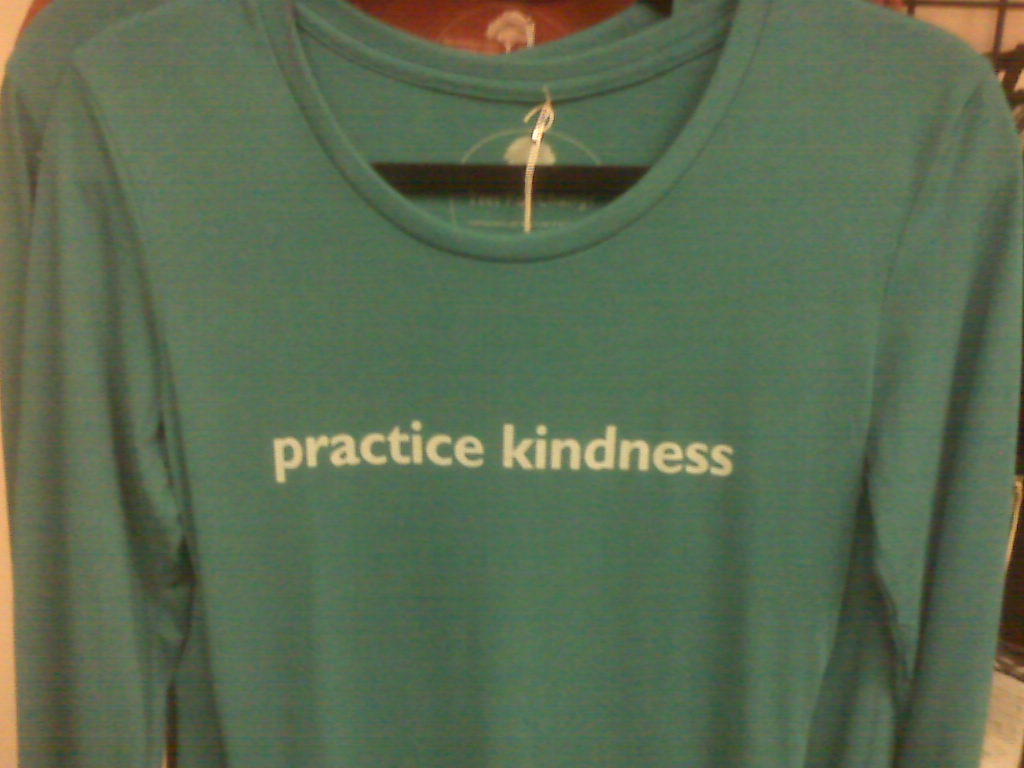
A number of years ago I had a conversation with a cherished friend and co-worker who is no longer in this body. I was explaining to her the yoga practice of samtosha (contentment), which is one of the five niyamas that make up the second limb of the eight-limbed path of yoga set forth in Patanjali’s Yoga Sutras. My friend said it felt like a great revelation to think of contentment as a practice. She had thought of it as a state you were either lucky enough to have — or not.
Many states or characteristics or attitudes that we tend to think of as only being innate characteristics or good fortune can be cultivated.
Wearing an exhortation on a t-shirt might not necessarily be my style, but I do agree kindness is worthy of cultivation when it does not happen spontaneously.
Peace and light, E — Posted with WordPress for BlackBerry.
The first day of the advanced intensive this week, John Friend invited us to write in our journals about what we wanted to get out of the three days from both an energetic perspective and from the perspective of a particular asana that has challenged us. This was not long into the first session of the first day, but it was after he spent some time speaking about what he believes it takes to be a good student–of yoga and of life. Though he did not specifically relate the qualities to the Anusara principles or the mahabhutas (elements), based on what I have heard him teach before about studentship, which is a significant aspect of a committed yoga practice, the qualities of studentship he outlined are parallel to the principles of alignment.
The first quality of studentship, he explained, is having a simultaneous sense of wonder and of humbleness (openness to the teaching and the teacher). This is about being spacious (akasha) and an application of the first and highest principle–opening to grace.
The second is steadiness, which includes showing up, paying attention, being consistent, being diligent. This is being like the earth, being muscular and strong (muscular energy) in how one studies.
The student also needs to be accommodating, to be able to be fluid (like water), to go with the flow of the teacher, the studies, and the class as a whole. This is similar to how the expanding action of inner spiral helps us make more space to grow in a pose.
Third, the student should always do his or her best, to be on fire to learn and grow. Doing one’s best in this way is like the action of tucking the tail bone to engage fully outer (or contracting) spiral to draw into the inner power to shine.
Finally, just as air reaches out in all directions and the Anusara yogi, in asana practice, uses organic energy to extend outward, a good student makes offering of all he or she is learning, to make studying an act of loving service (seva).
When John asked us to take out our journals this week, I took mine out and wrote on what he asked. As I did so, I found myself remembering the first time he asked me to write in my journal, which was at an Inner Harmony retreat in 2003, when I was in the middle of my Anusara teacher training. I have been keeping a journal steadily since I was 11, and though I was on fire for studying yoga, being told what to write in my journal felt a little like an invasion of sacred and intimate personal space. I think others probably expected this; they had “yoga” notebooks with them and did not need to write in a personal journal when the received this instruction, but all I had was my regular journal.
I am still in Miami; tomorrow I will be visiting a friend and then joining with others for the Mahashivaratri celebration, or I would pull out my journal entry from the week at Inner Harmony to see what I wrote. I know that I wrote as much about why it was hard for me to be told what to write in my journal as I wrote on whatever was the topic on which I had been directed to write. I know also that was the week I really decided how important it was to study with John. Finding the balance between knowing what was my own space and truly understanding where I would best learn by following completely the teacher, was a critical part of my yoga studies. Being a good student is not always easy, but it is an evolving part of the sadhana (practice) of relationship, which is the true yoga. This is why how to be a good student initiated the week’s teachings for a group of advanced students, most of whom were teachers themselves.
This afternoon, at the end of the last session, John asked us to get out our journals (I am still using my regular journal as I am not much for taking notes and separate notebooks for yoga just get left behind mostly empty) and look at what we had written on the first day. Did we get out of the training what we had written that we wanted, he asked. For me, the answer was mostly yes, and in some profound and unexpected ways. Would I have gotten so much in that regard if I had not done what my teacher directed and thereby focused my intention for the training? I think probably not. And part of what I wanted, though I did not write it down that way, was to be yet still a better student of my teacher, the teachings, and the spirit.
Fridays 1/4-3/7 all levels practice.
RSVP’s very helpful to make sure there’s room for you and that we listen for your arrival (door stays locked).
Doors will open at 6 for visiting and connecting (including those who may be on the challenges of embodiment list and want the yoga vibe, but are not sure about participating in group practice).
Please show up by 6:30 to make sure we hear you knocking; structured practice will start no later than 6:45 and run until 7:45.
Expect centering (meditation, breath work); slow alignment-based flow (with alternatives for whatever shape you’ve arrived in), balance work, functional movement practices, dance and playful movement incorporated for lightness and perspective when it suits, with savanna and closing.