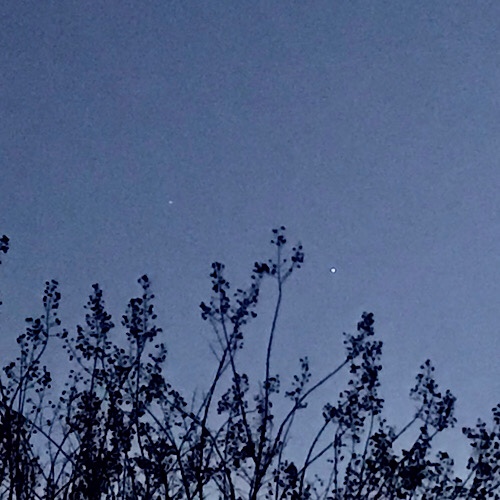
Morning Meditation
Tattoo circa the Kavanaugh hearings. I have strategically placed reminders to keep me engaged.
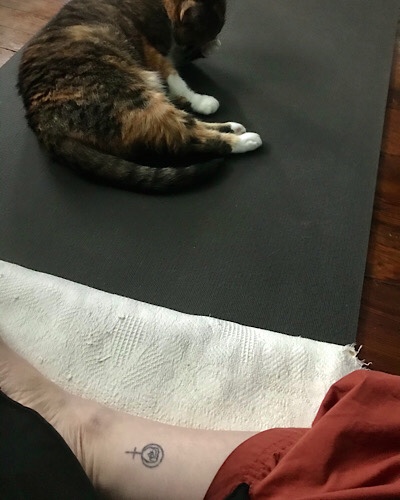
Tattoo circa the Kavanaugh hearings. I have strategically placed reminders to keep me engaged.
This morning when I woke, my first thought was that I thought it had rained in the night. My second thought was that I felt well-rested for having slept through the night — not having had my sleep disrupted by thunder or the earthquake, as was the case for recent nights — perhaps I had just dreamed about the sound of rain..
The yoga teachings say that there are four states of consciousness: waking, dreaming, deep (dreamless) sleep, and the fourth or turya state. The fourth state is both beyond the other states and also encompasses the others. It is where we find in meditation the merger of the individual consciousness with universal consciousness. The better we are able to access the fourth state, the more the other three states, and how we think and act in them, are illuminated by the very light of being.
The more I meditate, the more aware I am of what is going on around me while I am in a non-waking state. I am also finding that waking and dreaming are more luminous.
My awareness of the rain without knowing whether the awareness came while I was awake or asleep show both that I am finding more awareness in the different states and that I have a long way to go and much to discover.
Siva Nataraja spied doing his wild dance.
In 2000 or 2001, shortly before I started practicing Anusara yoga, a teacher who regularly played music in class, played for us a recording of Alice Coltrane singing a tantric chant to Siva and the Goddess Bhuvaneshvari. I only heard the chant once while we were in savasana — corpse pose/final relaxation. Although I only heard the chant once, for several months afterwards, I found myself having a recurring dream that I was wondering in a neighborhood that looked like the one where I grew up and went to high school and chanting the full chant. At the time I merely found it curious that I seemed to have learned the sanskrit just by hearing the chant one time. I have since learned that the recording may have been done right near my high school; that is where the Coltrane’s had a recording studio. I also learned that the chant was a tantric chant. At the time, my teachers were coming from a classical yoga perspective. Did I actually learn the chant by osmosis? Was having the very vibration of the chanting near where I lived and studied the catalyst for me, as a receptive being, discovering a path of tantric yoga?
I have found other recordings of the chant. One is Atman’s “Dancing to the Goddess” on the Eternal Dance CD, which is an electronica version. The other is Ragani’s “Om Mata” on the Best of Both Worlds, which is a very nice kirtan/pop version. I have several of Alice Coltrane’s recordings, which are great jazz, if you aren’t familiar with Alice Coltrane as a fabulous musician in her own right. Recently I searched again on the internet to see if the bootleg had become available. There was nothing on YouTube (though some good Alice Coltrane things to watch). I bought Alice Coltrane’s “Radha-Krsna Mana Sankirtana,” which was originally recorded in 1977 (when I was in high school) and reissued in 2005, as I thought that was a promising source. It has some good things on it, but no luck finding the recording I wanted to hear.
The chant goes like this:
Samba sadasiva, samba sadasiva, samba sadasiva, samba shambo.
Om mata, om mata, om sri mata, jagade mata.
Om bhuvaneshvari, sri bhuvaneshvari, hari parashakti, devi bhuvaneshvari.
It is a chant to the benevolent, auspicious one within, the radiant goddess, the creatrix of the world. Bhuvaneshvari is one of the ten wisdom goddesses.
Please advise if you have access to the Alice Coltrane or another recording of this beautiful chant.
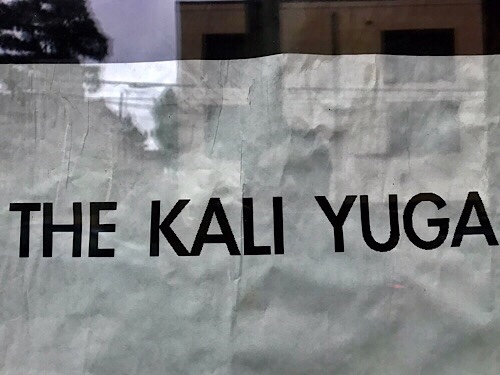
What are you going to do about it?
They are only visible for a short while between the time it is dark enough for their light to be visible and before they set.