|

“Dry Clean Only” (Don’t Believe Everything You Read)

As I was doing my laundry yesterday, most of which I line-dried, I thought about the fact that I have not been to the dry cleaner in nearly a decade. This is one of the small things I have chosen in order to be a little kinder to the environment.

Some of my clothes, especially things I bought several years ago, say “dry clean only.”  This includes knits made of wool, tencel, modal, or rayon (all of which are natural fibers) and linen and silk unconstructed clothing.  All of these do fine with hand washing (or on the gentle cycle in the washing machine) and being hung up to dry (this also applies to cotton, button-down shirts).   Of course, if it doesn’t say to dry clean then you definitely don’t need to dry clean.

Always believed the label?  How was clothing made of natural fibers cleaned before there was such a thing as a dry cleaner?  Think they look better or it is easier to get them dry cleaned?  Think about the solvents, the plastic, the energy for the cleaning method, and whether you drive to the dry cleaners.  Then make a decision.

Most things do not need to be cleaned by use of poisonous solvents (just because a solvent is “organic” or “natural” doesn’t mean it is good for the environment) and then wrapped in non-recyclable plastic to take home (many dry cleaners will take back the hangers, but will say they need to use the plastic wrap because their premises are too dusty for your clothes to stay clean outside the plastic wrapper).

So look for clothes that say “gentle wash, line dry” instead of “dry clean only.”  If it says “dry clean only” think about whether it really applies.  It will not apply for a wool sweater, most knits, or unlined clothes.  A business suit — yes, it won’t keep its shape unless you dry clean.  Do you really need to wear a business suit?  Will a choice not to wear a suit impact whether some people think you are truly “professional”?  Possibly.  If you decide you need to wear a suit regularly, how many times can you wear it before taking it to the dry cleaners?

PS.  Don’t experiment with things that are new and expensive.  Try it on older clothes and discover whether you need to believe everything you read.

Similar Posts

  • | |

    Kate Swift, Inherent Sexism in Language, and the Bhagavad Gita

    When I read Kate Swift’s obituary yesterday, it lead me to think more deeply about a recent conversation I had about the Bhagavad Gita.  The Bhagavad Gita, not surprisingly, is required reading for most yoga teachers.  It is an integral part of the history and philosophy of yoga thought and practice.  It is, though, about a battle in the middle of war, in a time and place where a woman’s highest and best (and arguably only role in life) is to be obedient first to parents and then to husband.  Purity, obedience, and beauty (as decided by society) are the great virtues of women.  As a dialogue between a male warrior (Arjuna) and a male incarnation of the deity (Krishna), all of the spiritual and social teachings are presented in terms of men and males, right down to the pronouns.  The translation that was being discussed was that by Juan Mascaro.  As a mid-twentieth century translation by a Spaniard at Cambridge University who has lectured on “Literary and Spiritual Values in the Authorized Version of the Bible,” the translation no doubt perpetuates (without any specific or willful intention to do so) the inherent sexism that is also found in the English language and in the Bible and its notion of God.

    The question raised was how a book that perpetuates sexist stereotypes could be required reading to be a yoga teacher.  (See my previous blog entry on how we, as yoga teachers, can rely on a book that is primarily about war.)  How would it read, it was suggested, if all the pronouns in the Gita were changed from he to she?  The person raising the question said that making this change made the spiritual guidance more accessible to her.  For me, shifting the pronouns from male to female does not address the challenge because I do not believe in spirit that can be given gender.  I read the Gita and other yoga texts in two ways:  (1) as historical and literary/philosophical documents that are products of the author’s time and place in history; and (2) as a source of universal human truths.  The Gita, as a dialogue between a warrior and a male avatar of “God,” does not have much place in the ideals I hold dear.  Neither the caste system nor the roles for women espoused in the text support my own beliefs about equality, justice, fairness, or love.  The extraordinary teachings of yoga, though, transcend the history out of which they arose.  To do justice to the yoga texts — and not just the yoga texts, but the great teachings and texts that are an integral part of our social fabric — we must both recognize their historical context and be open to learning what has transcended history and cultural boundaries to make them living words.

    In attempting to make the shift to a modern interpretation that allows for “feminism,” I know many who try to address some of the challenge for modern readers by saying that we all have characteristics of the masculine and the feminine, and so we can read the guidance in the texts as being valid for both sexes.  The problem I have with that is Kate Swift’s point.  If we label various personality traits and characteristics as being elementally male or female, we are still perpetuating sexism through linguistic bias.  It is not enough for me to make the warrior female and allow her “male” characteristics.  What I think is that all human characteristics are gender neutral.  If the teachings are not to be biased when we as teachers transmit our reflections on the texts to our students (after recognizing how history has done it), then we need to say that all people can be assertive or passive, strong or sweet, rigorous or soft, etc, but not just say that some are masculine and some are feminine and that in having all of these traits to some degree, we are showing that we are both god and goddess, masculine and feminine.

    Or we could just not do any labeling at all, instead concentrating on the truly universal yoga teachings of right action, selfless service, and deep abiding love–none of which have anything to do with gender.

  • | | |

    Daniel Webster Statue (and Siva tattva)

    On the column that supports this bas-relief and a larger than life standing portrait of Daniel Webster, is engraved: “liberty and union now and forever one and inseparable.” Kind of sounds like a description of the absolute consciousness, the one self, though that was probably, mostly not the intent.

  • | |

    State of the Garden (Happy May Day)

    image

    image

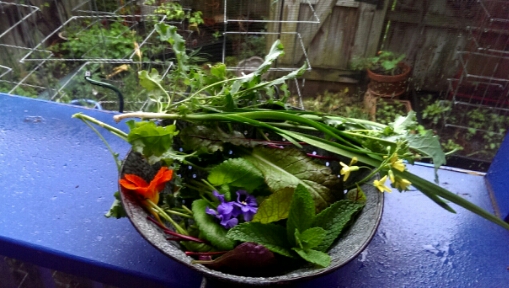
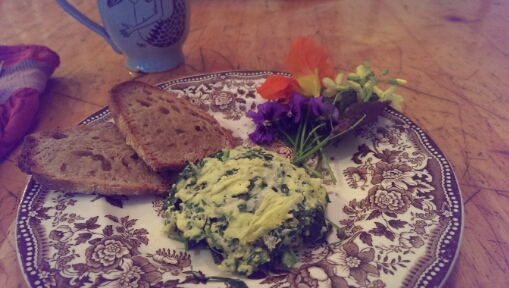
    Thanks to the farmers who come in to town, I know the people who gather the eggs and milk the goats to make cheese. Thanks to my friend Jess, who left a tub of sourdough starter on my porch Friday morning, and my inspiration to make dough to rise overnight between dinner with neighbors and going to bed, I have homemade sourdough bread.  With such a fairly wet and very active chef, it was pretty successful to do a sort of hybrid of the New York Times’ no knead bread, which I kneaded, but not for 10-15 minutes, and Martha Rose Shulman’s no-yeast sourdough country bread (in Great Breads).

Leave a Reply

Your email address will not be published. Required fields are marked *

This site uses Akismet to reduce spam. Learn how your comment data is processed.