| |

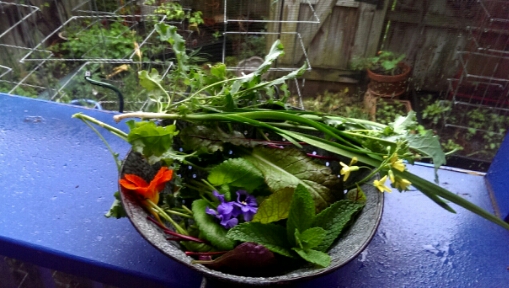
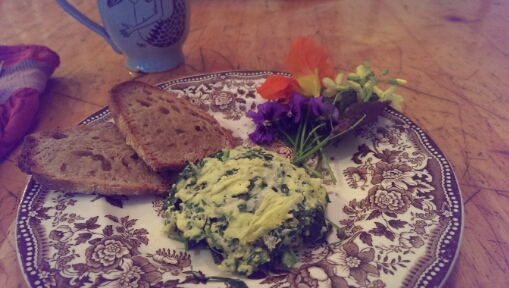
State of the Garden (Happy May Day)
image

image

Thanks to the farmers who come in to town, I know the people who gather the eggs and milk the goats to make cheese. Thanks to my friend Jess, who left a tub of sourdough starter on my porch Friday morning, and my inspiration to make dough to rise overnight between dinner with neighbors and going to bed, I have homemade sourdough bread.  With such a fairly wet and very active chef, it was pretty successful to do a sort of hybrid of the New York Times’ no knead bread, which I kneaded, but not for 10-15 minutes, and Martha Rose Shulman’s no-yeast sourdough country bread (in Great Breads).

Similar Posts

  • |

    Happy Thanksgiving?

    Last night as I waited on the metro platform at Takoma Park after yoga class, a large man in a shabby black coat came up to me and said, “happy thanksgiving.”

    “Happy thanksgiving,” I replied, thinking I like Thanksgiving better than I like Valentine’s Day, even considering the somewhat unsavory roots of both holidays.

    “Oops,” he said, “I meant ‘happy Valentine’s Day; I’ve been getting that wrong all day.”

    “That’s OK,” I said.  “Every day should be a day of thanks giving.”  I had been enjoying the day fully even though I had not engaged in any Hallmark-driven behavior and was feeling fully grateful for my life and not just because of the post-yoga class glow.

    “I don’t have anyone to give red roses to any more,” the man lamented.  “My mother has passed; my grandma has passed.  I don’t have a girl right now.”

    “Your mother and grandma are still here in your heart, and they know you love them.  They do not need roses,”  I offered.  “In fact, you have helped the world be a better place not buying any roses today.  Most bouquets of roses are laden with pesticides and cut and wrapped by women in poor countries who get sick from the pesticides.”  At this, a young woman watching me with commiseration lit up with a big smile.  Who would start giving advice on the hazards of Valentine’s Day flowers — I restrained myself from talking fair trade chocolate — in this situation?

    “You’re nice,” the man said, “what’s your name?”  The metro was still not due for another eight minutes, and, being the introverted, cautious, small, middle-aged woman that I am and thus feeling a little pressured by his longing for someone to talk to, I did the verbal dance to extricate myself from the conversation and get back to the email I had been in the middle of reading.  He went away peaceably, so it was alright.

  • | | | |

    Disobedience and Isvara Pranadhana

    MoveOn just posted this Howard Zinn quote on Facebook:  “Civil disobedience is not our problem. Our problem is civil obedience. Our problem is that people all over the world have obeyed the dictates of leaders…and millions have been killed because of this obedience…Our problem is that people are obedient all over the world in the face of poverty and starvation and stupidity, and war, and cruelty. Our problem is that people are obedient while the jails are full of petty thieves… (and) the grand thieves are running the country. That’s our problem.”

    It spoke my mind and resonated with what I wrote about yesterday with regard to how to be open to yoga’s invitation to practice humility without ceding power to authoritarian structures.   This quote is spurring me to think aboutPatanjali’s eight-limbed path of yoga, and particularly the niyama (observance) of ishvara pranadhana (surrender).  I  don’t see why a true, radical yogini could not simultaneously surrender to the mysterious outrageousness of being while still being appropriately disobedient to authoritarian structure.  But maybe that is because I was raised a Quaker; there’s quite a bit of overlap between some of the tantric yoga principles and the teachings of Quakers.

  • |

    Do You Know When to Ask for Help?

    In yoga class and in daily activities, it is easy to get caught up in trying to do things that are not expanding our capacity, but pushing past it for the sake of some external goal. Sometimes what keeps us from seeking assistance or using a prop (on or off the mat) is some untoward sense of shame that we cannot do it (whatever it is) by ourselves or fear of feeling or seeming weak. This includes not just seeking physical support or assistance, but also asking a question that admits we need help understanding a task or posture.

    Sometimes we are right to think that we need to push our boundaries and do something without external support. More common, though, is not having the sensitivity and courage to know and admit when we need help. And fending for ourselves when when we are beyond our capacity and help is available quite often leads to unnecessary suffering.

    Learning when and how to ask for help is one of my core yoga practices. What about you?

    Peace and light, E — Posted with WordPress for BlackBerry.

One Comment

  1. Looks lovely! Happy to see my starter’s children having happy and productive lives!

Leave a Reply

Your email address will not be published. Required fields are marked *

This site uses Akismet to reduce spam. Learn how your comment data is processed.