| |

One Person’s Weeds

Last year, some romaine lettuce must have bolted.  I have baby romaine lettuce coming up everywhere.  Having reverted to the wild, it is quite bitter.  It is also taking up a fair amount of space, so to be able to plant more appealing things (new herbs and greens) I will be pulling it up.  It has become, in essence, a weed.  Later in the year, I’ll also have a surfeit of volunteer epazote and purslane, which many would pull as weeds.  Those, I actively encourage, eating young the ones that come up over and over again through the bricks and confining in containers a few others to grow larger and to reseed.

Even though it is too bitter to be palatable raw, the now “weed” romaine tastes fine cooked as a tender green.  So it does not get discarded.  I just won’t make myself eat it in its bitter form as the salad green that it is “supposed” to be.  Instead, since it is nourishing and tasty as a cooked green, it is a welcome early addition to the garden.

Just I have challenges and tribulations from whatever is my overall plan for the garden, I have my share of aches, pains, challenges, and disappointments, in life and in my yoga practice.  The question is how to discriminate (viveka) among those that are poisonous, those that are bitter, and those that can be made nourishing and sweet, through the cooking of understanding, practice, and effort.

Similar Posts

  • | |

    Signs Around Town (and a Tantic Philosophical Conundrum)

    I haven’t photographed the t-shirt with the statement “it’s all good” to go with the sign below “needs work,” but I would need to if I wanted to show the apparent philosophical tangle of tantra.

    The tantric texts do tell us that it is all good; more accurately, they tell us that all is divine and perfect, and that we are just an element of the “all.” It is hard to believe that when we can see suffering and bad behavior (including some of our own) all around us.

    The tricky thing about the declaration that all is divine is that it does not mean that there is no work to be done. The work, though, is not to fix ourselves or what is wrong or bad. Rather, the work (sadhana) is to study so that with discrimination (viveka) we can determine what is out of alignment and causing our own suffering or contributing to suffering of other beings and move towards and unveil the perfection and fullness that we are.

    It is sort of like finding a great treasure that has been neglected and misused out of ignorance or carelessness at a yard sale. It takes knowledge to recognize that the cheap, discarded thing is a treasure and skill and effort to restore its intrinsic worth.

    Peace and light, E — Posted with WordPress for BlackBerry.

  • | | | | |

    Signs Around Town (and Symmetry)

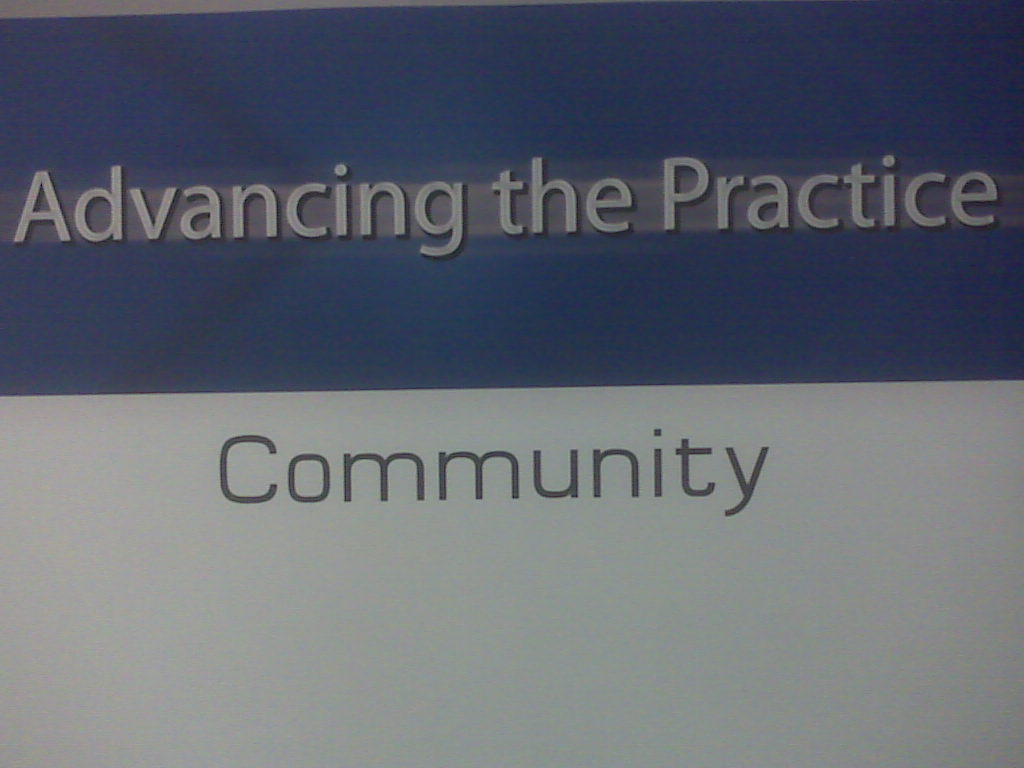
    Advancing
    The practice.
    Community.

    I spied this sign yesterday in the exhibitor hall on the lower level of the Marriott in Woodley Park. I was attending a portion of the 38th Annual Conference of Enrolled Actuaries. (Go ahead: I dare you to put that into your favorite search engine).

    Although this sign was to invite enrollment in one of the actuarial professional organizations, it seems most similar to the stated aspirations of various yoga groups and schools.

    I’m not surprised by this symmetry. I think that anyone who seeks to live so that employment and dharma (aligned life) are in harmony and who supports, participates, and works in community, is living like a yogin, though perhaps never knowing about or having any interest in yoga per se.

    There are many life paths and humanistic and spiritual practices that guide life towards a contented path of service, the true reason, to my thinking, for a steady, long-term yoga practice (including asana, pranayama, and meditation).

    I personally find the yoga practices to be among the most helpful ways to engage my body and mind for my health and well-being. Among other things, the practices have helped me listen with open enough awareness to be able to comprehend with my law-trained mind some small portion of the language of actuaries.

    Peace and light, E — Posted with WordPress for BlackBerry.

  • | | |

    “Who Goes On A Diet to Lose Three Pounds?” (and the Carbon Footprint of Orange Juice)

    The other night after yoga class, a group of us went out to celebrate a friend’s 39th birthday.  During the ambling course of the conversation, I said that I was turning 50 later this year.  I added that I would grow my hair another couple of inches longer and lose three pounds, and 50 would be just fine (let’s leave aside for now all the societal conditioning that goes along with feeling that such an age marker wouldn’t feel too old as long as my hair was long and my body at a youthful weight).

    “Who goes on a diet to lose three pounds?” asked one of my friends.  I find that people sometimes look at me and are shocked that I pay attention to my weight.  They have an idea that someone who stays slim is just lucky rather than consistently mindful.  My grandmother who was 4’11” in her high-heeled slippers was the one who taught me to be mindful in this way.  Once or twice a year, she would moderate her diet to lose the two pounds that crept on after one too many desserts over the course of a few months without any other change in her modest, healthful for those days diet.

    Going on a diet to lose three pounds means never having to lose 10 or 20 pounds or more.  It means returning to mindfully eating a little extra less for a couple of weeks after a couple of months of having eaten a little more than what is perfectly sustaining rather than having to go through a major lifestyle change.  In my middle age, I pay attention to my diet not as much for how I look in my clothes and feel about my body, but more for whether what I am eating is healthy for me and the planet.  One of the best and easiest ways to be at an optimal weight, feel healthier, and have less impact on the planet is simply to eat less (though this is a new announcement by the government, any one with even an ounce of common sense knew that, no matter how much exotic, novel, or challenging diets seemed more appealing).

    Part of eating the right amount for your ideal fit with your body and its relationship to the planet and society is having food that is not necessary for a healthy body only on special occasions (which is different than rigidly forbidding it to yourself).  In reviewing what is sustaining for me and the planet while still enjoying a delicious diet, I periodically take a look at what I am eating and think about what is really fulfilling.  One of the things I enjoy, but have known really should be a treat is orange juice (which I stopped drinking on other than an occasional basis several months ago and truly have not missed).

    If you are eating multiple servings of vegetables and a piece or two of fruit a day, orange juice processed, packaged, and shipped outside of a grower state provides little more benefit to your diet than does a can of soda.  If you kept everything else in your diet consistent and aren’t already eating enough to be gaining weight, eliminating the unnecessary glass of juice would not only diminish your carbon footprint (and if it is not organic, your chemicals into the drinking water footprint as well as your carbon footprint), but you also would be eliminating the number of calories it takes to gain a pound over the course of a month.  And if you live in one of those states covered in snow and ice and are yearning to eat something from the land of sunshine, eat an orange or some other tropical fruit–organic if you can get it — and skip the processing, the cooking (pasteurizing), and some of the packaging that goes into it being shipped to your grocery store as juice.


Leave a Reply

Your email address will not be published. Required fields are marked *

This site uses Akismet to reduce spam. Learn how your comment data is processed.