Savasana

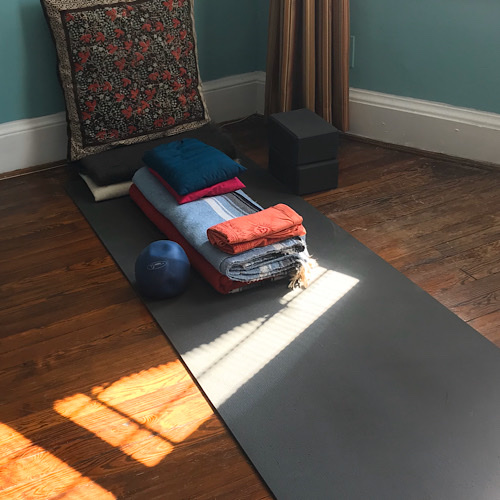
Savasana–pose of the corpse, the pose of final relaxation, the pose without which no practice is fully complete– is both a very simple pose and one that is rather advanced.

Sometimes when I teach beginners I ask them what was the first Sanskrit word they learned. Usually they guess the word is “yoga.” The first Sanskrit pose name they get, though, and it doesn’t take more than a couple of classes is savasana. For most beginning the practice of yoga, the permission to stretch out on the back after an hour or more of new ways of engaging body, mind, and spirit is welcome indeed. This is particularly true for those who are overly busy and chronically sleep-deprived as are so many people I know.

What teachers often miss about savasana is that it can be very hard for some students. Injuries (chronic or episodic), tightness, or habitual misalignment (or expectations of how lying down should feel) make it challenging to be in the pose. The default can be to put supports under the knees or head without taking the time to recognize that it may be necessary to focus on and adjust the alignment before relaxing to see if ease can be found without props.

Other practitioners find it agitating to be asked to lie still for 5-10 minutes, because they are so used to being active all the time. Even if they can make their bodies still, their minds race around, and the idea of final relaxation seems anathema.

At the beginning,
savasana can be just stopping movement and enjoying letting go and relaxing.

But the pose is something much deeper than relaxing after a good workout. The pose of the corpse is not about being unmoving like a dead body, but about ceasing consciously acting and surrendering to the elemental vibration of universal being so that the inner fullness becomes indistinguishable from that which infuses all of the matter of the universe. As one gets more advanced, the alignment in the pose evidently becomes one of inner fullness and luminousity supporting the draping of the physical body. We practice going to earth and light, dissolving the constant awareness of our individuality.

Peace and light, E — Posted with WordPress for BlackBerry.

Similar Posts

  • | | |

    Gratitude and Self-Acceptance

    On Friday night, Betsy Downing was at Willow Street’s Silver Spring studios leading a weekend workshop.  The focus of the weekend was learning how yoga practice can assist us in “interesting times.”  In this regard, Betsy invited us to recommit to two practices that we know support us when we fully practice them.  I did not feel the need for more meditation or asana or pranayama.  I do those steadily.

    I have been struggling, though, with where I am lately — I think something was triggered with all the confined time during the great snows.  This morning I decided that for me, this invitation would best serve if I allowed it to help refocus my practice.  In getting a little off-kilter, I forgot to practice fully gratitude and self-acceptance.  Remembering to practice those fully will nourish me well in these challenged times.

  • | | | | |

    Living Mindfully in a Heat Wave, Ahimsa, and “Opening to Grace”

    Ahimsa, which is the first of the yamas in Patanjali’s Yoga Sutras, and thus is the first practice or principle of the eight-limbed path, is usually translated as non-violence or non-harming.  Over my years of practice and study, I have read and heard many versions–some general, some personal beliefs–as to what it means to practice nonviolence as part of a path of yoga.  As I watch the way people around me are behaving and reacting to the heat and drought, I thought about how, for me, the practice ahimsa is as much about seeking to be in alignment with the movements and shifts around us that we cannot change as about refraining from specific acts of violence (though that is obviously a basic element).

    In terms of aligning with the world arounds us and the cycles of our own body-mind, when we are sensitive to what will best serve our own self while having the least impact on the environment, we are practicing ahimsa, in other words, “opening to grace.”  How does practicing ahimsa by behaving mindfully incorporate many aspects of the Anusara first principle of opening to grace? Opening to grace, as a practice principle, invites us to be open, sensitive, spacious, and radically affirm what is so that we can expand, shift, and serve ourselves and others in the best way possible under the circumstance. To be open in this way, try not to rage at the heat–or whatever is your weather. Soften, listen, and mindfully discover how you can live at your fullest, kindest, and most generous with what you cannot change.

    When the temperature soars above 95F for days in a row, it is an act of violence to rage against it or to consume outrageous amounts of fossil fuels to cool our businesses and homes enough to wear warm clothes, sleep under blankets, cook and eat hot foods, or do an athletic asana practice or workout (lest we feel that we are not fulfilling some externally motivated personal notion of fitness–having external notions of how we should look, act govern us without accepting the actual situation is its own form of violence against ourselves) that we would not do if we could not artificially cool our environment.

    Perhaps I have no call to speak on this: my central air conditioning is on, though I’ve been keeping it between 78-82F and I have been moving, dressing, and eating in a way that honors the fact that those temperatures are as cool as it is going to be until the heat wave breaks. Some might argue that using any air conditioning or even an electric fan or a refrigerator is doing excessive harm to the environment. That may in fact be true, but asking for more than we can do just makes things seem impossible, and then we are less likely to make any shift at all.

    Peace and light, E — Posted with WordPress for BlackBerry.

  • | | | |

    Web Version of Hot Summer E-Newsletter

    Dear Friends,

    Recent newsletters I have received from well-known yoga teachers, in addition to sharing their wonderful offerings and teachings about yoga, have included references to the Gulf Oil Spill, the on-going economic crisis, and the humanitarian tragedies in Chili and Haiti and elsewhere.  The information is presented as showing what yoga can do to help us better serve those in need, seek change in ourselves and the world around us, and find our own light in the face of things we cannot change, but these teachers are no longer keeping quiet about the presence of serious turmoil and tragedy.

    As one who has been outspoken (perhaps too much so) about such issues in the context of yoga, as those of you who follow my blog know, it seems that it is no longer possible to be silent.  We are all familiar with adages, “silence is golden” and “silence speaks louder than words.”  We are also invited, as yogis, to observe the four gates of speech to the best of our ability, on and off the mat:  (1) is it truthful?  (2) is it necessary? (3) is it the right time? and (4) is it said in a kind manner?  These gates are important for evaluating individual utterances.

    For the past couple of weeks, I have been thinking about turning the “four gates” on their head, turning them upside-down in the tantric tradition, and asking how they apply to silence.  When we are silent on an issue, on something that moves us, on something in a relationship that is important to us, are we being true to ourselves to be silent?  Are we being honest by saying nothing (for saying nothing is, indeed, saying something)? Is staying silent timely or is it truly timely to speak up (using the four gates as guidance on how to speak up?); is being silent kind–we’ve all done it ourselves or experienced cold or hostile silences?

    For me, more than ever, it is no longer the time to be silent.  We must speak for the light, for action, for aligning better with nature, for deepening community, for enhancing the subtle energies that will help us heal and grow and shift society.  As long as we are not practicing true “renunciate” yoga–giving up family, friends, shelter, and creature comforts, but instead are practicing the yoga of those still engaged in “regular” life, then we need to become more and more sensitive to how we can joyously affirm life, but passionately engage in seeking change that makes the light more available to all, while still going about our daily business.  This is a razor’s edge balance.  It can be so difficult to live consistently with our ideals, to speak and act in truth and kindness for ourselves and others the ideal all of the time.  Our yoga invites us to cultivate and celebrate our strengths, to affirm ourselves and then to expand.  Expansion can be intensely challenging and sometimes as much painful as exhilerating, but I think it is worth it.

    This summer, in classes, I will be inviting all to join me in the questions I am exploring for myself:  what is my intention?  How can manifesting my intention make life sweeter for myself and those around me?

    Join me for both class offerings and a special workshop up at Willow Street.  William Penn House classes continue with special pricing for public interest workers, students, seniors, and those with other challenges.  A portion of the proceeds from every student goes to support William Penn House’s work.

    At Willow Street, the Saturday morning class has changed:  it is now a “Fusion Flow” from 8:45-10.  What’s the difference between the flow class and Level 2?  We’ve already been doing a slow flow, but there will be fewer breaks, and more time for silence (a timely, nurturing silence), for students to get into their own groove to work towards manifesting their intention.  We will have music most times to bring in a stronger sense of the dance, but I will continue, as always, to emphasize healthy alignment for the class as a whole and be responsive to questions.  Gentle/Therapeutics is at noon as usual.  There’s a free class weekend up at Willow Street where I will be teaching both types of classes on July 17th in the Takoma Park studio and Gentle/Therapeutics in the Silver Spring Studio on Sunday July 18th.  The summer session starts on July 24th.  Those who sign up for a class and a workshop simultaneously, get a $20 discount.  For more information or to register on-line, please visit www.willowstreetyoga.com.

    Want a siesta-like retreat from the heat?  Ready for some relaxation and self-nurture?  Treat yourself to two blissful hours of restorative yoga poses for a sweet afternoon retreat without all the travel!  All levels welcome at the:  Summertime Restorative Extravaganza, Saturday, July 31, 2010, 2:30pm-4:30pm, Willow Street Yoga Center, Takoma Park.  $35.

    As always, feel free to email me with questions or comments or join me on the blog:  www.rosegardenyoga.com.  Just FYI, we’ve fixed the issues with subscribing to the blog.  If you haven’t already, just hit subscribe on the home page, follow the instructions, and then get an email in your inbox the day after I’ve posted a new blog entry.

    Hope you are all having a great start to your summer and look forward to seeing you soon.
    Peace and light,

    Elizabeth

One Comment

Leave a Reply

Your email address will not be published. Required fields are marked *

This site uses Akismet to reduce spam. Learn how your comment data is processed.