Savasana

Savasana–pose of the corpse, the pose of final relaxation, the pose without which no practice is fully complete– is both a very simple pose and one that is rather advanced.

Sometimes when I teach beginners I ask them what was the first Sanskrit word they learned. Usually they guess the word is “yoga.” The first Sanskrit pose name they get, though, and it doesn’t take more than a couple of classes is savasana. For most beginning the practice of yoga, the permission to stretch out on the back after an hour or more of new ways of engaging body, mind, and spirit is welcome indeed. This is particularly true for those who are overly busy and chronically sleep-deprived as are so many people I know.

What teachers often miss about savasana is that it can be very hard for some students. Injuries (chronic or episodic), tightness, or habitual misalignment (or expectations of how lying down should feel) make it challenging to be in the pose. The default can be to put supports under the knees or head without taking the time to recognize that it may be necessary to focus on and adjust the alignment before relaxing to see if ease can be found without props.

Other practitioners find it agitating to be asked to lie still for 5-10 minutes, because they are so used to being active all the time. Even if they can make their bodies still, their minds race around, and the idea of final relaxation seems anathema.

At the beginning,
savasana can be just stopping movement and enjoying letting go and relaxing.

But the pose is something much deeper than relaxing after a good workout. The pose of the corpse is not about being unmoving like a dead body, but about ceasing consciously acting and surrendering to the elemental vibration of universal being so that the inner fullness becomes indistinguishable from that which infuses all of the matter of the universe. As one gets more advanced, the alignment in the pose evidently becomes one of inner fullness and luminousity supporting the draping of the physical body. We practice going to earth and light, dissolving the constant awareness of our individuality.

Peace and light, E — Posted with WordPress for BlackBerry.

Similar Posts

  • | | | | |

    Making Beauty

    My top word for the week is “dank,” which evokes so much in so little space.

    I was attending a conference for much of the early part of the week and simultaneously needed to meet a combination of expected and unexpected deadlines.

    I had the delight and nourishment, though, of my daily practice and teaching.

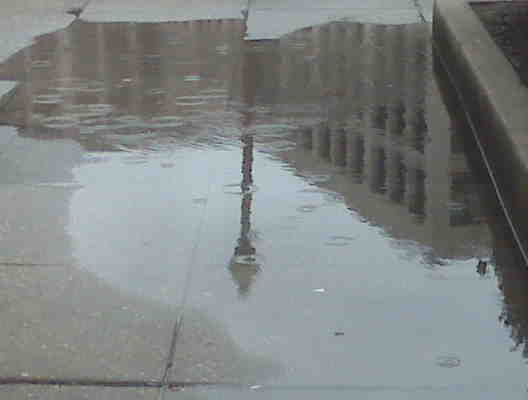
    Through making art — however we do it — we find the beauty that is there. Even in the circa 1974, tied for the second ugliest building on the National Mall, Frances Perkins Department of Labor Building before 8am on another dank morning.

    Peace and light, E — Posted with WordPress for BlackBerry.

  • | | | |

    Lady Macbeth (and Bhavana)

    The young woman sitting next to me on the train north from New York, who is impossibly tall and has lovely, strong features (i.e., is perfectly cast), is memorizing Lady Macbeth’s lines.

    I had on my own lap print-outs of mantras that Paul Muller-Ortega has invited us to memorize as part of our continuing studies.

    To enter the character of Lady Macbeth, one of the first steps is to memorize the lines, to know completely what she says and not just to hear it and appreciate it. Memorizing the lines is an essential part of the route to becoming Lady Macbeth.

    Paul Muller-Ortega has suggested that the reason to memorize various mantras is not to acquire them, not to be able to demonstrate a superficial knowledge or skill, but to aid in the profound practice of
    bhavana–deep contemplation at the heart level. It is not the fact of memorization, but the activity of memorizing. It is no accident that we call memorizing, “knowing by heart.” We seek to learn by heart to invite ourselves into the space of concentration that requires. It is a slow and difficult process for me. I persist, though, because of the deepening and expanding understanding it facilitates.

    I note for those yogis (and other readers) who might find the idea of learning mantras alien or uncomfortable or apparently at odds with your own religious beliefs or practices, that studying the mantras does not require or make one a Hindu. I think of it as an invitation to understand and embody the highest archetypes and principles they invoke and represent and compatible with my other observances.

    Peace and light, E — Posted with WordPress for BlackBerry.
  • | | |

    Shaktipat?

    Some of the yoga traditions that include a guru lineage believe that a guru can transmit grace (whatever that might mean) through their presence or touch. Back in the days when I was doing my first yoga teacher training, a fellow student asked me whether I had ever received shaktipat? My answer was yes–when I’d had the opportunity to shake hands with William Brennan. He’s not a guru, my fellow student objected.  But he is a being of extraordinary grace, power, and intelligence who has devoted himself to the service of our collective well-being and my being in his presence inspires me to show my best light; isn’t that what’s supposed to happen with shaktipat? I don’t think she was ever fully persuaded by my unorthodox reading, but I had no need to persuade.

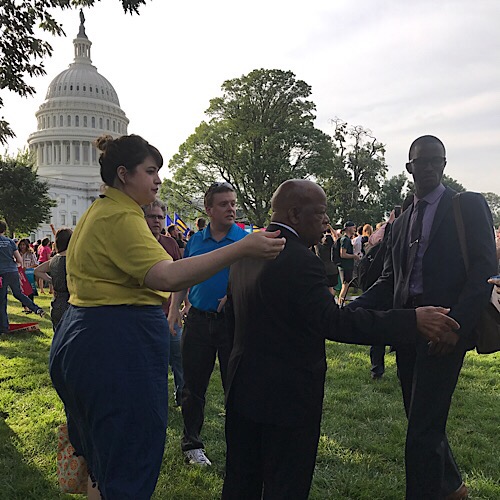
    I found myself thinking about that discussion today, having gotten to shake John Lewis’s hand when he walked through the crowd to speak at day 2 of the people’s filibuster for health care. In the presence of his inspiration, I am compelled to figure out what more can I be doing.

  • | | | |

    “The mind and spirit become ripe…”

    I have been indulging in reading the thriller Angelology (complete with stories of angels and the war between good and evil), which  I picked up at the Books for America shop in Dupont Circle a couple of weeks ago for the kind of night of reading that is the equivalent of a night of watching television if I had a television.  Relatively early in the book, a professor says to one of the brilliant students who is a central character to the plot:  “I have found that our texts will speak deeply to someone or they will say nothing whatsoever.  It depends upon your sensitivity toward the subject.  The mind and spirit become ripe in their own fashion and at their own pace.  Beautiful music plays, but not everyone with ears can hear it.”

    This statement encapsulated the ongoing thinking I do about my attraction to yoga and the tantric philosophy.  I was contemplating especially deeply this week on my return from California, with no particular insight arising, what has drawn me in to this world of meditation and yoga.  What am I doing, having been born in New York City and working as a civil servant in DC, coming from atheist Jewish grandparents and converted to Quakerism parents, finding such joy in learning Sankrit chants and working with energetic principles described in these ancient and medieval Indian texts?  I do not doubt that the practices resonate and the texts speak to me and that the attraction is energetic, just as we are drawn to certain tastes and colors and entertainment and people and no interest arises from others.  I just wonder why these practices and texts and not something else and why they hold me to such a degree that I am moved to teach them.

One Comment

Leave a Reply

Your email address will not be published. Required fields are marked *

This site uses Akismet to reduce spam. Learn how your comment data is processed.