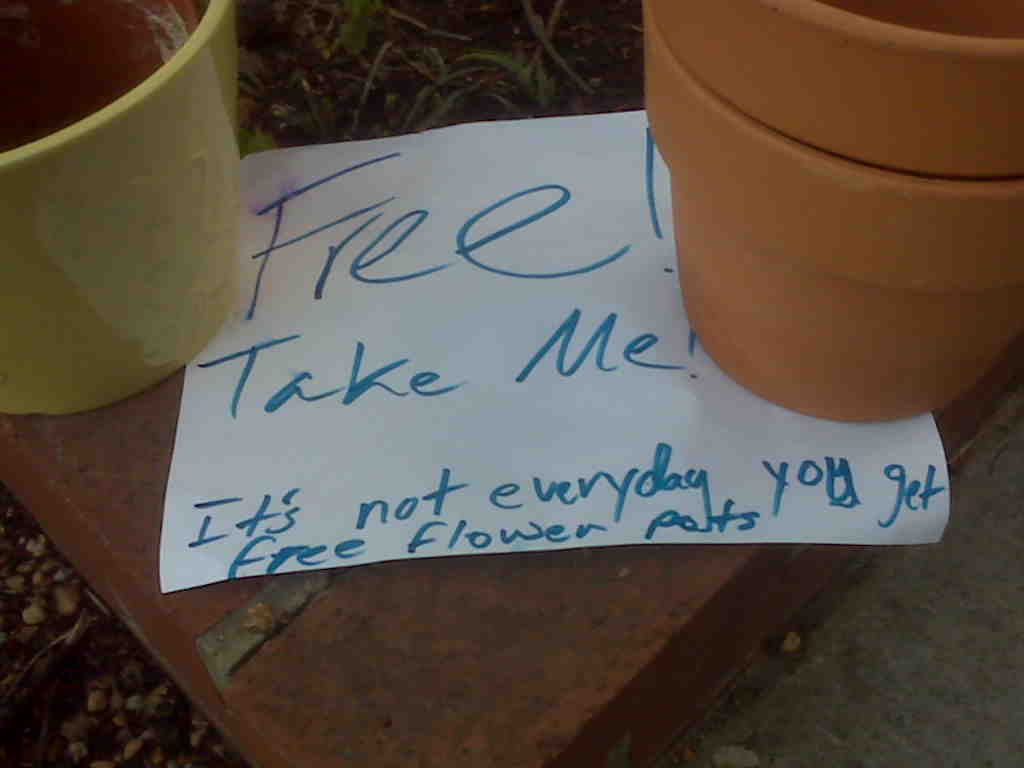
Another Person’s Treasure
Peace and light, E — Posted with WordPress for BlackBerry.
Peace and light, E — Posted with WordPress for BlackBerry.
Jane asks in response to my pictures of the tropicals indoors, “[w]hat, if anything, do you do to avoid bringing unwanted outdoor things in with the plants?” I assume she means bugs of various kinds, though it could also mean weeds, or, quite frankly, baby rodents in my garden location. What works best for me is taking the time to properly tend the plants right before I bring them inside. I do not repot the orchids that are spiking or in bloom, but I do take ones that are struggling or ones which have only had new green growth for the year out of the pots, change or at least rearrange the potting medium, and snip off dead roots, branches, leaves, etc. I brush off the outsides of the pots. After I have done that, I give them a good watering with the hose, letting the excess water run off before bringing the plants inside. A moth or two always comes inside, a few ants, maybe a couple of flies and mosquitoes, but I think it is worth it.
The answer for me then is two-fold, as it would be with any “unwanted things” in life. I try to take appropriate, healthful efforts to purify and fortify so that the wanted things outshine the unwanted things and the unwanted are released. As that is a challenging process, I also have expanded my tolerance, by recognizing them as part of the whole, for the things I don’t want that come with those things that I do want . It’s these two practices together that have made it easier for me to appreciate and have beauty in my life.
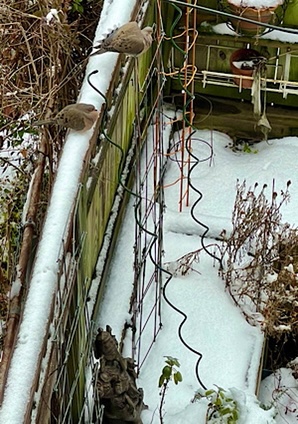
The doves perched in that spot for at least an hour and a half–right above the murti of Ganesha.
Thanks to the generous Cate Stillman for this podcast. What I like most about Cate’s perspective is her teaching that truly practicing Ayurveda is paying attention at the deepest level, including paying attention to what in the classic teaching of Ayurveda work for you and what do not–being that they are imbued with cultural elements of the Indian subcontinent that do not necessarily support or resonate with our culture or individual constitutions.
As I study more, I find that it turns out that I had been practicing Ayurveda already by keeping to a regular daily and weekly routine, eating seasonally and locally, eating with sensitivity to impact on my digestion and energy level, and by having a steady practice. Not being interested in detox (more some other time on the dangers of detox) or constitution types, or arcane herbal remedies (many of these, by the way, are becoming endangered species), it turns out, does not mean having rejected Ayurveda. I do know that whether I call it Ayurveda or just plain common sense, the more I live in a balanced, sensitive, and steady way in terms of diet, sleep, entertainment, work, and consumption in general, the more I optimize my health and sense of well-being.
As I have discussed with a few of you, I have been contemplating deeply and for a long time the questions of what is a guru and who is a guru. In the context of this contemplation, I read to enhance my background and understanding, deepen my contemplation, and give myself food for thought or additional exploration. Here are some books that I have in my library about gurus or those who have been labeled gurus (in no particular order). Some are written with loving devotion by disciples. Some question or comment on the interrelationship between the status of guru and the sometimes all too human foibles of the guru and his disciples. Some are of the guru’s own experience of practice and his relationship with his own guru.
Be Love Now, Ram Dass, HarperOne (New York, NY 2010)
Miracle of Love — Stories About Neem Karoli Baba, Ram Dass, E.P. Dutton (New York, NY 1979)
Autobiography of a Yogi, Paramahansa Yogananda, Self-Realization Fellowship (13th Ed., reprinted 2001)
The Golden Guru — The Strange Journey of Bhagwan Shree Rajneesh, James S. Gordon, The Stephen Green Press (Lexington, Mass. 1987)
My Guru and His Disciple, Christoper Isherwood, Penguin Books (New York, NY 1981)
Ramakrishna and His Disciples, Christopher Isherwood, Simon and Schuster (New York, NY 1970)
Great Swan — Meetings with Ramakrishna, Lex Hixon, Shambhala Dragon Editions (Boston, Mass. 1992)
Bhagawan Nityananda of Ganeshpuri, Swami Muktananda Paramahamsa, SYDA Foundation (South Fallsburg, NY 1996)
The Buddha from Brooklyn — A Tale of Spiritual Seduction, Martha Sherrill, Vintage Books (New York, NY 2001)
Yoga and the Quest for the True Self, Stephen Cope, Bantam (New York, NY 1999)
At the Eleventh Hour — The Biography of Swami Rama, Pandit Rajmani Tigunait, Himalayan Institute Press (Honesdale, Pa. 2001)
Play of Consciousness, Swami Muktananda Paramahansa, SYDA Foundation (Oakland Ca. 1974)
The Great Oom — the Improbable Birth of Yoga in America, Robert Love, Viking Press (New York, NY 2010)
ps Jess–Yes, the widget for Library Thing is coming for the website. I just need to add more books, so that it is a decent start at a representation of at least the yoga-related portion of my library.