Unwanted Things?

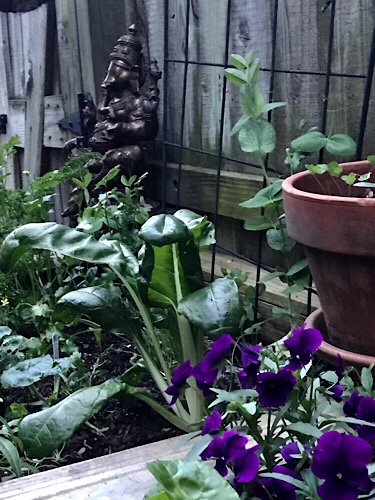
Jane asks in response to my pictures of the tropicals indoors, “[w]hat, if anything, do you do to avoid bringing unwanted outdoor things in with the plants?”  I assume she means bugs of various kinds, though it could also mean weeds, or, quite frankly, baby rodents in my garden location.  What works best for me is taking the time to properly tend the plants right before I bring them inside.  I do not repot the orchids that are spiking or in bloom, but I do take ones that are struggling or ones which have only had new green growth for the year out of the pots, change or at least rearrange the potting medium, and snip off dead roots, branches, leaves, etc.  I brush off the outsides of the pots.  After I have done that, I give them a good watering with the hose, letting the excess water run off before bringing the plants inside.  A moth or two always comes inside, a few ants, maybe a couple of flies and mosquitoes, but I think it is worth it.

The answer for me then is two-fold, as it would be with any “unwanted things” in life.   I try to take appropriate, healthful efforts to purify and fortify so that the wanted things outshine the unwanted things and the unwanted are released.  As that is a challenging process, I also have expanded my tolerance, by recognizing them as part of the whole, for the things I don’t want that come with those things that I do want .  It’s these two practices together that have made it easier for me to appreciate and have beauty in my life.

Similar Posts

  • | | |

    Tulip Mania

    Whenever I see extensive plantings of tulips, it brings to mind the tulip mania of the 17th century Dutch. At the height of the mania, single bulbs could sell for several times the annual income of a skilled worker.

    Now, the tulip is just another beautiful flower. How could it ever have been the focus of such outrageous extremes of lust, gambing, greed, and social mania?

    It is a great contemplation to examine what leads us to desire and seek and value particular things–either individually or collectively. Do the desires bring us to a place of greater good and true fulfillment or is the desire just fueling the unhappy dance of craving and loss?

    The tantric philosophers point out that desire itself is not bad. After all, it is what gets us out of bed in the morning and can turn us to the good. But if it is driven by external opinion and emptiness of self, then it yields suffering–the suffering from which yoga seeks to free us.

    Peace and light, E — Posted with WordPress for BlackBerry.

  • | | | | | |

    The “Highest First” and Knowing What Is a Weed

    Webster’s On-Line Dictionary defines a “weed” as”any plant growing in cultivated ground to the injury of the crop or desired vegetation, or to the disfigurement of the place; an unsightly, useless, or injurious plant.”  At first blush, this might seem like an easy concept, but if we start breaking down the definition, we can see how much our education, assumptions, and prejudices come into play in deciding what is a weed and what is not.  We need to recognize individual plants (when they first come out of the earth and when they are in full leaf or flower) and what they offer.  We need to know how to foster growth of what we choose to plant, including knowing what will thrive in our location and bring more health and beauty to ourselves and the planet, and we need to have a sense of aesthetics that will cultivate not only our connection to spirit, but optimize the shining through of spirit in all that surrounds us.

    Several years ago, I bought a sprig of epazote in a two inch grower’s pot.  It went to seed and came back all over my little garden.  It grows wild beside highways where it is a native plant.  I really like the taste, and it is hard to find here, so I give seedlings away to friends who want it for their own gardens (locals just ask, and I’ll give you some).  It is one plant I know I do not have to replace; it will come back every year if I let it go to seed.  If I had not controlled it by taking it out of prime planting spaces and either using it right away or replanting it someplace nothing else will grow, though, it would be crowding out other plants in a way that is less than optimal.  It is thus both a desired plant and a potentially invasive weed depending on how it fits in with the whole.

    I have seen neighbors using Roundup to kill purslane and dandelions that have grown up between the bricks on the sidewalk in front of their houses.  Although I think both purslane and dandelions are pretty plants and perfect for spots where nothing else will grow, I can appreciate wanting the front of the house to look tidy.  Why not pick the free edible plants instead of spraying toxic chemicals?  I let edible wild plants come up between the crevices and then either relocate them or treat weeding as harvesting, getting incredible flavor and nutrition from something that most are taught to try and eradicate.

    There are other plants that are sufficiently invasive or poisonous, though, that I do my best to eliminate them from my space (though I do not use pesticides).  The other day, I was walking down East Capitol Street after teaching the William Penn House class and saw some English Ivy climbing up a beautiful tree in one of the sidewalk tree boxes.  I stopped to pull it all off because English Ivy left unchecked will kill a tree.  While engaged in this activity an older couple who lived in the house next to the tree walked up to me and my fellow yogi who was helping me with the ivy removal.  The woman thanked me, saying that she had been meaning to pull the ivy.  Ivy is an example of a plant people think is pretty and appropriate to plant, but it does not belong in our climate and is incredibly destructive.  By my lights, it is a weed, even though I can buy it in most nurseries in the area.  I am blessed not to have poison ivy where I live, but it should be removed.  It is too hard to live with it.

    What does determining whether a plant is truly a weed, whether it causes injury or interferes with what is desired or is unsightly, useless or injurious have to do with the “first principle” in Anusara yoga of “opening to grace?”  The first principle invites us to be ready in the first instance to recognize the auspiciousness of both what we seek out and what we encounter.  In teaching meditation and related practices of Blue Throat Yoga, Paul Muller-Ortega speaks of this as “the highest first.”  As we study and practice (jnana/vijnana), we approach the same and new things with ever more refined technique, knowledge and understanding.  The progressive refinement from our efforts helps us then to open up to a deeper perception of the best of our nature.  We keep repeating the cycle of studying and practicing, always remembering the first principle, and we, despite and because of ourselves, shift our relationship with the world around and inside us.  To be open is a softness, a spaciousness, a willingness to see that is without effort.  We temper what gets in the way of effortless opening with the fire to study and to practice with the intention learn how to be more effortless in understanding how things are part of the whole.

    How do we apply first principle in knowing what to weed from our garden (or, for that matter, how to address in ourselves a physical, mental or emotional characteristic or pattern of behavior that may or may not serve us or both–our individual “weeds”)?

    Is the “desired” vegetation a desire that would help align the gardener and the garden with nature or is it something that was taught that comes from an unsustainable aesthetic and social paradigm (for example, a perfectly green lawn with no plants other than grass)?  If the crop is one that truly nourishes (so worth preserving from injury or interference), does it just mean that the “weed” needs to be relocated so that both the crop and the “weed” can flourish simultaneously?  In other words, is the “weed” beneficial in its own way, but just needs to be shifted so that its inherent good can truly be appreciated and honored?

    Is a determination of injuriousness, uselessness, or unsightliness based on ignorance or true discriminative wisdom?  We cannnot know unless we both sweetly open to recognize the potential for discovering the good in what seems most harmful (perhaps one day scientists will find an extraordinary benefit from poison ivy, just as the deadly poisonous plant digitalis is also a powerful heart medicine) and continue to study and practice with an intention to open ever more deeply.


    From left to right: volunteer epazote, lemon balm, purslane and dill.  Dinner:  black beans flavored with epazote; greens, including purslane.  Lemon balm (aka melissa) makes a delicious and quieting evening tea.

  • | | | |

    Potage D’Ete Au Mid-Atlantic (and jivan mukti)

    potage Could not resist the french name.  More fun than summer local vegetable stew.  An alternative name could be:  how to make three okra and six beans into dinner for two.  Or maybe four.  When I was out in the garden this morning, I simply picked what needed to be picked.  Featured here:  three okra, six beans, one jalapeno, two ancho chiles (one partly dried on the plant), two large tomatoes (both of which are only partly viable), two ripe and one green (fell off while I was picking the ripe ones) roma tomatoes, one very small garlic clove, baby leeks, garlic chives, tarragon, parsley, dill, and herb fennel.  Serve over quinoa, couscous, rice, or pasta, and it is easily a meal for two.  Add some red beans or other dried beans, and it could be dinner for four.

    One of the things I like about eating from the garden is the necessity of being creative.  Cooking from a cook book, who wants an ingredient list this long?  I could also be disappointed that no one of my plants is giving me enough to create a dish out of mostly one or two ingredients.  If I were getting these ingredients from the store, I would get more okra or beans or peppers.   There is a great joy in finding a sense of abundance and sparked creativity and celebrating pleasure, art, fulfillment, delight, offerings with what we have been given, whether it is the food from our garden, our bodies, our talents, our families, or the time and place into which we were born.  In finding the highest sense of abundance and creativity within our limitations, we are truly experiencing the yoga concept of jivan mukti, living liberation.

  • | | |

    The Exquisiteness of Order (Winter Theme)

    By order, I mean how things are arranged in space or time.  Even chaos theory presumes order in that sense.  On and off the mat, there is a certain order to things that is optimal.  We do not plant seeds and then till the soil.  Or think of the difference between peeling and chopping vegetables and then cooking them or cooking them and then peeling and chopping them.  One or the other is not necessarily wrong if you do not have a specific dish in mind, but which you choose will dictate the results. Once you have gotten started in the sequence, though, the path shifts and is partly set.  To reach an exquisite rather than a disgusting result, the next steps are ordered by the initial choice.

    If only one musician is playing a single note, then there is no possibility of discordance.  Add more musicians and more notes and who plays what notes when can mean cacophony, a catchy tune, or an extraordinary and ecstatic work of art.  None of us are alone and none of us are playing just a single note, so in the great fabric of our being, it is best to understand how to make music.

    Sequencing on the mat is more subtle than what poses should be done in what order in a particular practice to emphasize backbends v. forward bends and twists to be able to do the strongest poses with the least possibility of injury, as important as that is.  The order in which we apply the Anusara principles not only aligns the physical body, but brings symmetry to the physical and energetic bodies, helping us to feel more in harmony in everything we do on and off the mat.  I am, in this, a decent musician and not Bach, but the more I pay attention to the optimal sequence of things (keeping in mind that over most things we have no control as to when, whether, and how they happen) and the more I learn and appreciate the exquisiteness of order, the more I feel, understand, and experience the subtleties and joys of harmony.

Leave a Reply

Your email address will not be published. Required fields are marked *

This site uses Akismet to reduce spam. Learn how your comment data is processed.