| | | |

Some Books About Gurus

As I have discussed with a few of you, I have been contemplating deeply and for a long time the questions of what is a guru and who is a guru.  In the context of this contemplation, I read to enhance my background and understanding, deepen my contemplation, and give myself food for thought or additional exploration.  Here are some books that I have in my library about gurus or those who have been labeled gurus (in no particular order).  Some are written with loving devotion by disciples.  Some question or comment on the interrelationship between the status of guru and the sometimes all too human foibles of the guru and his disciples.  Some are of the guru’s own experience of practice and his relationship with his own guru.

Be Love Now, Ram Dass, HarperOne (New York, NY 2010)

Miracle of Love — Stories About Neem Karoli Baba, Ram Dass, E.P. Dutton (New York, NY 1979)

Autobiography of a Yogi, Paramahansa Yogananda, Self-Realization Fellowship (13th Ed., reprinted 2001)

The Golden Guru — The Strange Journey of Bhagwan Shree Rajneesh, James S. Gordon, The Stephen Green Press (Lexington, Mass. 1987)

My Guru and His Disciple, Christoper Isherwood, Penguin Books (New York, NY 1981)

Ramakrishna and His Disciples, Christopher Isherwood, Simon and Schuster (New York, NY 1970)

Great Swan — Meetings with Ramakrishna, Lex Hixon, Shambhala Dragon Editions (Boston, Mass. 1992)

Bhagawan Nityananda of Ganeshpuri, Swami Muktananda Paramahamsa, SYDA Foundation (South Fallsburg, NY 1996)

The Buddha from Brooklyn — A Tale of Spiritual Seduction, Martha Sherrill, Vintage Books (New York, NY 2001)

Yoga and the Quest for the True Self, Stephen Cope, Bantam (New York, NY 1999)

At the Eleventh HourThe Biography of Swami Rama, Pandit Rajmani Tigunait, Himalayan Institute Press (Honesdale, Pa. 2001)

Play of Consciousness, Swami Muktananda Paramahansa, SYDA Foundation (Oakland Ca. 1974)

The Great Oom — the Improbable Birth of Yoga in America, Robert Love, Viking Press (New York, NY 2010)

ps Jess–Yes, the widget for Library Thing is coming for the website.  I just need to add more books, so that it is a decent start at a representation of at least the yoga-related portion of my library.

Similar Posts

  • | | |

    Blossoms Around Town

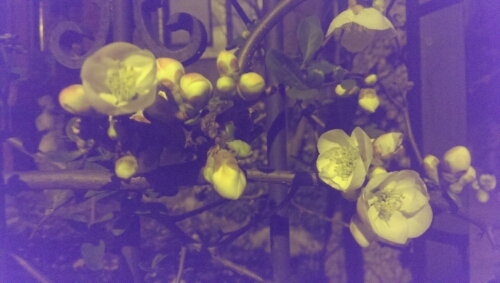
    I feel compelled to make clear that I have avoided going to the tidal basin. All the blossoms I have visited have been in my neighborhood at times when few enough were outside that I could maintain full social distancing.

    The continuing disregard for the need to social distance–whether out of willful selfishness or ignorance or both is truly alarming.

  • | |

    Hot Water Bottles and Wristwarmers

    One of my father’s joke bits of wisdom is “everything in moderation, including moderation.”  When I first studied philosophy academically, I was very much taken with Aristotle’s concept of the “golden mean,” which (this is a gross oversimplification) advocates living in moderation as a way of right living.  Pantanjali in the niyamas in his Yoga Sutras invites the yogin to balance effort (tapas) and surrender  (ishvara pranadhana) in our practice.  The Bhagavad Gita suggests that extreme austerities are just as indulgent as wildly excessive consumption of food, sleep, and comforts.

    What does that mean in our modern, middle class lives in a time when we are being confronted head-on with the impact on the earth and our fellow beings of the way we, as a society, have been consuming?

    In part, I think it is mindfulness.  It is not denial, but balance — choosing ways to consume less, but still not feel deprived.  I am fortunate in that much of what we are learning now about both lifestyle and impact (the stuff under the “green living” umbrella) is not new to me.  My parents were children of the Depression and my father had a modest income. I went to Quaker youth camp in upstate New York in the 1970s, and I did volunteer work for the first Earth Day when I was in college.  We turned the lights off when we weren’t in the room, we turned off the faucets when we were brushing our teeth, or lathering our hair in the shower.  We creatively changed what we cooked out of Julia Child, Craig Claiborne, Virginia Lee, or Diana Kennedy or the New York Times Food Section with what we learned from Diet for a Small Planet.  We wore warmer clothing inside to be able to keep the heat down.  It is important for me to try to live mindfully, but I also very much like to be warm and comfortable, love the feel of beautiful fabrics, and one of my greatest pleasures is eating well.

    I have a number of reasons I like to keep the heat down in the winter:  it feels better on my sinuses because the air is not as dry and I do not like to have to run a humidifier (yet another electrical appliance); it costs a lot of money to keep an old row house at even 65F in the cold months; and I am concerned about my carbon footprint.  I can get really cold when I am working at my desk or getting ready for bed.  I don’t like being cold, and it seems silly to insist on being miserably uncomfortable just so I can feel better from the perspective of some perceived moral ground.  So I try to create a balance.

    Hot water bottles and wrist warmers are part of the balance.  Two hot water bottles taken to bed (and then I use the water on the plants the next morning) makes going to bed toasty and delightful, but not too hot in the middle of the night.  If I am working at home and it is midday, I can warm myself up with a two-minute handstand or a few sun salutes or some abs work or other arm balances. That’s not an option if I am on a conference call or at the office.  Nor does it make sense after dinner when it is time to get energetically quiet.  The wrist warmers, though, make an amazing difference (I also enjoy wearing them when I start practicing until I warm up as another layer that easily can come on or off.  I kind of like the way I look and enjoyed all the complements I got when I was meandering around New York over the holidays.  They are a great way to use scrap yarn (especially if you don’t have the time, yarn, or inclination for a larger project — see my post on “Sauca (and the blanket).”

    If you want to make your own wrist warmers and you are a fantastic knitter, you can go for four double-pointed needles, multiple colors, and add a thumb section.  For those of you who are newer to knitting or who want wrist warmers very quickly, here’s all it takes to make the one’s shown above.

    1.  Two needles of appropriate gauge and less than a skein of yarn.

    2.  Measure loosely around your knuckles.  That’s the right width for your wrist warmer (notice that the girth of your knuckles and your forearm a couple of inches below the elbow are about the same).  Then knit about a two-inch square to make sure you know how many stitches you get per inch horizontally.  When you have your gauge correct, unravel your test square to use that yarn in your wrist warmers.  I recommend rechecking the gauge about an inch or two into your first wrist warmer to make sure you were right.  It is easier to start over at that stage than to try and fix it later or have to give them away to someone larger or smaller (unless you want to).

    3.  Cast on the correct number of stitches for how many stitches per inch you get with your yarn and needles and the width you measured around your knuckles.  It is OK to round to the nearest half inch.  First two rows are simple rib — k1, p1.  Then do basic plain knitting (k first row, p return row) until the first wrist warmer is about 6-8 inches long and reaches almost the desired length up your lower arm.  Then do 6-8 rows of moss stitch (row 1 — k1, p1, row 2, p1, k1) [or you could just do more ribbing].  Cast off.  Measure second wrist warmer against the second.  Turned inside-out, using the knitting yarn, sew into a tube, leaving a whole for the thumb a the end with just the double row of ribbing.  The sewn part at the knuckle end should be about 2/3 to 3/4 inches, then there should be about a 1 1/2 to 2 inch whole (just hold it up on your hand to make sure it fits).

    4.  They will stretch out as you wear them, but if they are a little too wide or tight, you can wet them and then make them either longer and thinner or shorter and wider by blocking.

    4.  Bored with the colors you have at home?  It’s pretty easy to swap with a fellow knitter.

    5.  Want to be just a little fancier?  Do stripes by alternating colors when you change rows.  Want to practice cables.  Do one center cable, just remember that it won’t be in the center if you want it to go on the top of your hand; it will start a quarter of the way in.

    6.  New to knitting?  Go into any yarn store, tell them that this is your project, and they’ll tell you a good yarn, what needles you need, and show you how to cast on, knit and pearl.  There are farmers at the Dupont Circle Fresh Farm Market on Sunday who have beautiful homespun, hand-dyed yarns.  They might not show you how to knit, but they include patterns for hats.

    7.  Have fun.  Be creative.  Be part of a fashion wave.  Stay warm.

  • |

    Theater of the Absurd

    Last night I went with a group of friends for dinner and to see “Hell Meets Henry Halfway” at the Woolly Mammoth.   We all had a most enjoyable time, although the play was pretty negative.  What could you expect, though, from a play based on a 1930s novel written by a Polish exile that was about declining monarchies and social depravity, etc?  What relieved the bleakness of the outlook was the slapstick playfulness of the acting and staging.  It was also a pleasure just to see beautiful technique, and acting was wonderful.

    As the recession deepens, I have been trying to go to see more theater and dance, to support local theaters and restaurants that I care to have still in my world.  It would be easy to settle into a mindset of anti-consumption at this time.  Better I think, even if we are trying to shift the consumer orientation of our society, to become ever more mindful in our consumption, being especially mindful of those around us are struggling from the sudden shift.  The right action, I think,  for those who cannot help but recognize problems, or suffering, or even absurdity, is not only to seek change, but also to see the playfulness in everything to keep the spirit vital and to be able to accept the change that might not be realized despite our best efforts and intentions.

One Comment

Leave a Reply

Your email address will not be published. Required fields are marked *

This site uses Akismet to reduce spam. Learn how your comment data is processed.