We Are Reminded That No One Place Is Any Better
Curator’s notes at the exhibit John Gossage’s “The Pond” at the Smithsonian American Art Museum.

Curator’s notes at the exhibit John Gossage’s “The Pond” at the Smithsonian American Art Museum.
A nyaya is literally a recursion, something which leads back to an essential principle. In my recent studies of meditation, we have been taught various nyayas that help to explicate the experience of meditation and the whys and benefits of steady practice.
At the place where we have been staying for our meditation and study retreats with Paul Muller-Ortega, there is a wonderful cat named Oberon. I first met him last summer when I was walking the labyrinth just before dawn. I’d heard a meow off in the distance. Lonely for cat company since my Becky had so recently left her body, I called to the cat. He came running to me and walked the labyrinth with me. Each time I have visited, I have had some special moments with Oberon, who lives fully up to his name — Oberon being the King of the Faeries.
Oberon loves the meditation hall and often tries to get in. He also brings offerings. Last winter, he brought us a mostly dead bird. As well intended as it might have been on Oberon’s part, it was not particularly welcomed in the meditation hall. On the final night of our retreat this time, we were reveling in the good fortune of having fellow students (and my sometimes teachers and the creators of many CDs in my music collection) Heather and Benjy Wertheimer lead us in kirtan. At one point, I left my place to go to the facilities. A fellow student, stopped me, “Elizabeth, the cat has a really big mouse.” I went to look. Oberon did not have a mouse; he had a young bunny. “It’s a bunny I said.” The other students who were outside were horrified.
Without thinking, I went to him, “Oberon, drop it!” I said, as if it were appropriate to speak to the King of the Faeries as if he were an obedient dog. He listened though and dropped the bunny, which remained frozen. I held Oberon by the scruff of the neck. “Go bunny; bunny run,” I said, but the bunny did not move. I then tapped the bunny on his back at the tail. The bunny remained frozen, though it did not appear yet to be injured. I let go of Oberon and went to get a towel or something to pick up the bunny. Then Oberon tapped the bunny just where I had touched it. Off ran the bunny through the shoes neatly piled outside the meditation hall. I caught Oberon and picked him up. The bunny again froze, looking back at us. At this point I was completely oblivious to anything other than the cat and the bunny. “Bunny run; go now.” Oberon squirmed, but did not scratch me, letting me continue to hold him. Finally, the bunny ran off into the scrub and disappeared. I put down Oberon. He sniffed the trail, but then came back to me for a petting when I called. “Thank you for the offering Oberon; I know it was well intentioned, but we are not so keen on bringing dead baby animals into the meditation hall.” He sniffed, lifted his regal head, and sat down to wash.
Leaving aside what my actions may have done to the fabric of the world order and the pondering I could do about the interrelationship between destiny and free will, I felt that I had been given a wonderful lesson about life and practice. Practice can bring us great freedom if we stay steady on the path. Like the bunny, though, we can stay frozen in fear and old patterns, even when we are given a glimpse of the freedom of self we can get from practice. As dire as things may be (or perhaps even when they are at their worst), we return to the familiar, regardless of whether we are unhappy with it, regardless of how old patterns are limiting our ability to grow. Sometimes it is dissatisfaction with and pain from the old patterns themselves (revealed more clearly by practice already begun) that push us to go further, just as it took Oberon getting the bunny to run again for me to realize he was sufficiently healthy to be able to run off. And just as I stayed with Oberon and the bunny until the bunny finally took his chance at freedom, the practice and the truths and freedom practice can reveal will always be there. No matter how many times we forget or return to the stuck and the familiar, the opportunity for growth and freedom continues to await.
When I am feeling stuck, when I am finding myself returning to patterns that do not serve, I will think about my own personal nyaya of the cat and the bunny. I hope it will serve to keep me moving forward, less stuck, less attached to the familiar that no longer serves.
For a moment before going inside.

How are you going to engage?
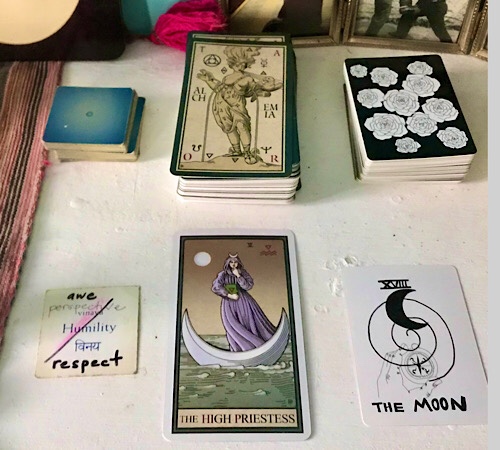
After my morning practice, while I was riding on the bus to Georgetown yesterday to volunteer at the Lantern, the sutra “madyama vikasha cittananda labah,” Pratyabijna Hrdayam, 17, started resonating in the forefront of my consciousness. Swami Shantananda in The Splendor of Recognition, translates this sutra as “[t]he bliss of Consciousness is attained through the expansion of the center.” What an elegant reminder of the true purpose of practice and the essential basis for the alignment principle of “stabilize the periphery; move from the core” about which I wrote yesterday.
When we practice, we seek to go inward to discover that of our true nature that is light-filled and joyous. We do so not just to stay in that place still and inert, but so that we can then extend out into every thought and action from a place of illuminated, blissful wisdom. It will not change the fact of difficulties, challenges, strains, etc, but when we stabilize the outside, remember to go inward, and find the inner space of stillness and light, then when we move back outward into the world, we will be better able to respond in the highest.
World Wide Knit in Public Day is this weekend — June 13th (and 14, 20, and 21). What will you be knitting? I have started a pair of leg-warmers. The pattern was really for ankle warmers, but I have chosen to make them longer than the pattern suggested. The nice farmers who raise the sheep, spin and dye the yarn, and sell it at the Dupont Fresh Farm Market, called them “yoga socks.” The yarn is beautiful. The sample pair looked like something I would want on my feet in colder weather. The project was small enough to tuck into my carry bag. Definitely a go for summer knitting (unlike the three-quarter finished mohair shruggy that has become a lapful of furry stuff).
“Why are they so short?” I asked. “We had originally designed them to be longer, but our teacher said we might need to grab our ankles?” they explained. “When would you do that, when it would not matter whether you were touching fabric instead of your skin,” I puzzled out loud, not out of criticism, but really wanting to know, thinking maybe in Pilates. The farmers could not really think of a reason. I bought an extra skein along with the kit to make the — oh, let’s call them footless socks — calf height. The yarn has a bit of a stickiness to it, so they are not slippery. They will be good to wear for yoga.
I’ve never knitted on double-pointed, size 2 needles, in the round before, though I happened to have four in the house (picked up at a yard sale for a $1 a decade or two ago and put in the sewing box). I tend not to knit from patterns for whole projects. So I had a little learning to do. The pattern did not explain how to use the double-pointed needles; that knowledge was assumed. I am not used to the contraints of following a pattern. Doing so, on occasion, though, forces me to learn a new technique. It took my a couple of hours to get into the rhythm, but now I’ve eased into the project.
I sometimes seek the same type expansion with cooking. Though easily able to cook something delicious without a recipe with most ingredients, sometimes I pick out a complicated recipe just to expand my skills in the kitchen.
Yoga, most of all, benefits from a combination of free exploration and attentive development to the knowledge imparted by a teacher. We are most full and expanded when we combine experience and teachings. We receive the teachings and then we practice again and again to make it not just our own experience, but part of our being. This process is called vikalpa samskara.
