Art and Culture | Asana, Pranayama, and Yoga Practice | Community and Family | Food for the Mind (Yoga Philosophy, etc)
Huffington Post Article on Anusara Grand Gathering
A nice story on the intention and practice of Anusara yoga.
A nice story on the intention and practice of Anusara yoga.
This full moon is both the one called by some “guru purnima“–with rituals to honor the teacher–and also the relatively rare blue moon. I’ve been seeing lots of postings on social media about guru purnima by my friends who are engaged in the practice, study, and teaching of yoga. The variations in the postings about guru purnima are as wide as what the person believes is the guru–from recognition of a person who has been named a guru; to teachers, recognized as such; to simply the invocation of our own teacher within. Suggestions for ritual range from specific puja to just an invitation to think about the concept and to recognize those who have imparted wisdom to us that has enhanced our lives (even if we have to do a lot of work to know that).
I’ve never personally been called to have a guru (among other things, it is too counter to my unprogrammed Quaker upbringing). I do, though, have many teachers, some more formally serving in that role than others and I cheerfully honor them today.
I invite you to think about what it means to have teachers, i.e., to be a true student. How we might be living if we consciously interrelate with all around us, human and not, as both a student and teacher all of the time? What quality of listening and openness would that require? What might we be learning? What might we teach?

I am returning to a contemplation of teachings about the tattvas (the 36 elements in Kashir Shaivism; in Vedanta only 25). Each time I go back to study, practice, and contemplate the tattvas, a new understanding arises about how I am in the world and how I might want to shift my alignment to be better able to serve, for want of a better word, the good. The tattvas provide a way of understanding the structure of consciousness [Consciousness], from the most metaphysical, universal elements to the most diverse, individual, physical elements and the relationship between the two. Practicing asana with the Anusara principles of alignment at the same time as reading these teachings has, for me, helped bridge the space between the intuitive and concrete understandings of being in the world. The point of trying to understand these extraordinary philosophical ideas is not for the sake of acquiring academic learning, but rather is an invitation to use the joyous experience of wrestling intellectually, intuitively, and physically to illuminate understanding, as a way to dwell more consistently in the heart.
Reading Sources:
Kashmir Shaivism, The Secret Supreme, Swami Lakshmanjoo, ed. John Huges, Universal Shaiva Fellowship (2003)
Kashmir Shaivism, J.C. Chatterji (SUNY Press, 1986)
The Triadic Heart of Siva, Paul Eduardo Muller-Ortega (SUNY Press 1989)
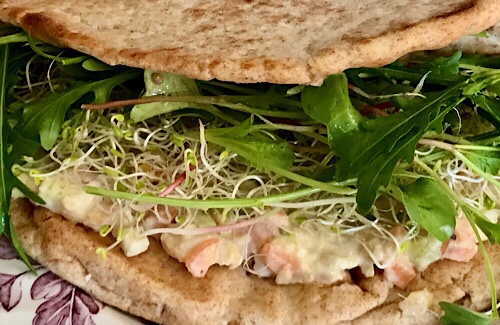
Chickpeas coarsely mashed can be treated like tuna or chicken salad. If all you have is a countertop, it’s still possible to grow your own sprouts. Pita bread was store bought and stored in the freezer.