Integrity
There was a joyous celebration at the US Supreme Court this afternoon to celebrate the historic appointment of Justice Ketanji Brown Jackson. May this nation heal.

There was a joyous celebration at the US Supreme Court this afternoon to celebrate the historic appointment of Justice Ketanji Brown Jackson. May this nation heal.
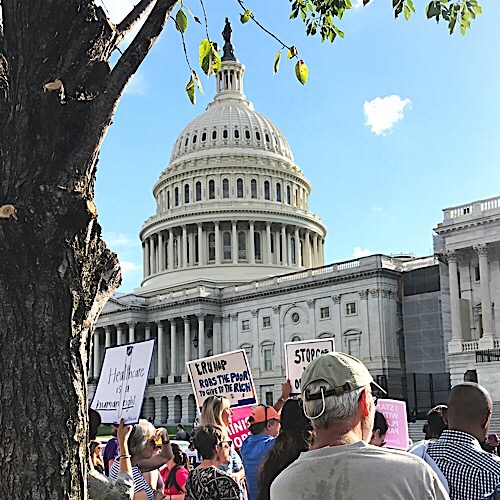
The filibuster and related activities, including an interfaith vigil on Wednesday the 28th, continues until Thursday. Details on various Facebook Pages–ACLU, NARAL, Planned Parenthood, Move On, and others.
Mostly I will be working during the scheduled times, but I will head over outside of my work day again. Senator Chris Murphy was on his way to dinner with friends from Connecticut who had spent the day doing citizen lobbying–telling their story about why keeping and improving on the ACA was important to them. Senator Murphy said that he’d heard people were outside and felt he needled to at least stop by and connect. He said this is just the beginning, don’t let them tinker and declare a victory if they only deprive 5 or 10 million people from getting insurance; he said keep it up; he’d like to see millions of people coming to D.C. and making their voices heard. I was starting to get caught up in listening and then realized it was time to be at William Penn House.
For the first few years I was teaching, one season a year, I would have as my overall session theme the Anusara invocation (for the words written out, click on “invocation” in the menu bar above). In so doing, I invited myself and others to contemplate at the heart level the meaning of each word, of why we were making the invocation, of how the invocation might inform not only our practice, but how we bring our practice off the mat and into our daily lives. Each time I chant the invocation–and it has been hundreds of times now over the years I have been studying, practicing, and teaching Anusara yoga–I seek to invoke into my practice the deepest qualities of the heart that it represents.
Over the winter break, when I was preparing for this session, the invocation called to me. I decided it was time to make it as a specific offering again. Last week and this week, including in the restorative workshop offered at Willow Street Yoga last Saturday, I have been exploring namah shivayah from the first line. Namah–which has the same verbal origins at the English word “name”–means to bow, to honor, to name. It forms the basis of the greeting namaste–with the light in me, I bow to the light in you. Sivayah here is our siva nature. It is variously the light within, auspiciousness, spirit, divine nature, elemental goodness.
When I was practicing in preparation for teaching the week’s classes and the restorative workshop and contemplating (practicing bhavana on) namah shivayah, I thought about a question I often get when I teach restoratives: “should I be maintaining the alignment principles or should I be relaxing completely?” When I get the question phrased this way, I look the student straight in the eye and respond, “yes.” I get a quizzical look; how could the answer be “yes” to an “either or” question? The answer is “yes” because in each pose, we are seeking to embody the fullest expression of namah shivayah. Taking the time to make sure to be in alignment when setting up for a pose, moving into a pose, reaching the pinnacle of a pose, and then moving out of or dissolving a pose, is out of loving respect for your body and the energy that courses through your body. We seek to be fully in alignment in all stages of each pose, not only to minimize the likelihood of being in pain or getting or aggravating an injury and to increase the likelihood of healing any existing injuries and expanding our capacity to feel free in our bodies, but also out of a profound respect and honor for the self, the teachings, and the practice.
Sometimes people think that focusing on getting the alignment just right is fussy or rigid and the antithesis of relaxation. In the case of restoratives especially, everyone coming to the practice wants to be at peace and feel free of effort. In the hunger to get to a place of relaxation, some hurry into the pose without honoring the alignment. Oftentimes, it is the hurry to relax and the loss of attention to the details of alignment (of both the mind-body and the props) that leads to pain or discomfort in a pose that is meant to be held for a long time, as are restoratives. When a student tells me that they are in pain in a particular posture, I invite the student to back off, set up the pose again, and far more often than not, all discomfort disappears, and the student is able to move into a blissful place. The student then experiences for herself how much the alignment enables the surrender to the exquisite opening to siva and the blissful attributes of siva (satcitananda).
One of the reasons I find restoratives to be such a powerful practice is because they require such focused attention on alignment to enable full relaxation. As such, they are a great way to understand the need for the perfect and simultaneous balance of effort (tapas) and surrender (ishvara pranadhana). So the answer is “yes;” the answer is “nama shivayah.” In everything we do, in every aspect of our practice on and off the mat, we want to be consciously in alignment. We want to use all the knowledge that has been imparted by our teachers and experienced in our own practice as a way of honoring and naming and helping to enable an unceasing, simultaneous, and full surrender to our own siva nature.
Yesterday the mysterious beeping was beeping again in Studio 1B. I have all sorts of approaches to teaching with the beeping. One of them is to switch the attention of the ears to music. We flowed to Now by Bhagavan Das (because it was already in the CD player and I like it well enough) and listened to selections from Love Reigns by Diana Rogers during final relaxation. Monty asked me after class to give a list of some good music for home practice. Here are some of my favorite “yoga” cds in no particular order:
Krishna Das — Live on Earth; Faith of the Heart
Wah! — Hidden in the Name; Jai, Jai, Jai
Jai Uttal — Kirtan (this double CD also has a useful spoken background piece on what is kirtan)
Deva Premal — Love is Space; The Embrace
Ragani — Best of Both Worlds
Dave Stringer — Mala; Japa; Divas and Devis
Shantala — Sri; The Love Window
Many of these are available at the Willow Street Yoga Center shops. Most should be available on-line directly from the artists. Dave Stringer also has other music available for download. The rest can be obtained from Amazon. Also great listening is Invocation, which was put together by Ty Burhow. It is a collection of different artists offering versions of the Anusara invocation. Willow Street work studies are raving about MC Yogi’s Elephant Power, which is rap music telling the stories of various deities — funny and delightful.
Mostly, I prefer to teach and practice without music, but I was a dancer and find music helps to lead me into heart and body simultaneously. I find bringing music into a practice session especially helpful when I am having trouble getting settled on my mat. I do not just play “yoga” music, but play whatever gets me into the spirit of play or relaxation and contemplation as I am moved. My bias is towards chamber music (especially Bach) and Indian classical music for a late evening quiet practice and for an upbeat daytime practice anything that would go with being outside on a grassy field on a bright sunny day with frisbee players around. Alice Coltrane is also wonderful if you haven’t discovered yet her discography.
Play what enhances rather than what distracts. Also, check out the artists when they come to town: Wah!, Dave Stringer, and Shantala (Heather and Benji Wertheimer) all come to town. Enjoy!