Signs Around Town
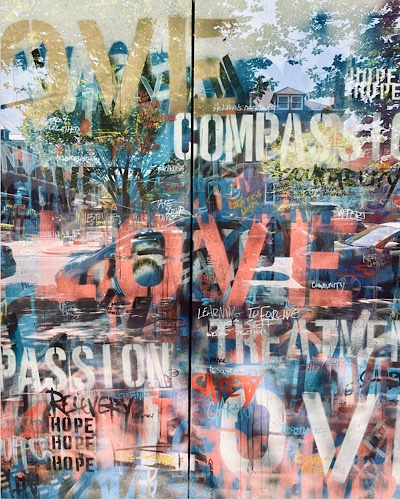
We will all need as much compassion as possible–for others and ourselves–for the great amount of work ahead of there is to be any meaningful healing and sustainability.

We will all need as much compassion as possible–for others and ourselves–for the great amount of work ahead of there is to be any meaningful healing and sustainability.
When I was meditating this morning, the last lines of Keats’ ‘Ode on A Grecian Urn’ welled up in my thoughts: “Beauty is truth, truth beauty, — that is all/ Ye know on earth, and all ye need to know.” How odd, I thought, for this to appear, as if out of nowhere. I have been contemplating this week on what it means to be refined, but not in the way of an aesthete. Rather, as I have been concentrating on the Anusara alignment principle of “ankle loop,” I have been thinking about how deepening our practice with repeated exploration and study we are able to refine our understanding and the flow of energy within us so that we can be more connected to ourselves and each other.
As I understand the essential structure of the Anusara principles, the “loops” are really tertiary principles. The primary principles are those of “attitude, alignment, and action,” which are the principles of how we practice. The secondary principles are the fundamental physical and energetic principles — “opening to grace, muscular energy, inner/expanding spiral, outer/contracting spiral, organic energy.” The loops serve to refine the secondary principles. Ankle loop, for example, which starts at the base of the shin bone, travels down the back of the heel and then back up through the arch, energizes the foot, lifts the arch, supports our stance and helps us focus muscular energy. When we are feeling challenged finding as much muscular energy in our feet and legs as would be optimal for a full expression of the pose, we can use ankle loop to refine our understanding and practice of muscular energy in the legs. Keeping in mind the primary principles of practice, though, the refinements should also always lead us towards the heart and not just get us into details. Getting more sophisticated and refined, likewise should not lead us to disdain for that which is unrefined.
Funny, then, that the aesthete’s call to beauty should arise in my meditation while I have been consciously thinking about refinement. What does it mean to appreciate and study refinements, but still honor and delight in a novice’s full expression of “attitude, alignment, and action” as much as an impeccably aligned and skillful pose that does not reveal a yearning for spirit? Beauty may be truth, and truth beauty, but what is “beauty?”
Let’s face it. When we are on travel and staying at someone else’s house or in a hotel and doing all the running around that comes with visiting or working or sightseeing out of town, we can get out of balance. This disruption of routine can upset our sleep and our digestion. You don’t need the exact collection of pillow shown in these photos. The point is that you can use whatever pillows and blankets (or even towels or your own coat or sweater to make the shapes of yoga bolsters and blankets) to do a nourishing and balancing restorative practice. I like to travel with a hot water bottle in the colder months; there is little more comforting than yoga restoratives with a hot water bottle.
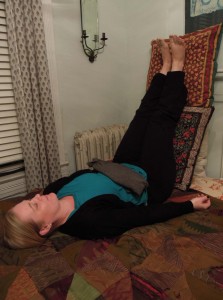
1. Legs up the headboard (sometimes there isn’t enough room on the floor to do any yoga even to do vipariti karani (legs up the wall pose)). Here, pillows are stacked against the head of the bed because it otherwise would be uncomfortable (and risky for the art over the bed). I suggest this pose first to surrender to being turned upside down, to undo the effects of gravity and too much walking around and carrying things, to relieve the legs and feet and to allow more energy to recenter itself in the heart. Stay for 10 minutes, or even longer.
2. Supported twist. Start with your left thigh against the pillow stack, so that the energy follows the natural direction of the large colon, thereby helping relieve the impact of travel disruption to the digestion. The gentle twist also wrings the adrenals, allowing them to release the toxicity of travel and disrupted diet. After 7-10 minutes, switch to the other side with the right thigh perfectly parallel to the pillows before bowing forward.
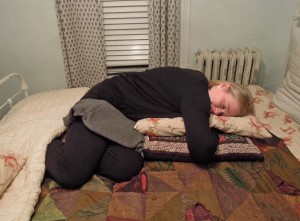

3. Balasana. Place a pillow or two between your heels and your seat. With your toes touching and knees wide apart, bring a couple of pillows, or folded blankets between your knees back to mid-thigh and then bow forward over the support, adjusting your makeshift props as needed to feel at ease in the pose. The pose invites a fullness in the back body, letting the adrenals rejuvenate after the cleansing action of the twists. This is good. Stay for 10-12 minutes or so, remembering to turn your head to the other side half way through.

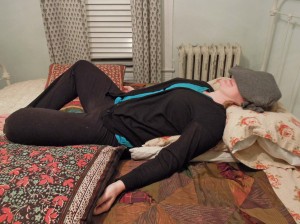
4. Supported supta badha konasana (bound angle pose). After you’ve relieved the feet and legs, nurtured the digestion and the adrenals, now is the moment to surrender to bliss (ananda) and open the heart to being right where you are–wherever that might be. Key for this pose is to make sure that the support under your back is right up against your sacrum. Shown by the fabulous yogini model are three possible ways to use the hot water bottle. I wouldn’t have thought to put it on my face, but she delighted in that idea, and I can see how it would be good for sinuses stressed by travel.
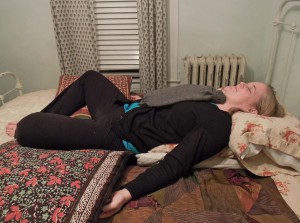
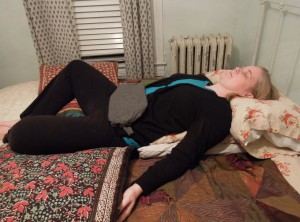
As with any physical practice, you should approach even gentle poses such as these with appropriate awareness, honoring your own body’s limits. If you want to learn how to practice yoga asana safely and optimally, it is best to take classes to supplement a personal practice.
Jupiter and Saturn glowing together so brightly that even the light pollution cannot obscure them. Jupiter is sometimes referred to as the guru planet, the weighty one. Take a look at the sky and use that to listen to your own inner guru, the space where you are fully grounded, engaged, and free in spirit all at the same time. For me, it’s still a work in progress.


Peace and light, E — Posted with WordPress for BlackBerry.