Guest Bedroom Restorative Yoga

Let’s face it.  When we are on travel and staying at someone else’s house or in a hotel and doing all the running around that comes with visiting or working or sightseeing out of town, we can get out of balance.  This disruption of routine can upset our sleep and our digestion.  You don’t need the exact collection of pillow shown in these photos.  The point is that you can use whatever pillows and blankets (or even towels or your own coat or sweater to make the shapes of yoga bolsters and blankets) to do a nourishing and balancing restorative practice.  I like to travel with a hot water bottle in the colder months; there is little more comforting than yoga restoratives with a hot water bottle.

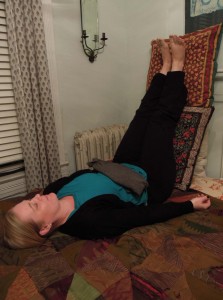
1.   Legs up the headboard (sometimes there isn’t enough room on the floor to do any yoga even to do vipariti karani (legs up the wall pose)).   Here, pillows are stacked against the head of the bed because it otherwise would be uncomfortable (and risky for the art over the bed).  I suggest this pose first to surrender to being turned upside down, to undo the effects of gravity and too much walking around and carrying things, to relieve the legs and feet and to allow more energy to recenter itself in the heart.  Stay for 10 minutes, or even longer.
guest bedroom restoratives 1a


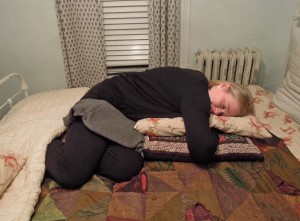
2.  Supported twist.  Start with your left thigh against the pillow stack, so that the energy follows the natural direction of the large colon, thereby helping relieve the impact of travel disruption to the digestion.  The gentle twist also wrings the adrenals, allowing them to release the toxicity of travel and disrupted diet.  After 7-10 minutes, switch to the other side with the right thigh perfectly parallel to the pillows before bowing forward.

 

guest bedroom restoratives 1bguest bedroom restoratives 1c


3.  Balasana.  Place a pillow or two between your heels and your seat.  With your toes touching and knees wide apart, bring a couple of pillows, or folded blankets between your knees back to mid-thigh and then bow forward over the support, adjusting your makeshift props as needed to feel at ease in the pose.  The pose invites a fullness in the back body, letting the adrenals rejuvenate after the cleansing action of the twists.  This is good.  Stay for 10-12 minutes or so, remembering to turn your head to the other side half way through.

guest bedroom restoratives 1d


4.  Supported supta badha konasana (bound angle pose).  After you’ve relieved the feet and legs, nurtured the digestion and the adrenals, now is the moment to surrender to bliss (ananda) and open the heart to being right where you are–wherever that might be.  Key for this pose is to make sure that the support under your back is right up against your sacrum.  Shown by the fabulous yogini model are three possible ways to use the hot water bottle.  I wouldn’t have thought to put it on my face, but she delighted in that idea, and I can see how it would be good for sinuses stressed by travel.


guest bedroom restoratives 1e guest bedroom restoratives 1f guest bedroom restoratives 1g


As with any physical practice, you should approach even gentle poses such as these with appropriate awareness, honoring your own body’s limits.  If you want to learn how to practice yoga  asana safely and optimally, it is best to take classes to supplement a personal practice.

Similar Posts

  • | | | | |

    Late Spring Greetings–Making Time and Space (Web Version of E-Newsletter)

    Dear Friends,
    I hope you are thriving to the greatest extent possible under your current circumstances in this outrageous Spring and weathering (pun intended) the wild fluctuations between apparent late winter and seemingly already mid-summer.  My garden has been uncertain at several moments, but partly due to careful attention at strategic points and partly out of love and luck, it is thriving–providing lots of herbs and greens and promising lots of tomatoes and peppers and beans.

    I write this letter a bit later than might have been desirable, as the summer session at Willow Street has already started, and my partial sabbatical from yoga teaching evidently has begun.  In practical terms of time and space this is the first time in almost eight years that I am not working weekends (first Saturdays and then Friday evenings) and commuting out to Takoma Park from Capitol Hill to teach.

    It took much contemplation to come to this partial sabbatical. Being a part of the Willow Street Community has been and continues to be important to me, and I have learned an incredible amount from the opportunity Suzie Hurley, and Joe and Natalie Miller, gave me to share my enthusiasm for the practices and the teachings with the fabulous variety of people who come to Willow Street as students.  It was an honor and a continuing source of inspiration and focus to be able to study with so many fine fellow teachers over the years.  And change can be hard for me.  It also is hard to let go of something that has been profoundly important.

    For my optimal health and well being, though, there just was not enough time for me to work full time and go where my heart is currently leading and also continue to teach on Friday nights or Saturday mornings.  I had to make a shift or start fraying around the edges, becoming less happy with everything.  Better to make some space to breath and feel and think without pressure.  Freeing my weekends fully will give me some of the space and time that I need at this crossroad in my life.  I am moving, I hope, towards a phase where there is more emphasis on nurturing self and relationship more deeply and exploring other creative pursuits with more seriousness.   To be able to work intelligently and with good will as a civil servant at this time and to continue to engage in our society that is in so much upheaval, leads me, for my abiding health and expansion, to the garden and the cat and my own practice and the growing and very special relationship that began on the trip to India (no value judgment implied by the order).  It also will be lots easier for me to study; going to a weekend workshop will no longer require my getting a substitute to cover my absence–expect to see me as a fellow student at the Friday nights of weekend workshops at Willow Street.  New ideas and opportunities for teaching will likely come, but not for the moment.

    I continue to lead the all levels yoga practice at William Penn House on Tuesday nights where you will be warmly welcomed by the regulars whatever your age or ability level and will be sure to enjoy the fruits of my new and varied explorations in yoga and other practices, while still keeping to the fundamental structure of class influenced by Anusara methodology.  Please join us.  A portion of each student’s payment supports the work of William Penn House.  While there is a suggested amount, if funds are a challenge, just pay what you can.

    Feel free to e-mail me if you are a more experienced practitioner who is interested in the Wednesday night practice or if you are interested in arranging private sessions or semi-private practices with your own small group.

    I look forward to seeing those of you who are local on a Tuesday night or at a workshop around town or in the neighborhood and also continuing to share photos and contemplations on this latest phase of my yogic (yes, I know that isn’t a real word) on the blog.

    Peace and light,

    Elizabeth

    clouds

  • | |

    The Swimming Spot (and Karunabdhe)

    swimming To find water deep enough for swimming and fresh enough for drinking in the desert is absolutely exquisite, sweet, refreshment.  It is love, nectar, and bliss all at once.

    A half a mile away on foot in certain directions, this swimming spot was invisible.  All that was readily apparent was dry heat and scrub.  Sometimes, we feel similarly separated from inner nurture and support amidst the challenges of the world.  When we are steady with our sadhana (yoga/meditation practice), we will more and more easily find our own inner bathing spot — karunabdhe (ocean of compassion, an aspect of shiva), even as we engage in and encounter the vagaries and tribulations of daily life.  When we know the ocean of compassion is right there in which to bathe whenever we need refreshment, we can engage more fully and with more light and compassion, better to serve and love and delight, whatever difficulties come our way.

2 Comments

Leave a Reply

Your email address will not be published. Required fields are marked *

This site uses Akismet to reduce spam. Learn how your comment data is processed.