When to Get a Hug (and shoulder loop)

It has been my experience that there are times when a hug feels like too much or not right or that it will not ease what hurts.  First there is a need for an openness of heart, a little intrinsic brightness, some recognition of worthiness to receive the love, before a strong embrace feels right.  In Anusara, we are taught to practice the opening, brightening, expanding principle of “opening to grace” before we draw in with the embrace of muscle energy.

“Shoulder loop” helps us refine muscle energy and by drawing the shoulder blades onto the back of the heart and then lifting and expanding the chest, it can be incredibly powerful and healing.  My experience with shoulder loop, though, especially when I have active shoulder or neck pain, is that if I am at all collapsed, if I am not doing maximum “inner body bright” shoulder loop feels OK, but it it is much harder to access and receive.  When I open to the possibilities by radically filling with light and energy, especially around the back of the heart — in a word, meeting the possibility of embrace from the inside out — then the embrace of shoulder loop is almost instantly healing and empowering.

Similar Posts

  • |

    Hanuman — Adamantine

    When I prepare to teach a workshop, I usually do a fair amount of background reading in addition to preparing the asana practice and contemplating the theme.  Right now, I am getting ready to teach a workshop on the hidden powers of hanumanasana (See Workshops page for more info).  A few weeks ago, I came across a tattered 1987 edition of an Indian publication of the Ramayana by Chakravarti Rajagopalachari. I was planning to read other works about Hanuman, but thought that I must be meant to read this one.

    It is an interesting little book.  Chakravarti, also known as “Rajaji” was the first Indian governor-general of India and a close compatriot of Gandhi.  The work is interesting from a historical perspective.  It was first published in 1951 in Tamil and then translated from Tamil into English.  The purpose of the work was to make the Ramayana accessible to those who were not educated in Sanskrit and philosophy.  Although purportedly for children, it obviously had appeal for a wider audience (the 1987 edition I found was the 25th).  Rather than a translation, it is a retelling of the story, filled with homilies and somewhat paternalistic commentaries. Although because it is faithful to the story it still has the relentless sexism of the original, Rajaji does tell his readers in his commentary that the commonly held belief (supported by the language of the Ramayana, which is regarded as a religious text) that a woman has sinned or is shamed if “a villain behaves like a brute” to her is just wrong.

    What was most interesting to me about this particular telling of the Ramayana, aside from its historical and social context, was how it resonated with my Anusara studies.  When Hanuman first battles the demons, Rajaji says the demons “showered missiles on him which mostly glanced harmlessly off his adamantine frame.”  Rajaji uses the word “adamantine” to describe Hanuman elsewhere in the work. Here, Hanuman is adamantine because his devotion and steadiness make an energetically impermeable boundary.  Hanuman is able to love deeply and to engage in battle fully, but is protected from the inside out by his practice and his devotion.  John Friend speaks often of using one’s practice to become “adamantine.”  He suggests that the practice of opening to grace, and then pulsing a perfect balance between drawing in and reaching out energetically (muscular and organic energy), gives us an adamantine core that enables us to be open to a full range of experience without being harmed by negative things.  I have experience myself from six steady years of Anusara practice, how the principles can indeed help me be open, while keeping negative energy from invading my space.

    A used copy of this edition would likely have been around when John Friend was traveling in India when he first went to the Siddha yoga ashram.  Did reading this particular edition lead him to use the word “adamantine” in the context of his teaching of the energetics of asana?  I do not have an answer to that question, nor should I conjecture.  What I do know, is that regardless of how I feel about some of the exterior social influences and teachings of the great Indian texts (think how I might feel about the Spanish Inquisition as it relates to the Bible), there is much to learn about meditation, yoga practice, and personal integrity interwoven in the stories.

    Other readings:

    The Concise Ramayana of Valmiki by Swami Venkatesananda (much more scholarly — the translation you would read if you were taking a university course, but didn’t know Sanskrit)

    The Ramayana retold by William Buck — easy to read; like reading a novel-length fairy tale rendition for adolescents (changes the ending to make what happens to Sita more palatable)

    The Ramayana — A Modern Retelling of the Great Indian Epic by Ramesh Menon.  Great novel.  Cannot recommend highly enough, but probably won’t resonate as much unless you are familiar with the Ramayana and other Indian epics and philosophy.

    The Monkey Grammarian by Octavio Paz, trans. from the Spanish by Helen Lane.  From the back cover:  “Hanuman, the red-faced monkey chief and ninth grammarian of Hindu mythology, is the protagonist of this dazzling prose poem — a mind journey into the temple city of Galta and the occasion … to explore the nature of naming and knowing, time and reality, and fixity and decay.”
  • |

    Pratyabijna Hrdayam Sutra 17 (and organic energy)

    The 17th sutra is “madhya vikasha cittananda labhah,” which is translated by Swami Shantananda as “the bliss of Consciousness is attained through expansion of the center.”

    Madyama, in our physical embodiment is the central channel, the sushumna nadi that runs vertically in the space of the spine.  One of the key actions of Anusara’s organic energy is expansion from the midline.  It is, in its essence, using the body to physically explore the bliss that comes from the expansion from the center.

    If we can get bliss just from expanding, then why would we first draw in?  In applying the Anusara principles, we use muscular energy first.  We hug into our core before reaching out.  This parallels the yoga texts.  If, for example, one already embodies the perfect bliss of consciousness, one doesn’t need to study the sutras or to practice yoga, one would just live from that place of perfect bliss.

    The way I think about it in terms of the Anusara principles, if one were perfectly open to grace and lived being fully open to and expressive of grace, there would be no need to explore, learn, or study any of the other principles.  That’s a rare being though.  Most of us, and definitely me, need practice to discover and embody even a glimpse of perfect bliss and grace.  So the expansion from the center comes after consciously softening and opening, after intentionally drawing in to strengthen and embrace, after making with discrimination further expansion, and after drawing in to contentrate mind and body with honed intensity.  With ever more refinement and practice, we then can experience and make offering a deeper bliss when we expand from our center.

  • | | | |

    Yoga Around Town

    I went to an in person yoga class today for the first time since before the pandemic started. I was alone in choosing to mask and distance—but the ventilation was good. I really enjoyed being there. In conversation after, a couple of people whom I have missed seeing quietly volunteered to me that they were fully vaccinated. I appreciated that.

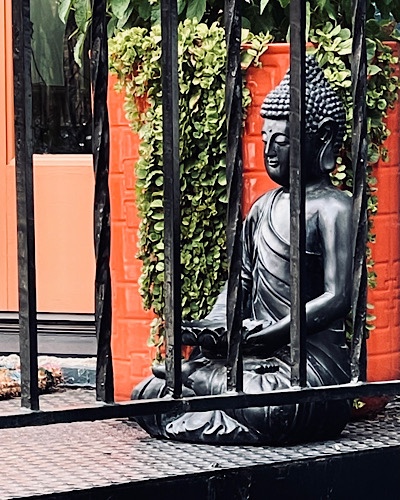
    I passed this on my walk to practice.
  • |

    Happy May Day (and radical affirmation)

    It feels wonderfully auspicious to me that my Spring classes at Willow Street are starting on May Day.  It is Beltane–the true end of winter and the beginning of the effulgence of the time of growth and light.  It is May Day–the mark of a shift in power from the oppressors to the once oppressed, now freed (I’m not going to get into whether that really worked as planned).  It is a time of tradition at my alma mater; the sophomores wake the seniors with strawberries and champagne, enjoying celebration and revelry (dancing around May poles and the like) as they get ready to take their final exams.  Today is Kentucky Derby; I remember a party where the fact I had mint in my garden for the juleps started a fabulous passion.

    The potential for delight, for freedom, for fullness is always with us.  For me, yoga helps me find it and recognize it.  The longer I practice, the more richness it offers.  This Spring session I will be focusing on radical affirmation of the potential in ourselves so that we can recognize and reveal it.  Much more on that to come; for now, I must head to the metro to go teach.

  • | |

    Kleshas (and the absence of helicopters)

    Last night when we walked out of William Penn House from the Tuesday night yoga class onto East Capitol Street, we could see a convocation of police cars in front of the Capitol — presumably in preparation for the President’s speech.  Karen asked, “where are the helicopters?”  “Maybe, Obama doesn’t need them,” I replied, “maybe he is choosing not to live in fear.”  There weren’t any army or police helicopters all night.  This was the first Presidential speech in eight years where helicopters did not relentlessly drone overhead, calling people to be afraid and to act from a place of fear.

    Patanjali’s yoga sutra II.3, says:  avidyha asmita raga dvesa abhinivesah klesah.  BKS Iyengar translates this sutra as follows:  “The five afflictions which disturb the equilibrium of consciousness are:  ignorance or lack of wisdom, ego, pride of the ego or the sense of ‘I’, attachment to pleasure, aversion to pain, fear of death and clinging to life.”

    The world is far scarier now than it has been for most of the past eight years.  In some ways, though, at least in my neighborhood, it feels less frightening because the signs of being afraid are not being emblazoned everywhere to call all to share in the fear.

    We can practice choosing to turn to a place of strength rather than fear on our yoga mats.  When we choose to do the difficult poses that are at our edge that bring up fear and aversion, we can notice the fear and aversion, but not become fully engaged in it.  By using the Anusara principle of opening to grace, we can accept fear and aversion as part of human being, but then soften and open to the full range of being, and not just cling to the fear.  Instead of avoiding the poses or beating ourselves up for being afraid, we can choose to use the yoga principles we know to invite a full experience of the moment and the possible poses.  Remaining open to witnessing the full range of our being through the pose, we next engage muscular energy (strengthening by embracing the muscles to the bone, hugging into our center [midline], and drawing from the periphery into our core).  Having found our strength, we expand more fully (expanding/inner spiral).  We then have space to draw more deeply into our core power (contracting/outer spiral).  With this balance of embrace and expansion of ourselves, we then can fully embody strength by reaching outward (organic energy) and making offering.  This pulsation of principles in poses has led me to discover physical and energetic abilities in my middle age I had not dreamed possible.

    Off the mat, the same principles can lead us to move from love and strength instead of fear and clinging.  As I got into bed with the peace of the night uninterrupted, I pondered how these principles can manifest and gave a profound thanks to whomever decided the harbingers of fear — the helicopters — were unnecessary.

Leave a Reply

Your email address will not be published. Required fields are marked *

This site uses Akismet to reduce spam. Learn how your comment data is processed.