| | | |

Found Exhortation

It is my experience that if I can simultaneously accept that I am ultimately not in control even while I am working to meet a particular goal that I feel less stressed by the vagaries of fate. 

It’s not easy to do, but I do think that is the balance that the yoga practices–the ones that aren’t trying to have us transcend embodiment–are trying to teach us.  And as the weather gets wilder, there will be more opportunities for practice.

image

Similar Posts

  • | |

    Artha, Kama, Dharma, Moksha (and Politics)

    Last night, Paul Muller-Ortega, as part of the introductory talk for the meditation intensive, spoke at some length about the principles of ardha, kama, dharma, moksha.

    As I have written about before, in the classical yoga view, it is the renunciation of the first three–material well-being, love and relationship, and right work or path, that leads us to the fourth–liberation. From a tantric yoga perspective, it is living and having the first three from the perspective of illuminated wisdom and discerning (viveka) insight (pratibha) that makes us free (jivanmukti) in this life.

    One of the most exquisite things about a steady practice and study, is that each time we revisit a core concept, we hear and understand new aspects to bring into our lives.

    When speaking of approaching these elemental aspects of human being, Paul noted that ardha includes not only material well-being, even wealth, but also the power that wealth brings and how we use it. Although he only mentioned that briefly amidst several other concepts, it really resonated with the current state of my being in relationship to the world and our country.

    I have been contemplating deeply about wealth and power in this time of budget debate, and how they can and should be used to bring nurture, peace, and health to the maximum degree possible. (You might guess that I don’t think increasing spending for war and decreasing spending for education and health is going to bring us freedom).

    Thinking about the power of money as part of our contemplation of our material well-being is something of critical importance at this time. If we shun or disdain in our minds wealth and power while still yearning for our own comforts, than we have lost an opportunity to bring the yoga principles into our lives as optimally as possible. (Of course, grasping and coveting money and power is completely destructive of the possibility of happiness, but most of us think about that, and it is why some say they are bad — money being the root of all evil, etc.).

    If we are really in the world and want to be happy and to share and spread happiness, while living in accordance with the principles of the yamas and niyamas, especially the yamas: ahimsa, satya, aparigraha, brahmacharya, asteya (non-harming, truthfulness, non-greediness, aligning with spirit, and non-stealing), that is when we will start opening up the possibility of true living liberation.

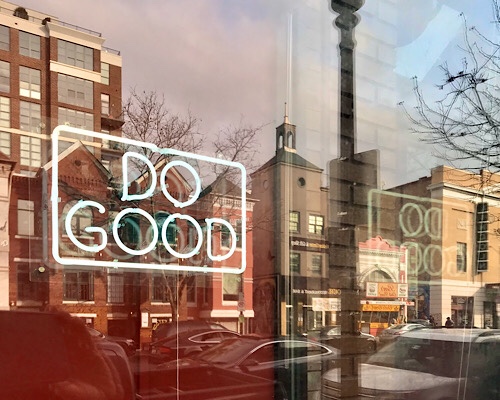
    Imagine, instead of thinking about material well-being as a “guilty pleasure” thinking of ways in which you can use your own well-being (and work through your practice to discover greater health and strength) to be a voice and power for good in your own individual way.

    Peace and light, E — Posted with WordPress for BlackBerry.

  • Dharma without Karma (Please Vote Next Tuesday)

    It’s no surprise:  I find myself more and more consumed by thought and activity regarding the state of the country and what I can do as a citizen (including voting) to make things better.  As I seek to stay engaged, but grounded and without anxiety, I find solace of the teaching in the Bhagavad Gita that true yoga is action without attachment.  To be detached is not the same as withdrawing from action.  In fact, the Gita suggests that the path of action is better than the path of renunciation.

    What is actionless action?  Given the Gita’s fundamental premise that we must act in accordance with our duty (what that means is the subject of much debate that is beyond a simple blog), actionless action does not mean disengaging from the process.  It also does not mean not caring.  Rather, it means that we should act fully in accordance with our principles (which principles should be shaped by the yoga guidelines of non-harming, truthfulness, non-stealing, alignment with nature, non-greediness, cleanliness, contentment, fervor, self-study, and surrender), but with the mental understanding that we are ultimately not in control of the outcome.  We act because not to act is a cop out.  We offer the fruits of our action to forces beyond ourselves.  We act out of love — not selfish love for personal gain — but with loving gratitude for being able to act at all.  We engage fully and then still seek to be free of being unsettled by either pleasure or pain from the outcome.  Whatever the results, we keep acting, we keep doing our duty, fully and with loving engagement.

    See:  BG IV.19-20:  He whose undertakings are free from anxious desire and fanciful thought, whose work is made pure in the fire of wisdom:  he is called wise by those who see.  In whatever work he does such a man in truth has peace:  he expects nothing, he relies on nothing, and ever has fullness of joy.  (trans. Juan Munoz)

    He who has abandoned all attachment to the fruits of action,/ Always content, not dependent,/ Even when performing action,/Does, in effect, nothing at all./ Performing action with the body alone, / Without wish, restrained in thought and self,/ With all motives of acquisition abandoned, He incurs no evil.  (trans. Winthrop Sargeant)

    P.S.  I will have voted in the morning and will be teaching at Wm Penn House on Tuesday so come join me resting in yoga before going home to watch the returns.

  • | | | |

    Reminder–No Class Tuesday July 2nd (and Svatantriya)–Web Version of E-Mailing

    Dear  Friends,

    Just a friendly reminder that there’s no practice at William Penn House or the house next week.  I’ll be off exercising the civil liberties currently available by traveling with my beloved to upstate New York to participate in tantric yoga philosophy camp (I know that’s not everyone’s idea of fun, but for those of us who love philosophy, it is quite wonderful to have found a group of people mostly outside of academia who truly relish such a conversation).  An afternoon and dinner in the City and a visit with my sister and brother-in-law who are only an hour out of the way will further emphasize just how much freedom I have to come and go and to gather in groups and talk and write.  For me to be going on such a vacation was partly good fortune and partly a lot of hard work and partly my balancing many conflicting desires, needs, aims, and possible outcomes, shaped by both the freedoms and strictures of this society.

    With regard to the strictures, I’ve seen and experienced just enough work-place harassment and discrimination and scholarship student financial struggle and their impact on my well-being to know that, as many challenges as I have faced, life can be far more burdened and limited by hardship and challenge.  I know from what was given to me and what was denied or only came after much hard work, how important it is that we make the safety nets of education, health care, housing, nourishing and tasty food, and a healthy ecology for all in our society.  I go on these trips to study philosophy or to practice yoga or to surround myself with beauty and flavor not ignorant of how much I have and how much it depended on scholarships and a decent public education and student loans and millions of women (and many men) before and with me seeking autonomy and meaningful choice as to how to live their lives and care for their bodies.

    I head out on vacation because I need both rest and inspiration, but I go knowing how much there is to be done at this, as Marge Piercy called it, “cruxtime.”  I go to study and talk, not just for anticipated pleasure, but also with the intention to open up new insight on how, since participation is unavoidable, to navigate more skillfully this volotile time in human history.

    I wish you a holiday week in which you are able recognize and experience your truest freedom–even if it is just the freedom of how to respond in the face of outrage or crisis or tragedy–and invite you to come join us for yoga some Tuesday night at William Penn House (click here for info) or the house practice on my return to nurture your body and join in community and conversation.

    Peace and light,

    Elizabeth


Leave a Reply

Your email address will not be published. Required fields are marked *

This site uses Akismet to reduce spam. Learn how your comment data is processed.