Art and Culture | Community and Family | Food for the Mind (Yoga Philosophy, etc) | Meditation | Photos | Poetry | Quaker
Signs Around Town (Excerpt)

Tears to my eyes, too: what a moving speech!
Several months ago, I started rereading books that I believed had contributed deeply to what I believe, how I think, how I write, what are my political views, and how I relate to other people, work, and the world in general. Part of my intention, which is still evolving along with my reading, was to explore how I got involved in yoga and how I could have become involved in a yoga community that imploded so explosively. The reading project is giving much opportunity for deep contemplation.
In honor of Jack Keroac’s birthday, the Library of Congress posted on Facebook, this list of 100 books that shaped America. I’m not sure I could get my list down to a 100 books and lots on my list are by non-American authors, but this list certainly resonates–especially the 1950-2000 section. And yes, On the Road is on my personal list and certainly is part of my road to yoga, along with other writings by the Beats.
How many of these have you read? How many of these have you read recently. How do you think your childhood and young adult reading influenced the way you practice and think about yoga?
I think snow can be beautiful and enjoy the hush when it first falls, but it’s not my favorite thing, which was one of the reasons I settled this far south (yes, DC is pretty far south for a native New Yorker). Last winter with its record snow falls felt at times as a seemingly endless exercise in looking for the good and trying to respond in the highest. Among other fallout of the snow, the February blizzard grounded my flight to San Francisco where I was supposed to go to celebrate the start of John Friend’s 2010 workshop schedule and to visit friends. Instead, I was home shoveling. With the arthritis in my spine and some other old injuries to groin and shoulder, I had to be extra careful with my alignment so that shoveling could be an enjoyable work out instead of a dreary and potentially debilitating task that I was doing instead of playing with friends and yogis in San Francisco. Being grounded at home and needing to be in alignment with the shoveling, led me to blog about Anusara alignment for snow shoveling. Putting this advice out there led to an editor at Yoga Journal discovering my blog and interviewing me for a short article that (I haven’t seen it yet–waiting for my copy to arrive in the mail, but a friend who was reading the most recent edition at Willow Street’s Silver Spring studio gave me the heads up last night) is in December’s magazine (page 22).
While missing out on a vacation due to weather is not exactly a momentous disappointment or life challenge, this story is an example of how we never know what life is going to bring our way. We cannot choose what life gives us, but we can choose how we respond, and how we respond will change how the path unfolds. I persist in the yoga and meditation and share my teachings and experiences because it has been so helpful in opening my perspective and finding more delight and opportunity in life. In that regard, one of the reasons I challenge myself on the mat, inviting myself into places of discomfort and effort and staying with them until I find ease and even delight, is to help me be able to see the good and to respond in the healthiest and most optimal way on and off the mat. While I love sometimes just to do the easeful poses, what has brought more strength and joy to all of my life is going deep into the hard places and staying with them.
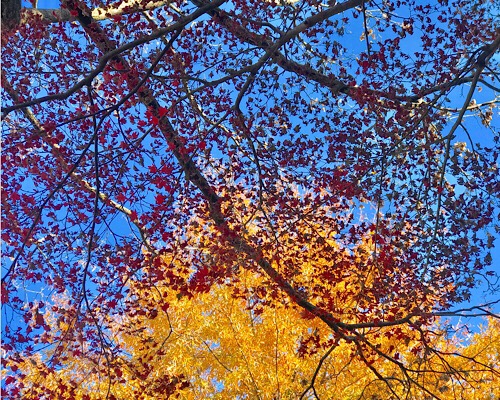
The red maple takes all my front garden and stretches over my neighbor’s; the glorious yellow is down the street. Such wild abundance before the bare months.