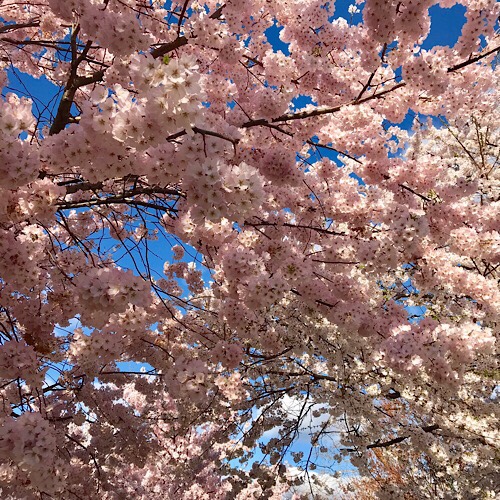
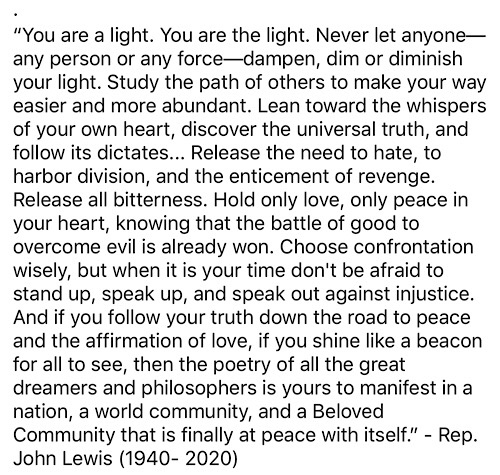
“You Are a Light”
I read today a piece in the Washington Post about Hindus needing to “take back” yoga. I read the article and the comments with great interest because it has been a matter of much discussion with those in my meditation and philosophy course as to the extent to which the practices we are learning are “religious” practices and whether they can be practiced consistently with other religions. There is much difference of opinion and strongly heated and held positions.
What I think is missing from the article is the question of distinctions between “spiritual” and “religious” practices. It is a simple fact that practicing yoga with depth and sincerity entails learning practices that are observed by Hindus. Does that make one a Hindu? Does it mean that one is “dissing” Hinduism if one learns and benefits from the practices, but does not self-identify as a Hindu.
What about Jews who have trees at the Christmas holidays (a tradition co-opted from the pagans in any event)? Is it OK that I have a mezuzuh even though my parents (who were born Jews) raised me in the Religious Society of Friends (Quakers), and I continue to be a member of a Quaker meeting, and observe no other Jewish laws or practices.
Is it OK for me to chant “Hindu” chants if I do not identify myself as a Hindu or attend Hindu temple? If it is not OK, for whom is it not OK? Quakers? Hindus? Jews? Me? Who is to decide or judge?
It seems to me that “religion” (as specific sects, identities, and strict rules) tends to highlight difference and disunity, but sincere spiritual practice — whether or not done in a religious context and observance — should be unifying because all religions at their highest and most universal, call upon us to recognize the unity of spirit in ourselves and in all beings.

At Union Station.
Today I have some hope. I keep on, though, regardless of hope. That is the practice.
You may have noticed that I do not say what I will be teaching. In my blogs and classes, when referring to the philosophy that inspires me, I speak of what I will be reading, what I will be contemplating, and what I will be exploring. It is not false humility. It is a recognition that reading and contemplating a work even several times over a few years is not enough to be “teaching” it. My teaching can, however, authentically be inspired by that level of exploration. I make offerings of what sparks me to think, to practice, and to want to continue to delve ever more deeply into the yoga practices.
This session, I will be reading, contemplating, and inspiring my own practices and my class plans from the Pratyabhijnahrdayam.
Pratyabhijnahrdayam: The Secret of Self-Recognition, J. Singh (Motalal Banarsidass Publishers, Reprinted 2008)
The Splendor of Recognition: An Exploration of the Pratyabhijna-hrdayam, Swami Shantananda with Peggy Bendet (SYDA Foundation, 2003)