On the Way to William Penn House for Tuesday Night Yoga Practice
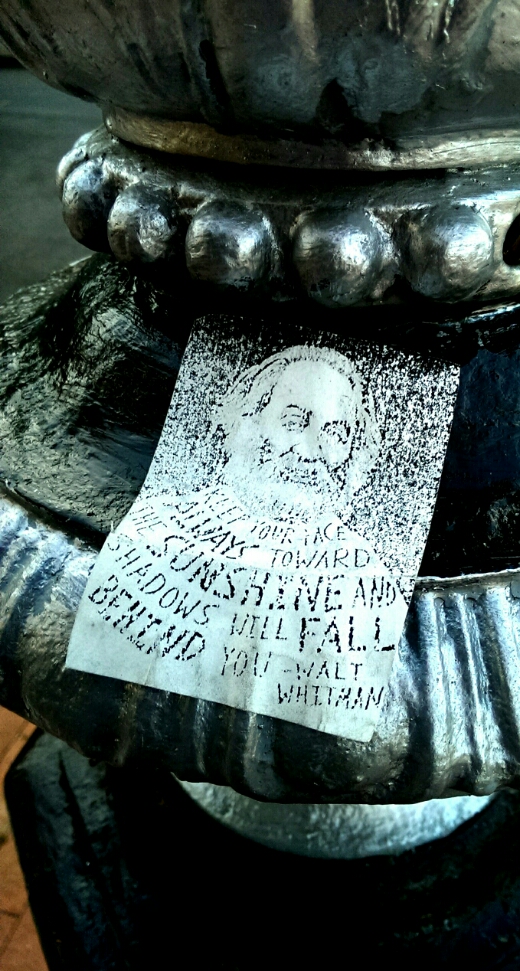
Every time I walk past this sculpture, I wonder whose idea it was to repaint it. For a long time it the gilding was chipped and faded. For me it had much more charm showing its age.
So too, I think, with humans. It is great to feel and look youthful naturally because of proper care of health, and quite another to disfigure ourselves and our looks with surgery and treatment seeking always to look like we have not fully lived out some life.
By all means, seek to remain vibrant and supple, but do please also honor the signs of experience.

Peace and light, E — Posted with WordPress for BlackBerry.
Last night in class, I asked why people continued to come to class. “To see how I can expand,” “for the community,” “for the delight,” “for relaxation,” were some of the answers. Orie asked me what led me to teach. The first reason I gave (and the one that was the primary reason for entering teacher training) was that I had been so inspired by what yoga had offered me that I wanted to share it.
The second reason I gave was that teaching helps keep me disciplined about my practice. I cannot abide hypocrisy, and so, I feel compelled to try my best to practice what I teach. I do not always embody fully the teachings in my own life and practice, but I am always trying. Knowing how the teachings and practices have shifted me and witnessing how the teachings inspire my students, leads me to continue to study, to practice, to try and align better on and off the mat.
Today, with a day of stressful meetings and phone calls ahead, it will be a good day to try to live the practice.
One of the ways I prepare for a restorative workshop is to spend some time looking for new music to play quietly in the background to enhance the fullness of the experience. In the past couple of days, I have enjoyed listening to quite a quantity of new and new to me music appropriate for my upcoming Finding the Warmth Inside: Relax Into Optimal Alignment with Anusara Restoratives on February 25th at Willow Street Yoga Center (click on the link for details and to register). Among the music I downloaded, which I am thoroughly enjoying (though it might be too upbeat for the restorative workshop playlist), is C.C. White’s “This is Soul Kirtan.”
As I was listening at my desk and swaying to the beat, I thought about the non-dual tantric philosophical principle that exhorts us to find the good in everything, to recognize that in all there is still a “divine” spark that is expressed in the creative effulgence of the universe itself. The music is joyous, delightful, offered with love, delivered with a high degree of professionalism–both the musical performance and the recording and presentation. I tried to fathom just how many centuries of human migration, suffering, oppression, bigotry, and then fighting for tolerance, education, equal rights, spirit, and freedom had to occur for this music to be able to exist at all and to be published and embraced, it being an extravagant blend of Indian spiritual/religious practice, American soul and blues (and all its history), and classical Western musical technique.

Peace and light, E — Posted with WordPress for BlackBerry.
Along with sufficient nutrition and shelter from the storm for as many as possible in greatest balance with the ecosystem,